Tag: ecommerce growth strategy

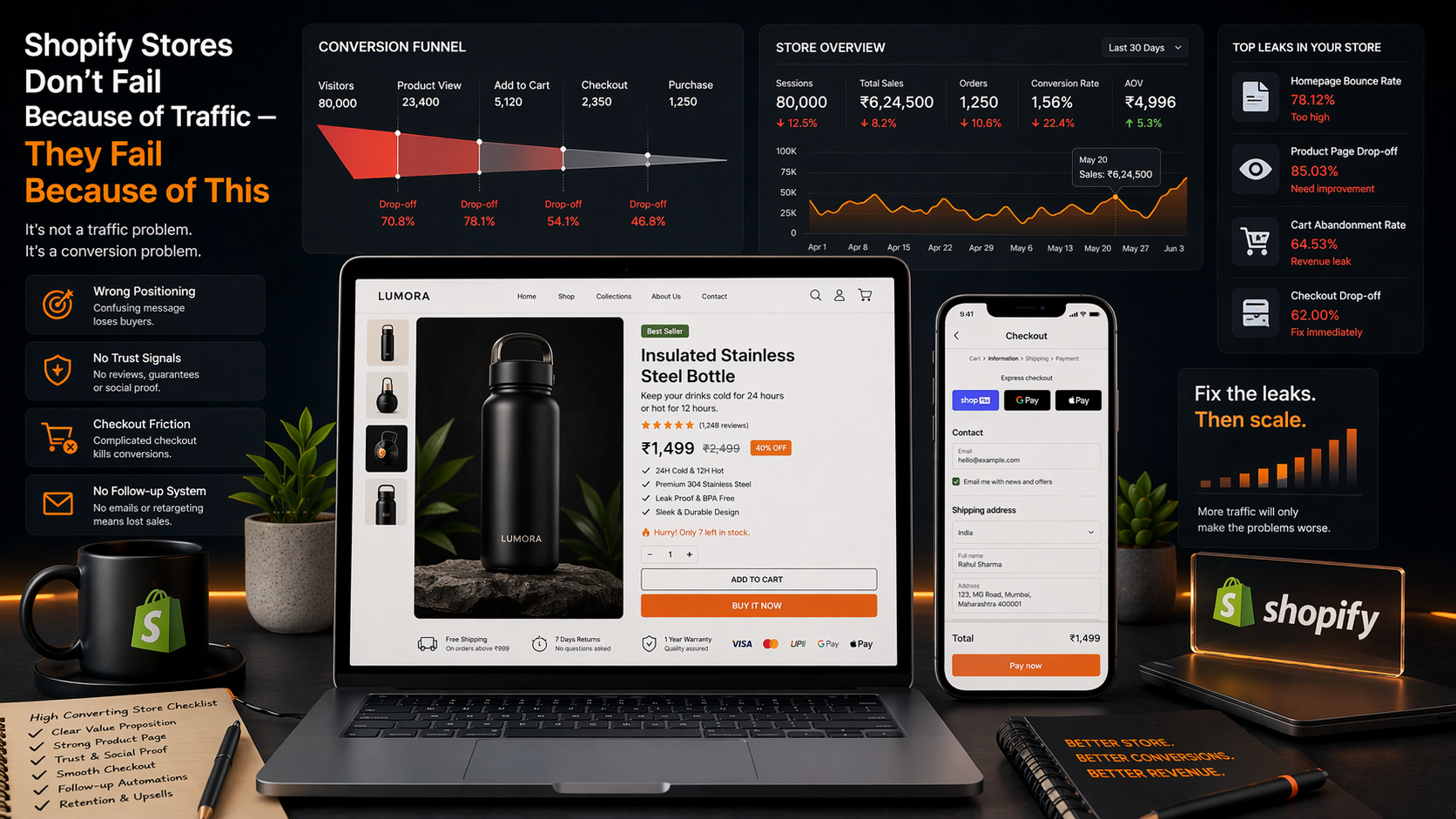
  • Shopify Stores Don’t Fail Because of Traffic — They Fail Because of This

    Shopify Stores Don’t Fail Because of Traffic — They Fail Because of This

    Most Shopify store owners blame traffic when sales don’t happen.

    “Not enough visitors.”
    “Ads are not working.”
    “Need to scale campaigns.”

    That’s the wrong diagnosis.

    Traffic is rarely the real problem. The real issue is what happens after the visitor lands on your store.


    The Real Problem: Poor Conversion Structure

    If 1,000 people visit your store and only a handful buy, the issue is not traffic—it’s conversion.

    Here’s where most stores fail:

    • Confusing homepage with no clear direction
    • Weak product positioning
    • No trust signals
    • Slow loading speed
    • Complicated checkout
    • No urgency or reason to act

    You don’t have a traffic problem. You have a system problem.


    Your Store Is Leaking Money

    Think of your store like a funnel.

    If users are dropping off at every stage:

    • Landing → Bounce
    • Product → Exit
    • Cart → Abandon
    • Checkout → Drop

    Then increasing traffic just means losing more money faster.

    Fix the leaks before pouring more traffic in.


    Homepage That Doesn’t Sell

    Most homepages look like catalogs.

    That doesn’t work.

    Your homepage should:

    • Clearly explain what you sell in seconds
    • Show the product in action
    • Highlight key benefits
    • Build trust instantly
    • Push users toward the product page

    If users are confused, they leave.


    Product Pages That Don’t Build Desire

    A weak product page kills conversions instantly.

    Common mistakes:

    • Generic descriptions
    • No emotional hook
    • Poor visuals
    • No reviews or proof
    • No objection handling

    A strong product page should make the user feel like they’re missing out if they don’t buy.


    Checkout That Creates Friction

    Every extra step reduces conversions.

    Problems:

    • Too many fields
    • Forced account creation
    • Limited payment options
    • Hidden charges

    Fix this, and conversions improve immediately.


    No Trust = No Sales

    People don’t buy from stores they don’t trust.

    If your store lacks:

    • Reviews
    • Testimonials
    • Clear policies
    • Professional design

    You’re losing sales, no matter how good your product is.


    Mobile Experience Is Broken

    Most users are on mobile.

    If your store:

    • Loads slowly
    • Feels cluttered
    • Is hard to navigate

    They leave instantly.

    Mobile optimization is not optional. It’s critical.


    No Backend Systems

    Even if users don’t buy immediately, you should bring them back.

    Most stores miss:

    • Abandoned cart emails
    • Retargeting ads
    • SMS follow-ups
    • Upsell sequences

    Without this, you’re leaving easy money on the table.


    The Truth

    More traffic will not fix a broken store.

    It will just expose how broken it is.

    A high-performing Shopify store focuses on:

    • Clear positioning
    • Strong product pages
    • Smooth checkout
    • Trust and credibility
    • Backend revenue systems

    Fix these, and your existing traffic will start converting.


    Final Reality Check

    If your store isn’t making money, stop blaming traffic.

    Fix the structure first.

    Because once your store converts, scaling becomes predictable—not risky.

  • Shopify vs Custom eCommerce: Which One Actually Makes You More Profit?

    Shopify vs Custom eCommerce: Which One Actually Makes You More Profit?

    Most people compare Shopify and custom eCommerce based on features.

    That’s the wrong approach.

    The only thing that matters is profit.

    Not setup speed. Not ease of use. Not even design.

    Profit.


    The Real Difference: Control vs Convenience

    Shopify is built for convenience.

    Custom eCommerce is built for control.

    Shopify gives you:

    • Fast setup
    • Ready-made features
    • App ecosystem
    • Managed hosting

    Custom eCommerce gives you:

    • Full control over everything
    • No platform limitations
    • Tailored performance
    • Custom workflows

    Convenience helps you start. Control helps you scale.


    Where Shopify Wins

    Let’s be clear—Shopify is not weak.

    It’s powerful for:

    • Quick launch stores
    • Founders with limited technical knowledge
    • Businesses testing products
    • Standard eCommerce models

    You can go live in days and start selling immediately.

    That speed matters in the early stage.


    Where Shopify Starts Costing You

    The problem shows up when you grow.

    As your store scales:

    • App costs increase
    • Transaction fees eat margins
    • Customization becomes limited
    • Performance depends on apps

    You don’t notice it at ₹1L/month.

    You feel it at ₹10L+/month.


    The Power of Custom eCommerce

    Custom eCommerce is not about building from scratch for fun.

    It’s about building exactly what your business needs.

    You get:

    • Optimized performance for your use case
    • Faster load times
    • Higher conversion control
    • No dependency on third-party apps
    • Better long-term cost efficiency

    You’re not renting a system. You’re owning it.


    Profit Comes From Margins + Conversion

    Let’s break it down simply.

    Profit depends on:

    • Conversion rate
    • Average order value
    • Cost per transaction
    • Operational efficiency

    Shopify impacts:

    • Transaction fees
    • App costs
    • Limited checkout control

    Custom eCommerce improves:

    • Conversion optimization
    • Checkout flow control
    • Cost efficiency at scale

    This is where the profit gap starts widening.


    Performance = Revenue

    Speed and performance directly impact revenue.

    A slower Shopify store (due to apps and scripts):

    • Reduces conversions
    • Increases bounce rate

    A custom-built store:

    • Loads faster
    • Handles traffic better
    • Delivers smoother UX

    Even a small increase in conversion rate can mean lakhs in extra revenue.


    Scalability: The Hidden Profit Factor

    Most people ignore this until it’s too late.

    As you grow:

    • Shopify becomes restrictive
    • Complex features require workarounds
    • Costs keep stacking

    Custom eCommerce:

    • Scales without performance drops
    • Supports advanced features easily
    • Adapts to your business model

    Scaling without friction = higher profit.


    Cost Comparison (The Truth Most Don’t Say)

    Shopify looks cheaper upfront.

    But over time:

    • Monthly plans
    • App subscriptions
    • Transaction fees

    All add up.

    Custom eCommerce:

    • Higher initial investment
    • Lower long-term operational cost

    Short-term saving vs long-term profit.


    When Shopify Makes More Sense

    Use Shopify if:

    • You’re starting out
    • You want to validate a product quickly
    • You don’t have technical resources
    • Speed matters more than control

    When Custom eCommerce Wins

    Go custom if:

    • You’re scaling aggressively
    • You need advanced features
    • You want better margins
    • You care about long-term profit

    The Reality

    Shopify helps you start fast.

    Custom eCommerce helps you grow profitably.

    The mistake most businesses make is staying on Shopify when they’ve already outgrown it.


    Final Take

    If your goal is to test, Shopify is enough.

    If your goal is to maximize profit, control your system.

    Because at scale, profit doesn’t come from convenience.

    It comes from optimization, control, and performance.