Category: Shopify

  • Real Estate SEO in 2026: How to Get Found by the Right Buyers

    Real Estate SEO in 2026: How to Get Found by the Right Buyers

    Real estate SEO is no longer just about ranking property pages on Google.

    Buyers now research properties through multiple digital touchpoints. They search for neighborhoods, compare property types, investigate prices, read reviews, and ask increasingly detailed questions through AI-powered search experiences.

    This changes what a successful SEO strategy should accomplish.

    The goal isn’t simply more traffic.

    It’s visibility among people who have genuine interest and intent—and a website experience that helps those visitors move toward an enquiry.


    Quick Answer

    A strong real estate SEO strategy in 2026 should bring together:

    Technical SEO — Make the website crawlable, indexable, fast, and easy to navigate.

    Local SEO — Build visibility for relevant cities, neighborhoods, and service areas.

    Property SEO — Optimize property and listing pages around specific search intent.

    Content & AEO — Answer the questions buyers, sellers, renters, and investors actually ask.

    GEO — Strengthen how the real estate business and its expertise are understood across AI-powered search.

    Conversion optimization — Make it easy for relevant visitors to request information, schedule viewings, call an agent, or enquire.


    Why Real Estate Search Is Changing

    A property search rarely begins and ends with one query.

    Someone might start with:

    “Homes for sale in [city]”

    Then their research can evolve into:

    “Which neighborhoods are good for families?”

    Then:

    “What should I look for when buying a home in this area?”

    And eventually:

    “Which real estate companies specialize in this type of property?”

    AI-powered search is making these conversational journeys increasingly important. Google’s current AI Search experiences support longer questions, follow-ups, comparisons, and deeper exploration of information.

    For real estate businesses, this means there are more opportunities to become visible before a buyer reaches the final enquiry stage.


    Start With Search Intent, Not Just Keywords

    Real estate SEO can become ineffective when every page is built around a keyword without understanding the person’s intent.

    Consider the difference between:

    “Real estate”

    and:

    “2-bedroom apartments for sale in [specific neighborhood]”

    The second query tells you considerably more about the searcher’s needs.

    A useful strategy considers different types of intent.

    Informational Intent

    People looking for knowledge:

    • How does the home-buying process work?
    • What should first-time buyers know?
    • What makes a neighborhood suitable for families?

    Research Intent

    People comparing options:

    • Best neighborhoods for buying a home
    • Apartment vs. house
    • Property investment areas
    • Neighborhood comparisons

    High-Intent Searches

    People closer to taking action:

    • Homes for sale in [location]
    • Apartments for rent in [location]
    • Luxury properties in [location]
    • Real estate agent near me

    The opportunity is to create a connected content journey across these different intents.


    Optimize Property Pages for People First

    Property pages are at the heart of a real estate website.

    But a page shouldn’t simply contain photographs, a price, and a contact button.

    It should clearly communicate the information a potential buyer needs.

    Important details can include:

    • Property type
    • Location
    • Price
    • Bedrooms and bathrooms
    • Property size
    • Features
    • Availability
    • Amenities
    • Neighborhood information
    • Agent information
    • Enquiry options

    Use clear headings and descriptive page titles so both visitors and search engines can understand the page quickly.

    Relevant structured data can also help search engines interpret specific information about a page when implemented correctly.

    The principle is simple:

    Make the property easy to understand before trying to make it rank.


    Local SEO Is at the Core of Real Estate Visibility

    Real estate is inherently local.

    A person isn’t generally searching for a property without a location in mind.

    They’re looking for:

    City → Neighborhood → Community → Property

    That makes local SEO particularly important.

    A real estate business should develop useful location-focused content around the markets it actually serves.

    This could include:

    • City pages
    • Neighborhood guides
    • Local property pages
    • Community resources
    • Area comparisons
    • Local buyer guides

    But every location page should have a reason to exist.

    Simply creating dozens of pages with the same content and changing the location name isn’t a sustainable local SEO strategy.


    Create Neighborhood Content That Helps Buyers

    Property listings capture people who already know what they want.

    Neighborhood content can capture people who are still deciding where they want to live or invest.

    For example:

    Living in [Neighborhood]: What Buyers Should Know

    A useful guide might discuss:

    • Property types
    • Local amenities
    • Transportation
    • Lifestyle considerations
    • Nearby communities
    • Who the area may suit
    • Questions buyers should consider

    This gives the real estate business an opportunity to demonstrate local knowledge.

    It can also create internal linking opportunities between neighborhood content and relevant property listings.


    AEO: Answer the Questions Behind the Search

    Real estate customers have questions throughout the buying journey.

    This is where Answer Engine Optimization (AEO) becomes valuable.

    Rather than creating content around keywords alone, identify the questions customers actually ask.

    For example:

    What should first-time buyers look for during a property viewing?

    How do I compare two neighborhoods?

    What questions should I ask a real estate agent?

    What factors should I consider before buying an investment property?

    A well-structured answer can help both users and modern search systems understand the subject.

    The goal isn’t to manipulate an answer engine.

    It’s to provide genuinely useful information in a clear format.


    GEO: Preparing for AI-Powered Property Discovery

    Generative Engine Optimization, or GEO, adds another dimension to real estate search visibility.

    Imagine someone asks an AI-powered search experience:

    “Which real estate agencies specialize in luxury properties in this area?”

    Or:

    “What neighborhoods should I consider if I want a family-friendly community?”

    The resulting answer can synthesize information from multiple sources.

    This makes brand clarity increasingly important.

    A real estate business should make it easy to understand:

    • Who the company is
    • Where it operates
    • What properties it specializes in
    • Who its customers are
    • What services it provides
    • What expertise it has

    GEO isn’t about guaranteeing a recommendation.

    It’s about creating a stronger and clearer digital presence that can be understood across generative search environments.


    Your Website Isn’t Your Only Search Asset

    A real estate brand can appear across many parts of the web:

    • Property portals
    • Business profiles
    • Reviews
    • Local directories
    • Industry publications
    • Social platforms
    • Partner websites
    • Local media

    This makes consistency important.

    Business names, locations, services, agent information, and other important details should be accurate across relevant platforms.

    A consistent digital presence can help reinforce the identity and context surrounding the business.


    Build Topical Authority Around Real Estate

    A real estate website shouldn’t rely entirely on property listings to demonstrate expertise.

    It can create useful resources around the topics its audience cares about.

    For example:

    Buying a Property

    → First-time buyer guides
    → Property viewing checklists
    → Financing questions
    → Neighborhood comparisons

    Selling a Property

    → Preparing a property for sale
    → Seller guides
    → Valuation considerations
    → Marketing resources

    Local Expertise

    → Neighborhood guides
    → Community information
    → Property trends
    → Area comparisons

    This creates a connected information ecosystem rather than a collection of isolated blog posts.


    Don’t Ignore Technical SEO

    AI search doesn’t eliminate traditional SEO fundamentals.

    Google continues to emphasize that established SEO practices remain relevant to its generative AI search experiences. Websites still need to be accessible, indexable, technically sound, and supported by useful content.

    For real estate websites, technical SEO should cover areas such as:

    • Crawlability
    • Indexation
    • Internal linking
    • Canonical URLs
    • Mobile usability
    • Page speed
    • Image optimization
    • XML sitemaps
    • Structured data
    • Clean site architecture

    This is especially important for large property websites where thousands of listing pages can create crawling and indexing challenges.


    Real Estate Images Are Part of the Experience

    Property search is highly visual.

    Images can help buyers understand a property before they contact an agent.

    But large property galleries can also create performance problems if they’re not optimized.

    Consider:

    • Appropriate image compression
    • Responsive images
    • Descriptive filenames
    • Useful alt text
    • Efficient image delivery
    • Organized galleries

    The objective is to balance visual quality with website performance.


    Website Design Can Determine Whether SEO Traffic Converts

    Getting someone to a property page is only the beginning.

    The website should make the next action obvious.

    For example:

    View Property → Request Details → Schedule Viewing → Contact Agent

    Useful conversion elements may include:

    • Clear enquiry forms
    • Click-to-call buttons
    • Viewing requests
    • Agent contact information
    • Property enquiry buttons
    • Mobile-friendly navigation
    • Easy access to location information

    A visitor shouldn’t have to navigate through multiple pages just to find out how to contact the business.


    Stop Measuring SEO Only by Traffic

    More traffic isn’t automatically better traffic.

    A real estate website receiving visitors who have no interest in its properties may generate impressive analytics but little business value.

    Instead, connect SEO reporting to meaningful actions.

    Search Visibility

    • Rankings
    • Impressions
    • Clicks
    • Organic traffic
    • Local visibility

    Website Engagement

    • Property page views
    • Listing interactions
    • Location-page engagement
    • Returning visitors

    Lead Generation

    • Enquiry forms
    • Phone calls
    • Viewing requests
    • Agent enquiries
    • Qualified leads

    AI Search Visibility

    Where measurable:

    • AI brand mentions
    • Citations
    • Visibility for important customer questions
    • Competitor appearances
    • AI referral traffic

    Google has also expanded reporting around generative AI search experiences, making AI-related visibility increasingly measurable alongside traditional search performance.


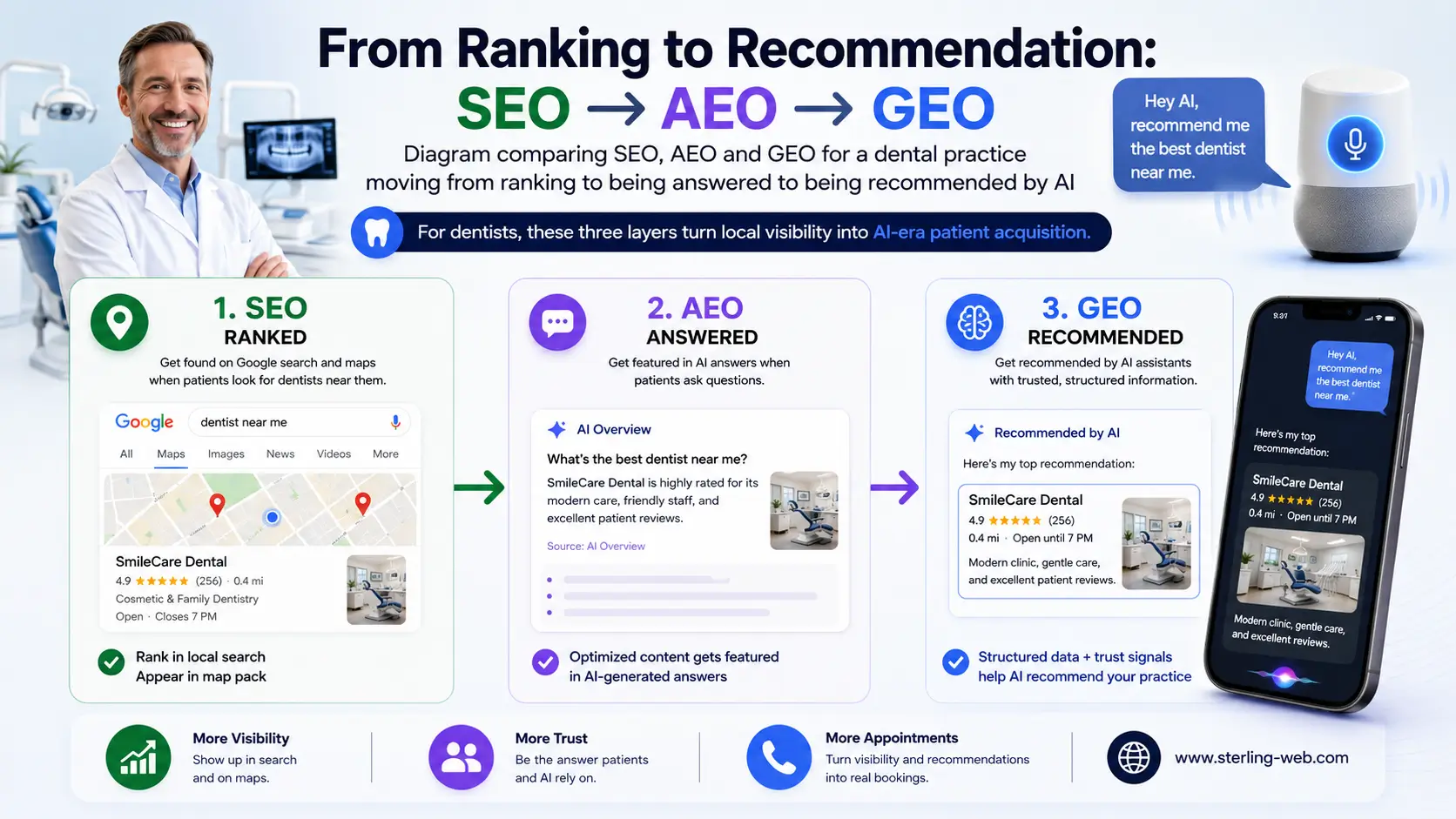
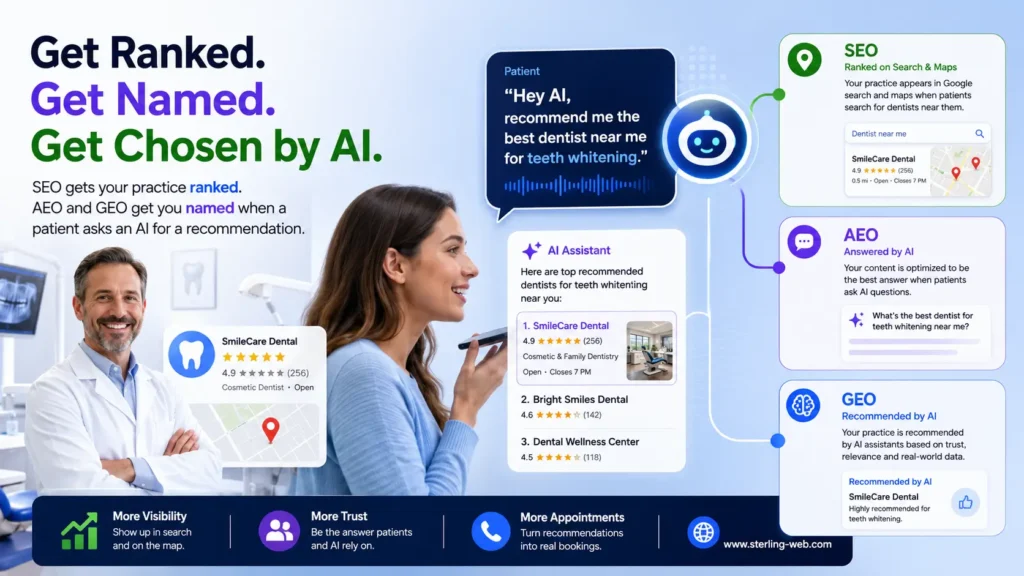
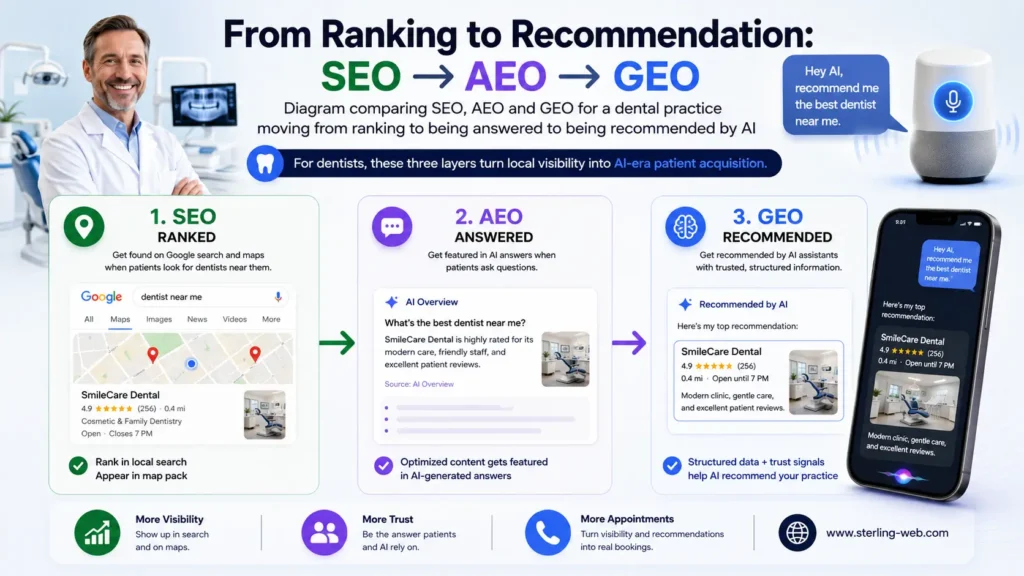
    SEO + AEO + GEO: A More Complete Real Estate Strategy

    These strategies don’t need to operate separately.

    They can support different stages of the same customer journey.

    SEO

    Be discoverable.

    Build the technical and content foundation for traditional search.

    Local SEO

    Be relevant to the right location.

    Connect your business with the markets and communities you serve.

    AEO

    Be useful.

    Answer the questions your customers ask.

    GEO

    Be understandable across AI search.

    Strengthen how your brand, expertise, and services are represented in generative search environments.

    Conversion Optimization

    Make the next step easy.

    Turn relevant interest into enquiries.


    What Real Estate Businesses Should Focus on in 2026

    A modern real estate SEO strategy should prioritize quality of visibility over quantity of traffic.

    That means asking:

    Are we appearing for the right searches?

    Are our property pages useful?

    Can buyers understand our locations and expertise?

    Are we answering questions before customers contact us?

    Can AI-powered search understand our business?

    Can visitors easily take the next step?

    These questions provide a much more useful framework than simply asking whether organic traffic increased this month.


    How SterlingWeb Approaches Real Estate SEO

    At SterlingWeb, the approach to modern search visibility connects SEO with AEO and GEO rather than treating them as isolated activities.

    For real estate businesses, this means looking at the complete search journey:

    Technical SEO for crawlability, indexation, performance, and site architecture.

    Local SEO for city, neighborhood, and service-area visibility.

    Content & AEO for answering real buyer questions.

    GEO for strengthening brand understanding across AI-powered search.

    Website UX for turning relevant visitors into meaningful enquiries.

    The objective isn’t simply to increase the number of people visiting a website.

    It’s to build a digital presence that helps the right buyers find the right information at the right time.


    Why This Matters

    Real estate customers research before they enquire.

    They search for properties.

    They investigate neighborhoods.

    They compare options.

    They ask questions.

    They look for businesses they can trust.

    And increasingly, AI-powered search can become part of that research journey.

    Google’s current Search developments reflect a broader move toward conversational exploration and AI-assisted discovery while continuing to connect users with relevant websites and content.

    For real estate businesses, this means SEO should no longer be viewed simply as a way to generate website traffic.

    It should be part of a broader property discovery and lead-generation strategy.


    Final Takeaway

    Real estate SEO in 2026 is about being found by the right buyers—not simply being found by more people.

    Technical SEO creates the foundation.

    Local SEO builds location relevance.

    Useful content supports research.

    AEO answers customer questions.

    GEO expands visibility across AI-powered search.

    And conversion-focused design turns relevant visitors into enquiries.

    The future of real estate search isn’t just about ranking higher.

    It’s about becoming visible, useful, relevant, and easy to engage with throughout the buyer journey.

    Want to improve your real estate website’s search visibility and lead-generation potential? Explore SEO, AEO, and GEO strategies with SterlingWeb.
  • SEO Content vs AI-Ready Content: What’s the Difference?

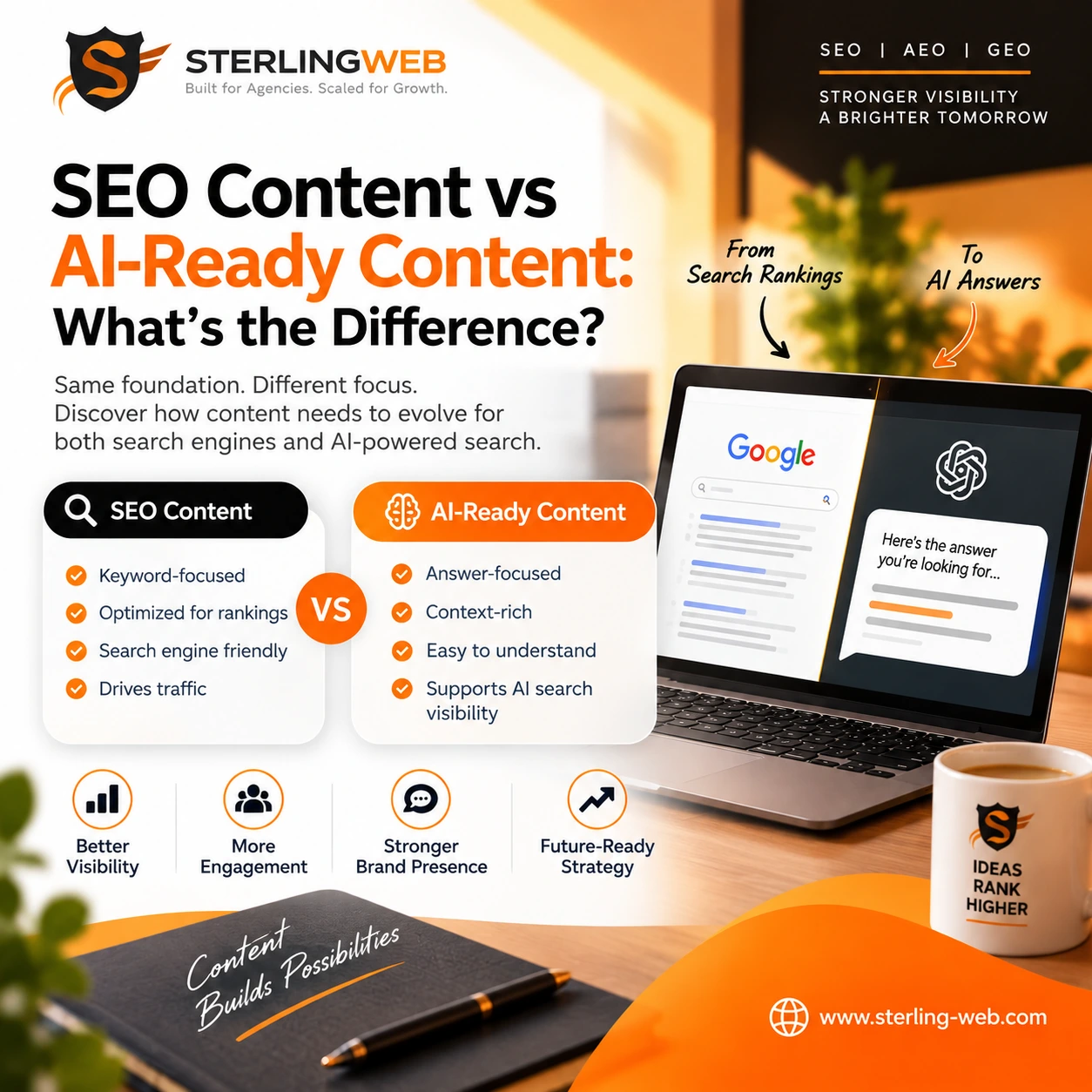
    SEO Content vs AI-Ready Content: What’s the Difference?

    For years, creating content for search meant understanding keywords, matching search intent, optimizing pages, and building authority.

    Those fundamentals still matter.

    But search is becoming more conversational and AI-driven. People are increasingly looking for direct answers, comparisons, recommendations, and explanations through AI-powered search experiences.

    This raises an important question:

    Is content that is optimized for traditional search automatically ready for AI search?

    Not necessarily.

    SEO content and AI-ready content share the same foundation, but they have different priorities.

    What Is SEO Content?

    SEO content is created primarily to help a webpage become discoverable and relevant in traditional search engines.

    It typically focuses on:

    • Search intent
    • Keyword relevance
    • Content quality
    • Page structure
    • Internal linking
    • Technical SEO
    • Topical relevance
    • Search-friendly titles and headings

    For example, a SaaS company targeting the keyword “CRM software for small businesses” might create a detailed page explaining its CRM features, benefits, use cases, and advantages.

    The objective is to provide relevant information while making the page understandable to search engines and useful to visitors.

    That foundation remains important.

    But AI-powered search introduces another layer.

    What Makes Content AI-Ready?

    AI-ready content is designed to be easy to understand, extract, summarize, and connect with a user’s specific question or context.

    Instead of focusing only on the keyword, it considers the broader information need behind the query.

    For example, a user might ask:

    “What CRM software is best for a small business with a remote sales team?”

    This is more than a keyword query.

    It contains context, a specific audience, and a decision-making requirement.

    AI-ready content should therefore provide clear information that addresses these different aspects rather than simply repeating the phrase “CRM software for small businesses.”

    AI-Ready Content Prioritizes Clarity

    AI systems need to understand what a page is actually saying.

    That makes clear definitions, direct answers, descriptive headings, logical sections, comparisons, examples, and supporting context particularly valuable.

    Instead of writing:

    “Our platform offers a comprehensive range of powerful features designed to transform your business operations.”

    A clearer approach would be:

    “Our CRM helps small businesses manage leads, sales activities, customer information, and follow-ups in one platform.”

    The second statement communicates the subject much more directly.

    SEO Content vs AI-Ready Content

    The difference isn’t that one replaces the other.

    It’s about expanding the purpose of your content.

    SEO ContentAI-Ready Content
    Focuses heavily on search intent and keywordsFocuses on questions, context, and meaning
    Optimized for discoverabilityOptimized for discoverability and understanding
    Uses relevant headings and keywordsUses clear, question-focused structures
    Builds topical relevanceBuilds topical relevance and contextual clarity
    Targets search resultsSupports traditional and AI-powered discovery
    Encourages users to click and exploreMakes information easier to extract and understand

    The strongest strategy isn’t SEO vs AI-ready content.

    It’s SEO + AI-ready content.

    Where AEO Fits In

    This is where Answer Engine Optimization (AEO) becomes important.

    AEO focuses on creating content that directly addresses the questions people ask.

    For example, instead of creating one broad article about accounting software, a business could build content around questions such as:

    • What accounting software is best for small businesses?
    • What should you look for in accounting software?
    • How does cloud accounting work?
    • What is the difference between accounting software and ERP software?

    Each question represents a different information need.

    When your content provides a clear and useful answer, it becomes more valuable for both users and answer-driven search experiences.

    Where GEO Comes In

    Generative Engine Optimization (GEO) takes the concept further by considering how your brand and expertise are understood within generative search experiences.

    GEO isn’t simply about adding AI-related keywords to existing content.

    It involves building a stronger overall information ecosystem around your brand.

    That can include:

    Clear brand information
    Your website should clearly explain what your business does, who it serves, and what it offers.

    Consistent expertise
    Your content should demonstrate knowledge around the topics your business wants to be associated with.

    Strong entity signals
    Your organization, people, products, and services should be represented consistently across relevant digital properties.

    Useful third-party presence
    Independent websites, industry publications, review platforms, and other authoritative sources can contribute to how a brand is understood online.

    This is why GEO should be viewed as an extension of a broader search visibility strategy rather than simply another content tactic.

    How to Make Existing SEO Content More AI-Ready

    You don’t necessarily need to replace your entire content library.

    Start by looking at your most important pages and ask:

    Does this page answer the main question quickly?

    Are the sections clearly organized around real user questions?

    Can someone understand the key point without reading every paragraph?

    Are important facts supported with useful context?

    Does the content clearly demonstrate the company’s expertise?

    Is the brand’s role and offering clearly explained?

    Often, improving structure and clarity can make existing content more useful without completely rewriting it.

    The Future Is Not SEO vs GEO

    SEO remains an important foundation for online visibility.

    But the search environment is expanding.

    Users aren’t always looking for a page to visit first. They may want an answer, a comparison, a recommendation, or a solution.

    That means businesses need content that works across different discovery experiences.

    SEO helps people find your content.

    AEO helps your content answer their questions.

    GEO helps strengthen how your brand is understood in generative search.

    At SterlingWeb, I work across SEO, AEO, and GEO to help businesses build a more complete search visibility strategy—one that considers both traditional search and the growing role of AI-powered discovery.

    Final Takeaway

    The question isn’t whether you should create SEO content or AI-ready content.

    Your best content should be both.

    Build it for search engines, structure it for people, make the answers clear, demonstrate genuine expertise, and give AI-powered search enough context to understand your brand and your subject matter.

    Search is changing. Your content strategy should evolve with it.

    👉 Explore SterlingWeb’s SEO, AEO & GEO services to build a stronger search visibility strategy for your business.


  • ChatGPT Ads vs. AI Citations: Why SEO, AEO & GEO Matter in 2026

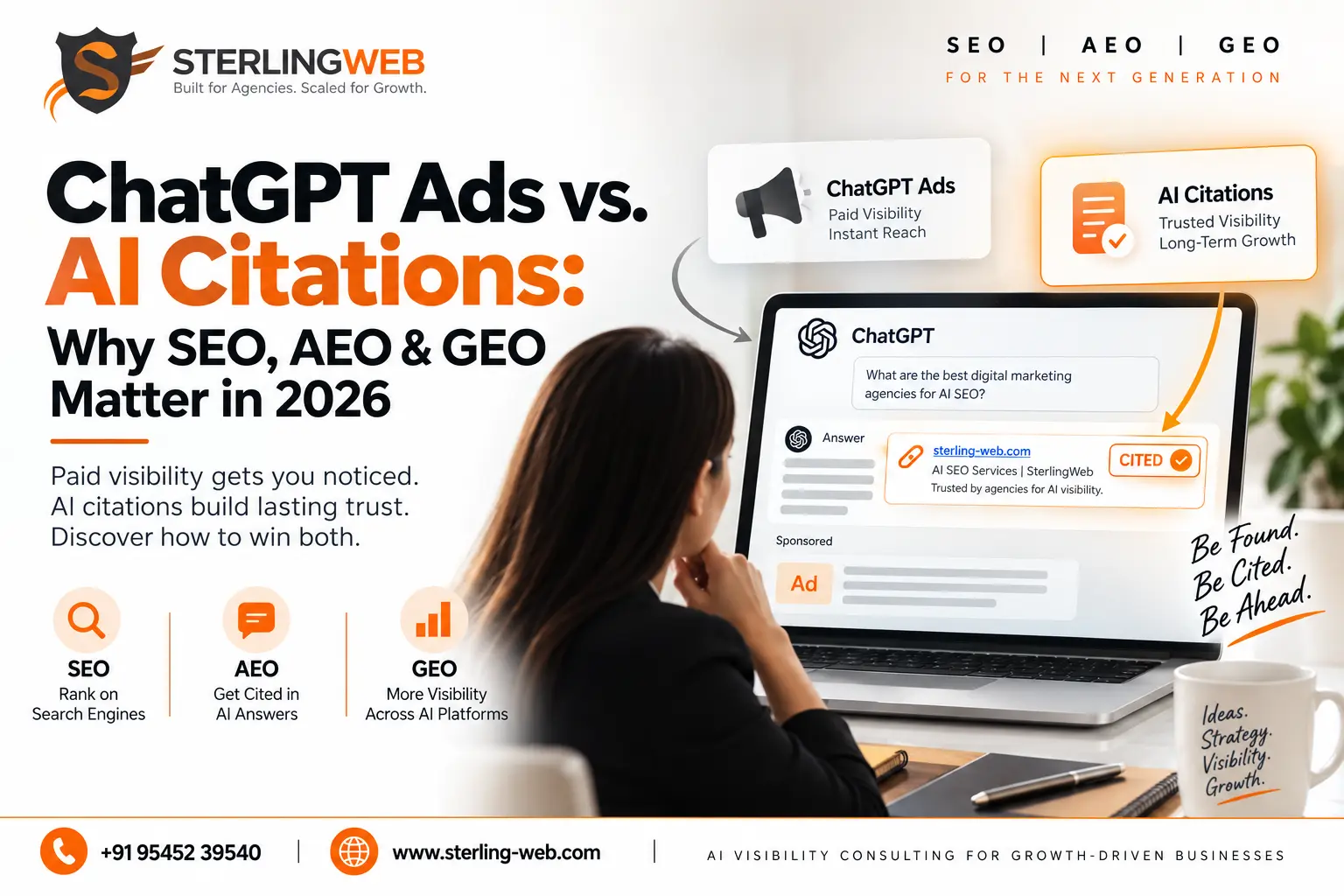
    ChatGPT Ads vs. AI Citations: Why SEO, AEO & GEO Matter in 2026

    ChatGPT Ads are sponsored placements shown below ChatGPT’s answers to logged-in Free and Go users, sold on a CPM or CPC basis through OpenAI’s Ads Manager. They are now live in more than 40 countries, including India, the US, the UK, Europe and Australia. But paid placement is only half the opportunity. The other half — often the more profitable half — is being cited inside the answer itself, which no amount of ad spend can buy. This guide explains both, and shows exactly how SterlingWeb engineers brands into ChatGPT’s answers.


    What Are ChatGPT Ads?

    ChatGPT Ads are OpenAI’s advertising product inside ChatGPT. OpenAI began testing them in the United States in early 2026 and expanded rapidly through the year — first to Canada, Australia and New Zealand, then the UK, Japan, South Korea, Mexico and Brazil, then 31 European markets, and on to India, the Middle East and North Africa.

    By OpenAI’s own reporting in August 2026, ChatGPT Ads passed a $1 billion annualised revenue run rate in under 200 days, with tens of thousands of advertisers on the platform. For context on the audience size, OpenAI describes an advertising-supported free tier that helps keep ChatGPT available to more than a billion weekly active users. This is no longer an experiment. It is a mainstream channel.

    Where ChatGPT Ads Appear

    Ads sit below the answer, clearly labelled and visually separated from ChatGPT’s response. OpenAI has been explicit that advertising does not influence the content of the answer itself — a principle it calls answer independence. The ad system uses the context of the current conversation to decide what to show, and depending on the country and the user’s settings, may also draw on broader ChatGPT usage context.

    Practically, that means the targeting signal is intent expressed in natural language rather than a keyword typed into a search box. Someone describing a renovation budget, a software shortlist or a shipping constraint is giving far richer targeting context than “best CRM software”.

    Who Actually Sees ChatGPT Ads

    • Logged-in users on the Free and Go plans see ads.
    • Plus, Pro, Business, Enterprise and Education accounts are ad-free.
    • Users under 18 — self-declared or predicted by OpenAI — are not shown ads.
    • Users can control ad personalisation, and advertisers never receive access to private conversations.

    This creates an important strategic gap that most agencies are ignoring: your highest-value B2B buyers are frequently on paid, ad-free tiers. A procurement lead, an agency director or a CTO evaluating vendors is very often a Plus, Business or Enterprise user. You cannot reach them with a ChatGPT ad at all. You can only reach them by being cited in the answer.

    How You Buy ChatGPT Ads

    OpenAI opened a self-serve Ads Manager during 2026, which brought small and medium businesses onto a platform that had started as a managed-sales and agency-partner model. Advertisers register, add payment details, set budgets, bids and pacing, upload creative, launch campaigns and review performance in the portal. Larger advertisers can still buy through the OpenAI Ads Solutions team, agency partners or one of 50+ technology and measurement partners.

    CapabilityWhat it means for you
    CPM biddingThe original buying model — pay per thousand impressions. Useful for awareness and category entry.
    CPC biddingPay per click, so spend aligns with action. OpenAI reports CPC and outcome-optimised bidding now account for most campaigns.
    Outcome-optimised biddingBid toward a conversion event rather than a click.
    Pixel & Conversions APIThe measurement foundation. Without these, you are flying blind on ROAS.
    Product feedsEcommerce catalogue ingestion — relevant for Shopify and WooCommerce stores.
    Geographic & platform targetingRestrict delivery by market and device context.
    Custom audiencesReach segments most relevant to your business.

    OpenAI has published early performance examples including an ecommerce advertiser reaching a 3x return on ad spend across a 28-day window, and a technology partner reporting that more than 80% of ad-driven ChatGPT traffic came from new customers. Treat these as directional, not as a benchmark you should expect to hit.

    Which Countries Have ChatGPT Ads

    As of the most recent OpenAI announcement, ChatGPT Ads are available in over 40 countries through the Ads Solutions team and partners, with self-service Ads Manager access covering the US, Canada, Australia, New Zealand, the UK, Japan, South Korea, Mexico, Brazil, 31 European markets, India, the Middle East and North Africa. India is one of ChatGPT’s largest and most active markets, and ads there run on the Free tier and the ₹399/month Go plan.

    Availability moves fast. Always confirm current market coverage in OpenAI’s Ads Manager availability documentation before building a media plan around it.

    Why ChatGPT Ads Change the Rules for SEO, AEO and GEO

    Google separated the funnel across many sessions. Someone searched, clicked, compared, searched again, and eventually converted. ChatGPT compresses discovery, consideration and decision into a single conversation. The user states a goal, describes constraints, asks for options, challenges the recommendation, and asks what to do next — all in one thread.

    That compression has three consequences that every business owner should sit with:

    1. The shortlist forms before you get a chance to bid. By the time an ad appears, ChatGPT has already named three or four brands in the answer. If you were not one of them, the ad is fighting uphill against a recommendation the user already trusts.
    2. Zero-click is now the default, not the exception. Your brand can influence a purchase without a single session appearing in Google Analytics. Traditional attribution under-reports AI-driven demand badly.
    3. Ad spend rents visibility. Citations own it. Pause the campaign and the placement disappears the same day. A well-built entity and content foundation keeps producing citations for years.

    Paid Placement vs Being Cited: The Two Ways to Show Up in ChatGPT

    These are genuinely different mechanisms with different levers. Confusing them is the single most expensive mistake we see.

    ChatGPT AdsChatGPT Citations (AEO/GEO)
    PositionBelow the answer, labelled sponsoredInside the answer, as a named brand or linked source
    Audience reachFree and Go users onlyEvery user, including Plus, Pro, Business and Enterprise
    Cost modelCPM / CPC — ongoing spendFixed investment in assets that compound
    SpeedDaysTypically 60–120 days for meaningful movement
    Trust perceptionRecognised as advertisingRead as an editorial recommendation
    DurabilityStops when budget stopsPersists and strengthens over time
    Who controls itOpenAI’s auctionYour entity signals, content and earned authority

    The correct answer for most businesses is not “one or the other”. It is citations as the foundation, ads as the accelerant — because an ad clicked by someone who already saw your brand recommended in the answer above it converts at a materially different rate than a cold impression.

    How ChatGPT Decides What to Cite

    ChatGPT answers from two layers, and the difference between them decides whether you get a passing mention or a clickable citation.

    Layer One: Training Data (Parametric Knowledge)

    This is what the model absorbed before its cutoff. Published analyses suggest a majority of ChatGPT responses are answered from this layer alone without a live web lookup. When ChatGPT answers from training, it may name your brand, but it rarely links to you. Winning here is a long game built on sustained press coverage, encyclopaedic presence and consistent brand description across the web.

    Layer Two: Live Retrieval (RAG)

    When a query has commercial or research intent — words like bestcomparereviewspricingalternatives, or a year — ChatGPT is far more likely to run a live search. It decomposes the question into sub-queries, retrieves pages, and synthesises an answer from a small handful of sources. This is the layer that produces clickable citations, and it is the layer you can influence this quarter.

    What the 2026 Citation Studies Show

    Several large-scale independent analyses published across 2025–2026 converge on a consistent picture. Figures vary by methodology, so treat them as directional patterns rather than precise constants:

    • Retrieval is brutally selective. Studies of large prompt samples find ChatGPT cites only around 15% of the pages it actually retrieves. Being retrieved is not the same as being cited.
    • Community and reference platforms dominate. An Ahrefs analysis of 9.6 million ChatGPT queries found Reddit captured close to a third of citations and Wikipedia around 15%. A Semrush study across roughly 230,000 prompts placed the top five as Reddit, Wikipedia, Medium, Forbes and LinkedIn.
    • Position on the page matters enormously. Analysis of over a million ChatGPT answers found roughly 44% of citations are pulled from the first third of a page. Burying your answer below 800 words of preamble is a self-inflicted wound.
    • Brand-owned content is structurally under-represented compared to earned media. Your own website alone is not enough.
    • Freshness beats raw authority on commercial queries. A competitor’s “Best X in 2026” guide updated this month can outrank your higher-DA page from last year.
    • Cross-platform presence beats single-domain optimisation. A brand that appears consistently across directories, review platforms and community discussions creates a denser trust signal than an isolated, perfectly optimised website.

    The conclusion is uncomfortable for traditional SEO teams: you cannot win ChatGPT citations from your own website alone. You need entity clarity, answer-first structure, retrievability, and earned presence in the places ChatGPT actually pulls from.

    SEO vs AEO vs GEO: What Each One Actually Does

    These three terms get used interchangeably by agencies that do not understand them. Here is the honest distinction.

    SEO — Search Engine Optimisation

    Earning rankings and clicks in classic search results. Crawlability, indexation, Core Web Vitals, internal linking, backlinks, keyword coverage. Still foundational — ChatGPT’s live retrieval leans on a search index, so a site that search engines cannot crawl or trust will not be retrieved either.

    AEO — Answer Engine Optimisation

    Structuring content so a machine can lift a clean, correct, self-contained answer out of it. Question-shaped headings, direct answers in the first 40–60 words of a section, definition blocks, comparison tables, FAQ and HowTo schema, unambiguous facts with dates and numbers.

    GEO — Generative Engine Optimisation

    Making your brand as an entity legible and trusted to generative systems, so you are named and recommended even when no link is shown. This is entity work: consistent naming, Organisation and Person schema with sameAs, knowledge-base and directory presence, review platform coverage, founder visibility, and earned mentions in the sources these models trust.

    The short version: SEO gets you found. AEO gets you quoted. GEO gets you recommended. ChatGPT Ads get you a paid slot underneath whoever won the first three.

    How SterlingWeb Helps Businesses Get Cited on ChatGPT

    SterlingWeb is a full-service digital agency based in Nashik, India, working with clients across India, the US, the UK, Europe and Australia. We run technical SEO, AEO and GEO programmes alongside Shopify and WordPress development — which matters, because most AI visibility work eventually requires someone who can actually ship code, not just write a recommendation deck.

    Here is the six-phase framework we use to move a brand from invisible to cited.

    Phase 1 — AI Visibility Audit and Citation Baseline

    We start by measuring what is actually happening, not what you assume is happening. That means:

    • Building a prompt set of 50–150 real buyer questions across the funnel — problem-aware, solution-aware, comparison, pricing, local and objection queries.
    • Running that set across ChatGPT, Perplexity, Gemini and Google AI Overviews and recording brand mention rate, citation rate, sentiment, and which competitors and third-party sources are winning each answer.
    • Auditing what ChatGPT currently believes about your brand — because incorrect or outdated entity facts are surprisingly common and quietly destroy conversion.
    • Scoring the site on SEO, AEO and GEO separately, so you can see which of the three is the actual bottleneck.

    You end this phase with a number you can hold us to: your baseline citation share on the queries that matter to your revenue.

    Phase 2 — Entity Foundation (The GEO Layer)

    Generative systems recommend entities they can identify with confidence. We make your brand unambiguous:

    • Schema architecture — Organization, LocalBusiness, Product, Service, Person, Article, FAQPage and BreadcrumbList, correctly nested and validated, with a full sameAs graph tying every profile back to one canonical entity.
    • Naming consistency — one legal name, one trading name, identical NAP data everywhere. Inconsistency splits your entity in two and halves your authority.
    • Knowledge base and directory presence — Wikidata, Crunchbase, industry directories, and the review platforms in your category (G2, Capterra, Trustpilot, Clutch, Google Business Profile, sector-specific equivalents).
    • Founder and expert entities — author profiles with real credentials, bylines and cross-linked identity. E-E-A-T signals matter more, not less, to answer engines.
    • International entity clarity — hreflang and geo-targeting done properly. We have seen brands targeting five markets whose entire site was signalling a single country. That alone suppresses visibility in four of them.

    Phase 3 — Answer-First Content Architecture (The AEO Layer)

    Since roughly 44% of citations come from the first third of a page, we restructure content so the extractable answer is at the top, not the bottom:

    • Answer-first blocks — every H2 and H3 opens with a complete, self-contained answer in 40–60 words before any elaboration.
    • Question-shaped headings that mirror how people actually phrase things to an AI, not how keyword tools phrase them.
    • Extractable formats — comparison tables, specification lists, definition blocks, step sequences and pricing tables. Machines lift structured chunks far more reliably than flowing prose.
    • Genuine FAQ depth covering objections, pricing, alternatives, timelines and “is this right for me” questions — with FAQPage schema behind them.
    • Statistics, dates and named sources, because content with verifiable specifics gets cited more than content full of adjectives.
    • A refresh cadence, since freshness demonstrably beats raw authority on commercial-intent queries.

    Phase 4 — Technical Retrievability

    If an AI crawler cannot fetch and parse your page cleanly, none of the content work matters. This is where an agency that writes code beats one that writes recommendations:

    • Explicit crawler policy for GPTBotOAI-SearchBotPerplexityBotClaudeBot and Google-Extended — a deliberate decision, documented, not an accident inherited from a theme’s default robots.txt.
    • Server-rendered content. JavaScript-dependent copy is a common and invisible cause of zero citations.
    • Clean semantic HTML, proper heading hierarchy, real tables and lists instead of styled divs.
    • Speed and Core Web Vitals, canonical hygiene, XML sitemaps, and IndexNow for fast discovery of updates.
    • An llms.txt file where appropriate, and clean, stable, descriptive URLs.

    SterlingWeb implements these changes directly on WordPress and Shopify. If your site runs on another stack — .NET, custom PHP, headless — we produce a precise, developer-ready specification and work alongside your existing development team. We would rather hand your developers an exact brief than pretend to expertise in a stack we do not ship on daily.

    Phase 5 — Earned Media and Community Signals

    This is the phase most agencies skip, and it is the one the data says matters most. Since brand-owned content is structurally under-represented in ChatGPT citations while community and editorial sources dominate, we build presence where the model is actually looking:

    • Genuine community participation in the subreddits and forums where your buyers ask questions — answering properly, not dropping links. Ham-fisted Reddit promotion gets removed and damages the brand.
    • Digital PR and expert commentary aimed at the publications that get cited in your category.
    • Review platform strategy — volume, recency and response quality on the platforms ChatGPT pulls into product comparisons.
    • Original research and data you own — surveys, benchmarks, price studies. Original data is the most reliably citable asset a brand can produce.
    • Founder-led publishing on LinkedIn and Medium, both of which appear in the top-cited source sets.
    • Notability groundwork — building the independent secondary coverage that makes an eventual Wikipedia entry viable. We never write our clients’ own Wikipedia pages; that gets reverted and hurts you.

    Phase 6 — Measurement, Reporting and Iteration

    AI visibility fails as a service when nobody can prove it worked. Our monthly reporting tracks:

    • Citation share and mention rate across your tracked prompt set, versus named competitors.
    • Sentiment and factual accuracy of how AI systems describe you.
    • Referral traffic from chatgpt.comperplexity.ai and other AI sources, segmented in GA4.
    • AI crawler hit rates from server logs — the earliest signal that technical fixes are working.
    • Assisted conversions and self-reported attribution (“how did you hear about us?”), because AI-influenced demand is systematically under-counted by last-click models.
    • Classic SEO metrics in parallel, since the two reinforce each other.

    Should You Run ChatGPT Ads or Invest in Citations? A Budget Framework

    An honest answer depends on your model, margin and time horizon. These are the patterns we see:

    Your situationRecommended split
    D2C ecommerce, consumer audience, healthy margin, product feed readyAds early — your buyers skew toward Free/Go tiers. Run AEO/GEO in parallel to lower long-term CAC.
    B2B SaaS or services with long sales cyclesCitations first. Your decision-makers are disproportionately on ad-free paid plans. Ads are a poor primary channel here.
    Local service businessGEO + local entity work first. Ads have limited local targeting maturity today.
    New brand with no search footprintAds for immediate signal and learning, entity foundation running underneath from day one.
    Established brand already ranking well in GoogleAEO retrofit of existing content — you likely have the authority already and are simply losing citations to structure.
    Tight budget, must pick oneCitations. They compound. Ad spend does not.

    Your First 90 Days: A Practical Plan

    Days 1–30: Baseline and Foundation

    • Build and run your prompt set; record baseline citation and mention rates.
    • Audit and fix crawler access, rendering and Core Web Vitals.
    • Deploy or repair Organization, Product/Service and FAQPage schema with a complete sameAs graph.
    • Correct naming and NAP inconsistencies across every profile you own.
    • Set up GA4 segmentation for AI referral sources and log-based crawler tracking.

    Days 31–60: Content Restructure

    • Retrofit your top 10–20 commercial pages to answer-first structure.
    • Publish comparison, alternatives and pricing pages — the exact formats commercial queries trigger.
    • Add substantive FAQ sections with schema across service and product pages.
    • Claim and complete every relevant directory and review profile.

    Days 61–90: Authority and Amplification

    • Launch community participation and digital PR outreach.
    • Publish one piece of original research or proprietary data.
    • Begin founder-led publishing on LinkedIn and Medium.
    • Re-run the prompt set and compare against baseline.
    • If ads fit your model, launch a controlled CPC test with Pixel and Conversions API in place before you spend meaningfully.

    Mistakes That Quietly Kill AI Visibility

    1. Blocking AI crawlers by accident. A default robots.txt or a security plugin quietly excluding GPTBot is the most common cause of zero citations we find.
    2. Burying the answer. Six paragraphs of context before the actual answer means the extractable portion of your page is empty.
    3. Treating AI visibility as a content-only project. Without entity and technical work, great content still goes uncited.
    4. Inconsistent brand naming across your site, LinkedIn, directories and press. It fragments your entity.
    5. Ignoring earned media because it is harder to control than your own blog.
    6. Spammy Reddit posting. It gets removed, and reputational damage in the sources AI trusts is expensive to repair.
    7. Letting content go stale. Freshness is a live ranking factor for commercial AI queries.
    8. Judging AI visibility by last-click revenue. You will conclude it does not work, right up until a competitor owns your category’s answers.

    Frequently Asked Questions About ChatGPT Ads and AI Citations

    What are ChatGPT Ads?

    ChatGPT Ads are sponsored placements shown below ChatGPT’s answers to logged-in users on the Free and Go plans. They are clearly labelled, visually separated from the answer, and targeted using the context of the conversation. OpenAI states that advertising does not influence the content of ChatGPT’s responses.

    How much do ChatGPT Ads cost?

    ChatGPT Ads are bought on a CPM (cost per thousand impressions) or CPC (cost per click) basis, with outcome-optimised bidding also available. OpenAI has not published fixed rate cards; pricing is auction-based and varies by market, category and competition. Budgets, bids and pacing are set inside Ads Manager, so there is no fixed minimum in the way there was during the early managed-sales phase.

    Can I advertise on ChatGPT from India?

    Yes. OpenAI launched self-service access to ChatGPT Ads via Ads Manager across India, Europe, the Middle East and North Africa in August 2026. Ads in India run for Free-tier users and subscribers on the ₹399 per month Go plan. Sign-up is at ads.openai.com.

    Do ChatGPT Ads influence ChatGPT’s answers?

    No. OpenAI has repeatedly stated that answer independence is non-negotiable — ads appear below and separate from the response, and advertising spend does not affect what ChatGPT recommends. That is precisely why AEO and GEO matter: the recommendation itself cannot be bought.

    Who does not see ChatGPT Ads?

    Users on Plus, Pro, Business, Enterprise and Education plans see no ads. Users who state they are under 18, or who OpenAI predicts are under 18, are also excluded. Logged-out users are outside the ad-serving environment. This is why paid placement alone cannot reach a large share of high-value B2B decision-makers.

    What is the difference between being cited and being mentioned in ChatGPT?

    mention is when ChatGPT writes your brand name in the answer text without a link — this usually comes from training data and reflects narrative authority. A citation is when ChatGPT attaches a clickable source link to your domain, which comes from live retrieval. Mentions build preference; citations build preference plus traffic. A complete programme targets both.

    How long does it take to get cited on ChatGPT?

    Technical and structural fixes can produce first movement in 30–60 days on lower-competition queries. Meaningful citation share on competitive commercial queries typically takes 90–180 days, because entity signals and earned media compound rather than switch on. Anyone promising ChatGPT citations in two weeks is selling you something that will not hold.

    Does traditional SEO still matter for ChatGPT visibility?

    Yes, substantially. ChatGPT’s live retrieval layer draws on a search index, so pages that are not crawlable, indexed or trusted in classic search are unlikely to be retrieved at all. SEO is necessary but no longer sufficient — it gets you into the retrieval pool, and AEO/GEO determine whether you get selected from it.

    Should I block GPTBot from crawling my site?

    It depends on your business model, and it should be a deliberate decision. Publishers monetising pageviews may reasonably restrict training crawlers while allowing search crawlers. Most commercial businesses selling products or services benefit from allowing both, since blocking removes you from the retrieval pool entirely. What you should never do is block AI crawlers by accident through a default configuration.

    Which sources does ChatGPT cite most often?

    Independent 2026 analyses consistently place community and reference platforms at the top. An Ahrefs study of 9.6 million queries found Reddit accounted for close to a third of citations and Wikipedia around 15%. A Semrush study across roughly 230,000 prompts listed the top five as Reddit, Wikipedia, Medium, Forbes and LinkedIn. Brand-owned websites are structurally under-represented compared to earned media.

    Does FAQ schema help you get cited by ChatGPT?

    It helps indirectly and meaningfully. Schema does not force a citation, but FAQ-structured content produces short, self-contained, unambiguous answer blocks that are far easier for a model to extract and attribute. Studies of frequently-cited brands consistently find structured content with FAQ markup among the shared characteristics.

    Where on a page do ChatGPT citations usually come from?

    Analysis of over a million ChatGPT answers found roughly 44% of citations were drawn from the first third of a page. Practically, this means every section should open with its answer, and your most citable facts should sit above the fold rather than in a conclusion.

    Can I measure ChatGPT visibility in Google Analytics?

    Only partially. You can segment referral traffic from chatgpt.com and other AI sources in GA4, but the majority of AI influence is zero-click and never appears as a session. A complete measurement approach combines GA4 referral segmentation, server-log crawler tracking, tracked prompt-set citation share, and self-reported attribution at the point of enquiry.

    Is it worth running ChatGPT Ads for a B2B business?

    Usually as a secondary channel rather than a primary one. Because ads serve only to Free and Go users, a large share of senior B2B decision-makers on paid, ad-free tiers are unreachable. For most B2B firms, investment in citations and entity authority reaches more of the buying committee per rupee or dollar spent, with ads layered on for retargeting-style reinforcement.

    What if ChatGPT says something incorrect about my brand?

    This is more common than most owners realise and it is fixable, though not instantly. The remedy is entity correction: publish clear, structured, authoritative facts on your own site, align every third-party profile and directory listing, and build fresh independent coverage that reinforces the correct information. Because outdated facts persist in training data, live retrieval signals are your fastest lever.

    Do I need a Wikipedia page to get cited on ChatGPT?

    No, but it is a strong advantage where it is achievable, given Wikipedia’s outsized share of citations and training data. It is a long-term project subject to strict notability standards, and writing your own page reliably backfires. The productive route is building the independent secondary coverage that makes a page viable later, while pursuing citations through other channels now.

    Does SterlingWeb work with clients outside India?

    Yes. SterlingWeb works with clients across India, the United States, the United Kingdom, Europe and Australia, and offers white-label AEO/GEO and development services to other agencies. We implement directly on WordPress and Shopify; for other technology stacks we supply a developer-ready specification for your existing team to implement.


    Get Your Free AI Search Visibility Audit

    ChatGPT Ads will get you a slot beneath the answer. Being cited puts you inside it — for every user, on every plan, without paying per impression.

    SterlingWeb runs a free AI Search Visibility Audit that scores your website across SEO, AEO and GEO, shows which competitors are currently winning your category’s AI answers, and identifies the specific technical and entity gaps holding you back.

    Run My Free AI Visibility Audit

    Talk to a Strategist

    Last updated: September 2026. ChatGPT Ads availability, formats and buying options are changing rapidly — verify current market coverage and specifications with OpenAI before finalising any media plan. Third-party citation statistics are drawn from published 2025–2026 analyses by Ahrefs, Semrush and other independent researchers; methodologies differ, so treat figures as directional.

  • 10 Best AI Visibility Agencies in India for AI Search, GEO & AEO in 2026

    10 Best AI Visibility Agencies in India for AI Search, GEO & AEO in 2026

    AI search has changed the way people discover businesses.

    Instead of searching Google, opening several websites, and manually comparing providers, users can now ask ChatGPT, Perplexity, Gemini, Google AI Overviews, or other AI-powered search experiences for recommendations, comparisons, and solutions.

    That creates a new challenge for businesses:

    How do you make sure AI systems understand, mention, recommend, and cite your brand?

    This is where AI visibility agencies come in.

    Unlike traditional SEO agencies that primarily focus on keyword rankings and organic traffic, AI visibility programs increasingly focus on brand mentions, citations, entity understanding, answer-engine visibility, generative search, content authority, and the sources AI systems rely on.

    The market is still evolving, so there isn’t one agency that is automatically the best for every business. The right choice depends on your industry, website size, target market, technical requirements, and whether you need SEO, AEO, GEO, or a combination of all three.

    This guide compares 10 AI visibility agencies and AI-search-focused providers worth evaluating in 2026.


    Quick Answer: Which Are the Best AI Visibility Agencies in India?

    Our shortlist includes:

    1. SterlingWeb — Best for integrated SEO + AEO + GEO
    2. RankingBite — Best for dedicated AI visibility and citation monitoring
    3. Techmagnate — Best for enterprise-scale AI SEO and GEO
    4. PageTraffic — Best for SEO-first organizations exploring GEO
    5. MMIO Tech — Best for integrated digital marketing and AI visibility
    6. iPullRank — Best for enterprise AI Search and technical relevance engineering
    7. BrandStory — Best for brand-led digital visibility
    8. DerivateX — Best for SaaS-focused AI visibility
    9. The Smarketers — Best for B2B demand generation combined with AI visibility
    10. Minuttia — Best for boutique B2B SaaS search and content programs

    This isn’t a universal ranking. Each agency has a different specialization, and buyers should evaluate the provider against their own requirements.


    Why AI Visibility Matters in 2026

    Traditional SEO still matters.

    But ranking on Google isn’t the only way customers discover a business anymore.

    AI-powered search can summarize information from multiple sources and provide a shortlist directly in the answer.

    For example, instead of searching:

    “Best SEO agencies in India”

    a potential customer might ask:

    “Which AI SEO agencies in India are best for a SaaS company?”

    The AI answer may mention only a handful of companies.

    That means your business can have a strong organic presence while still being missing from the AI-generated shortlist.

    This is why modern search strategies increasingly need to address both:

    Search visibility + AI visibility


    What Is AI Visibility?

    AI visibility refers to how frequently and accurately a brand appears across AI-powered search and answer experiences.

    It can include:

    • Brand mentions
    • AI recommendations
    • Website citations
    • Product recommendations
    • Category visibility
    • Competitor comparisons
    • AI-generated descriptions
    • Share of AI answers
    • AI sentiment
    • Entity recognition

    GEO focuses particularly on improving the likelihood that generative search systems can understand and use your content and brand information.

    For example, RankingBite describes GEO as making a brand “resolvable, quotable and corroborated” so generative models can name it when users ask for vendors.


    SEO vs AEO vs GEO

    One of the biggest things to check before hiring an AI visibility agency is whether the agency understands the difference between these disciplines.

    StrategyPrimary GoalMain Environment
    SEOImprove organic rankingsGoogle/Bing
    AEOWin direct answers and answer featuresAI Overviews, snippets, voice
    GEOImprove visibility in generative answersChatGPT, Perplexity, Gemini, Copilot
    AI VisibilityMeasure and improve overall AI presenceMultiple AI platforms

    The strongest programs don’t necessarily treat these as isolated activities.

    Technical SEO, content, structured data, entity optimization, authority, and AI-search optimization can reinforce one another.


    10 Best AI Visibility Agencies in India

    1. SterlingWeb

    Best for: Integrated SEO + AEO + GEO

    SterlingWeb

    SterlingWeb is an India-based search visibility agency combining traditional SEO with Answer Engine Optimization (AEO) and Generative Engine Optimization (GEO).

    Its positioning is particularly relevant for businesses that don’t want to maintain separate SEO, AEO, and GEO programs.

    SterlingWeb’s current service offering covers technical SEO, AEO for Google AI Overviews, GEO for ChatGPT, Perplexity, Gemini and Copilot, local SEO, structured data, entity-rich content, and AI visibility reporting.

    Key capabilities

    • Technical SEO
    • AI SEO
    • AEO
    • GEO
    • AI visibility consulting
    • Entity optimization
    • Schema and structured data
    • AI Overview optimization
    • Content optimization
    • Local SEO
    • AI citation signals
    • AI visibility audits

    SterlingWeb also offers a dedicated AI Search Visibility Audit covering technical SEO, structured data, GEO signals, AEO signals, local SEO, and AI visibility.

    What makes it different?

    The focus is on treating Google search, AI answers, and local discovery as connected visibility channels, rather than completely separate marketing programs.

    Best for

    Businesses and agencies looking for a combined:

    SEO + AEO + GEO + AI visibility strategy


    2. RankingBite

    Best for: Dedicated AI visibility and citation strategy

    RankingBite

    RankingBite is one of the more AI-visibility-focused agencies on this list.

    Its positioning centers around getting brands recommended by AI rather than focusing exclusively on traditional search rankings.

    The agency says it monitors six AI platforms and offers services around GEO, AEO, AI brand monitoring, entity and knowledge-graph work, and foundational SEO.

    Key capabilities

    • AI visibility
    • GEO
    • AEO
    • AI brand monitoring
    • Citation visibility
    • Entity optimization
    • Knowledge graph optimization
    • SEO

    Its AI brand monitoring service focuses on tracking how answer engines describe and recommend a brand over time.

    Best for

    Businesses that want a specialist AI visibility program with ongoing monitoring and competitive benchmarking.


    3. Techmagnate

    Best for: Enterprise AI SEO and GEO

    Techmagnate

    Techmagnate is a long-established Indian digital marketing agency that has expanded its search offering into AI SEO, GEO, and AEO.

    Its AI search offering specifically targets platforms including ChatGPT, Gemini, Perplexity, Claude, and Google AI Overviews.

    Key capabilities

    • AI SEO
    • GEO
    • AEO
    • Enterprise SEO
    • Content marketing
    • Search strategy
    • AI visibility reporting

    The company says it has more than 20 years in search and works with 200+ brands.

    Best for

    Larger companies looking for AI search optimization alongside an established enterprise SEO program.


    4. PageTraffic

    Best for: SEO-first businesses moving into AI search

    PageTraffic is a long-established Indian SEO agency and can be relevant for businesses that want to build AI visibility on top of a traditional search foundation.

    The advantage of an SEO-first provider is that many of the technical and content fundamentals required for AI visibility overlap with established organic-search practices.

    Key areas to evaluate

    • Technical SEO
    • Content strategy
    • Authority building
    • Organic search
    • GEO capabilities
    • AI search monitoring

    Best for

    Companies that already have traditional SEO requirements and want to extend their search strategy toward AI visibility.


    5. MMIO Tech

    Best for: Integrated SEO, marketing and GEO

    MMIO Tech appears in current 2026 AI visibility agency comparisons as a provider combining broader digital marketing capabilities with GEO and AI search optimization.

    Potential strengths

    • SEO
    • Content
    • AI search optimization
    • Technical optimization
    • Structured data
    • Digital marketing

    Best for

    Businesses looking for a broader digital marketing partner rather than a provider focused exclusively on AI visibility.

    What to verify before hiring: Ask for recent AI-search case studies, platform coverage, measurement methodology, and examples of actual citation/visibility improvements.


    6. iPullRank

    Best for: Enterprise AI Search and technical relevance engineering

    iPullRank

    iPullRank is a US-based enterprise search and AI Search agency rather than an India-focused provider, but it is worth including in an international comparison because of its AI Search specialization.

    Its Relevance Engineering approach combines AI, information retrieval, content strategy, digital PR, and user experience to improve visibility across AI Search platforms.

    Key capabilities

    • Relevance Engineering
    • GEO
    • AI Search strategy
    • Technical SEO
    • Content engineering
    • Digital PR
    • Enterprise content strategy

    Best for

    Large organizations with complicated websites, substantial content libraries, and sophisticated technical SEO requirements.


    7. BrandStory

    Best for: Brand-led digital visibility

    BrandStory is another agency appearing in current 2026 AI visibility comparisons. Its broader positioning combines digital marketing and brand storytelling.

    Potential strengths

    • Brand strategy
    • Content
    • Digital marketing
    • Search visibility
    • Online reputation
    • AI visibility

    Best for

    Companies where brand authority and storytelling are as important as technical search optimization.

    Before selecting the agency, verify the current scope of its dedicated GEO/AEO services and AI visibility measurement.


    8. DerivateX

    Best for: SaaS-focused AI visibility

    DerivateX appears in current AI visibility comparisons for B2B and SaaS companies.

    Its positioning is particularly relevant to businesses that want AI visibility connected to product discovery, demos, signups, and broader SaaS growth.

    Potential strengths

    • SaaS positioning
    • AI search visibility
    • Product/category visibility
    • Content strategy
    • Revenue-oriented search strategy

    Best for

    B2B SaaS companies looking for an AI-search strategy connected to commercial outcomes.


    9. The Smarketers

    Best for: B2B demand generation + AI visibility

    The Smarketers is known primarily for B2B marketing and demand generation, and current AI visibility comparisons include it among providers relevant to B2B companies.

    The potential advantage here is connecting AI-search visibility with a broader demand-generation strategy.

    Best for

    B2B companies that don’t want AI visibility treated as an isolated SEO project.


    10. Minuttia

    Best for: Boutique B2B SaaS search and content

    Minuttia is another provider worth considering for B2B SaaS businesses seeking a more specialized search/content partner.

    Current AI visibility comparisons position the company around B2B SaaS, content, GEO, and digital PR.

    Best for

    Early- and mid-stage B2B SaaS companies that want a boutique content + search + AI visibility approach.


    Comparison: AI Visibility Agencies

    AgencyBest ForAI SearchGEO/AEOTraditional SEOEnterprise
    SterlingWebSEO + AEO + GEO
    RankingBiteAI visibility
    TechmagnateEnterprise search
    PageTrafficSEO + AI search
    MMIO TechIntegrated marketing
    iPullRankEnterprise AI Search
    BrandStoryBrand visibility
    DerivateXSaaS
    The SmarketersB2B demand generation
    MinuttiaB2B SaaS

    Note: This is an editorial comparison, not an independently audited performance ranking. Service scope and platform coverage can change, so businesses should confirm current deliverables directly with each provider.


    How We Evaluated AI Visibility Agencies

    Choosing an AI visibility agency shouldn’t be based simply on how many services appear on its website.

    We recommend evaluating agencies across these eight areas.

    1. AI Platform Coverage

    Ask which platforms are actually monitored.

    For example:

    • ChatGPT
    • Google AI Overviews
    • Perplexity
    • Gemini
    • Claude
    • Microsoft Copilot

    Being visible on one platform doesn’t necessarily mean you’ll appear on another.


    2. Citation Strategy

    Ask:

    “How will you increase our chances of being cited?”

    A good agency should be able to explain:

    • Content structure
    • Source authority
    • Entity signals
    • Third-party mentions
    • Digital PR
    • Citation monitoring
    • Competitive analysis

    Avoid agencies that simply promise to “rank you in ChatGPT.”

    No reputable agency can guarantee a specific AI answer or permanent placement.


    3. Entity Optimization

    AI systems need to understand who your company is, what you offer, who you serve, and how you’re different.

    This means businesses should maintain consistent information across:

    • Website
    • Organization schema
    • Business profiles
    • Industry directories
    • LinkedIn
    • Review platforms
    • Publications
    • Partner websites

    Entity clarity is becoming an increasingly important component of AI search optimization.


    4. Content Quality

    Ask whether the agency creates content designed to answer actual customer questions.

    Strong AI-search content often includes:

    • Direct answers
    • Clear definitions
    • Original data
    • Expert commentary
    • Comparisons
    • Methodologies
    • FAQs
    • Examples
    • Supporting sources

    The goal isn’t to produce 100 generic AI-generated blogs.

    The goal is to create information worth referencing.


    5. Technical SEO

    AI visibility doesn’t eliminate technical SEO.

    An agency should still understand:

    • Crawlability
    • Indexation
    • Canonicals
    • Internal linking
    • XML sitemaps
    • Structured data
    • Page performance
    • JavaScript rendering
    • Content architecture

    SterlingWeb, for example, combines technical SEO with schema, AEO, GEO, entity-rich content, and AI-search optimization as one visibility program.


    6. Third-Party Authority

    One important question to ask an agency is:

    “How will you build authority beyond our website?”

    This can involve:

    • Digital PR
    • Industry publications
    • Expert contributions
    • Relevant directories
    • Reviews
    • Partnerships
    • Research
    • Community discussions

    AI systems don’t necessarily rely only on information published on your own website.


    7. Measurement

    A serious AI visibility program needs measurement.

    Look for reporting around:

    • AI mentions
    • AI citations
    • Recommendations
    • Competitor visibility
    • Share of voice
    • Sentiment
    • Prompt visibility
    • Platform-level performance

    For example, RankingBite describes AI brand monitoring as continuous measurement of how answer engines describe and recommend a brand.


    8. Business Outcomes

    Don’t stop at:

    “We increased your AI mentions.”

    Ask:

    “Did AI visibility contribute to qualified traffic, leads, demos, sales, or pipeline?”

    AI visibility metrics are useful, but they should eventually connect to business objectives.


    How Much Does AI Visibility Consulting Cost in India?

    Pricing varies significantly depending on:

    • Website size
    • Number of markets
    • Number of AI platforms
    • Content requirements
    • Technical complexity
    • Digital PR requirements
    • Reporting requirements
    • Enterprise requirements

    A typical engagement can include:

    Level 1: AI Visibility Audit

    Suitable for companies that want to understand their current position.

    Usually includes:

    • AI prompt testing
    • Competitor analysis
    • Technical review
    • Citation analysis
    • Entity review
    • Recommendations

    Level 2: Monthly AI Visibility Program

    Can include:

    • GEO
    • AEO
    • Technical SEO
    • Content
    • Entity optimization
    • Citation monitoring
    • Authority building
    • Monthly reporting

    Level 3: Enterprise AI Search Program

    Designed for companies with:

    • Multiple products
    • Multiple countries
    • Large websites
    • Multiple business units
    • Complex technical infrastructure

    For example, SterlingWeb currently publishes monthly SEO + AEO + GEO retainers starting at ₹1.25 lakh/$1,499 and extending to ₹6 lakh+/ $7,199 for its higher-tier program.

    Always compare scope rather than price alone.

    A ₹50,000/month program and a ₹3 lakh/month program may be doing completely different work.


    How Long Does AI Visibility Take?

    There is no universal timeline.

    Some brands already have:

    • Strong authority
    • High-quality content
    • Consistent entity information
    • Strong backlinks
    • Good technical SEO

    Others are starting almost from zero.

    A realistic AI visibility program should therefore begin with a baseline assessment, rather than promising a fixed number of days.

    Track progress against a fixed set of prompts and competitors over time.


    AI Visibility Agency vs Traditional SEO Agency

    Traditional SEO AgencyAI Visibility Agency
    Keyword rankingsAI answer visibility
    Organic trafficAI mentions & citations
    SERP optimizationAnswer optimization
    BacklinksAuthority + citation sources
    Keyword researchPrompt/query research
    Search snippetsAI-generated answers
    Google-focusedMulti-platform
    Ranking reportsAI visibility reports

    The best solution for many businesses isn’t choosing one over the other.

    It’s building a combined search visibility strategy.


    Questions to Ask Before Hiring an AI Visibility Agency

    Before signing a contract, ask:

    1. Which AI platforms do you monitor?

    2. Do you track citations or only brand mentions?

    3. How do you measure AI visibility?

    4. Can you show anonymized AI-search case studies?

    5. Do you optimize our existing content or only create new content?

    6. Do you work on technical SEO and structured data?

    7. Do you optimize third-party brand signals?

    8. How do you measure competitors?

    9. How often will AI visibility be monitored?

    10. How does the program connect AI visibility to leads and revenue?

    If an agency can’t clearly answer these questions, ask for more detail before committing.


    Frequently Asked Questions

    What is an AI visibility agency?

    An AI visibility agency helps businesses improve how their brand appears across AI-powered search and answer engines through SEO, GEO, AEO, content, entity optimization, authority building, and monitoring.

    What is AI visibility consulting?

    AI visibility consulting involves analyzing where and how a brand appears in AI-generated answers, identifying visibility gaps, and developing a strategy to improve mentions, recommendations, citations, and overall AI search presence.

    Is GEO replacing SEO?

    No.

    GEO builds on many SEO fundamentals. Technical accessibility, authoritative content, structured information, and strong websites remain important.

    The difference is the desired outcome: traditional SEO emphasizes search-result visibility, while GEO focuses on visibility within generative answers.

    Can an agency guarantee ChatGPT visibility?

    Be cautious of guarantees.

    AI-generated responses can change based on queries, models, sources, location, personalization, and platform updates.

    A credible provider should focus on improving measurable signals rather than promising permanent placement.

    What is the difference between GEO and AEO?

    AEO focuses on optimizing content for direct answers and answer-engine experiences.

    GEO focuses more specifically on visibility within generative AI responses.

    There is considerable overlap, which is why many agencies offer both.

    How can a company increase AI citations?

    Start with:

    1. Authoritative content
    2. Direct answers
    3. Original data
    4. Clear entities
    5. Structured information
    6. Strong technical SEO
    7. Relevant third-party mentions
    8. Consistent brand information
    9. Comparison and problem-solving content
    10. Continuous AI visibility monitoring

    Final Verdict: Which AI Visibility Agency Should You Choose?

    There isn’t one universal winner.

    The right agency depends on your business.

    Choose SterlingWeb if you want an integrated SEO + AEO + GEO + AI visibility program, particularly if you want technical SEO, structured data, content, entity optimization, and AI-search visibility managed together.

    Choose RankingBite if dedicated AI visibility, GEO, and AI brand monitoring are your primary requirements.

    Choose Techmagnate if you need a large established Indian search agency with AI SEO, GEO, AEO, and enterprise capabilities.

    Choose iPullRank if you’re a large organization looking for deep technical AI Search and relevance-engineering capabilities.

    For SaaS and B2B companies, specialized providers such as DerivateX, The Smarketers, and Minuttia may also be worth evaluating depending on your growth model and content requirements.

    The most important takeaway is simple:

    AI visibility is no longer just about ranking a webpage. It’s about becoming a source AI systems can understand, trust, mention, recommend, and cite.

    And that’s why the next generation of search strategy is moving from “Where do we rank?” to:

    “Will AI recommend us?”


  • Why AI Search Can’t Find Your Website: 7 Common Reasons

    Search is changing.

    People are no longer relying only on traditional Google results. They are increasingly asking AI-powered search experiences questions and expecting direct, summarized answers.

    That creates a new challenge for businesses:

    Your website can rank in traditional search and still have limited visibility in AI-generated answers.

    AI search systems need to be able to discover, access, understand, and evaluate your content. Google says its AI search experiences continue to rely on fundamental SEO practices such as crawlability, indexability, helpful content, and good page experience.

    Similarly, OpenAI says public websites can appear in ChatGPT Search, but site owners should ensure that OAI-SearchBot isn’t blocked if they want their content to be discoverable and potentially cited.

    So, why might AI search not be finding your website?

    Here are 7 common reasons—and what you can do about them.


    1. Search Crawlers Can’t Access Your Website

    The first problem is simple: AI can’t use content it can’t access.

    Your website may have:

    • A restrictive robots.txt file
    • Pages blocked from crawling
    • noindex directives
    • Firewall or CDN restrictions
    • Bot protection blocking legitimate crawlers
    • Login requirements
    • Server errors
    • Poorly configured security rules

    For ChatGPT Search, OpenAI specifically recommends allowing OAI-SearchBot to crawl your website.

    Google similarly recommends ensuring that Googlebot can access your pages, that pages return successful HTTP responses, and that their content is indexable.

    How to fix it

    Perform a technical crawl and check:

    • robots.txt
    • Meta robots
    • HTTP status codes
    • Canonical tags
    • XML sitemap
    • Server accessibility
    • CDN/WAF rules
    • Google Search Console indexing reports

    Also verify that legitimate AI crawlers aren’t accidentally being blocked by your security configuration.


    2. Your Content Isn’t Clearly Answering Search Intent

    AI search isn’t simply looking for pages stuffed with keywords.

    It needs content that clearly answers the user’s question.

    For example, a page targeting:

    Shopify SEO services India

    shouldn’t simply repeat that phrase throughout the page.

    It should explain:

    • What Shopify SEO is
    • Why Shopify stores need SEO
    • What services are included
    • Technical Shopify SEO problems
    • Content and keyword strategy
    • Internal linking
    • Structured data
    • Expected outcomes
    • Frequently asked questions

    Google recommends creating unique, useful content that satisfies people’s needs rather than producing generic content designed primarily for search engines.

    How to fix it

    Structure your content around real questions and user intent.

    Use:

    • Clear headings
    • Concise answers
    • Supporting explanations
    • Relevant examples
    • FAQs
    • Original insights
    • Expert experience
    • Useful statistics and evidence

    Think beyond:

    “How do I rank this keyword?”

    Instead ask:

    “Would an AI system consider this page a useful source for answering the user’s question?”


    3. Your Website Has Weak Topical Authority

    One isolated blog post rarely establishes strong expertise around a competitive subject.

    Imagine your company offers AI SEO services, but your website has only one article about AI SEO.

    Meanwhile, competitors have dozens of interconnected resources covering:

    • AI SEO
    • AEO
    • GEO
    • ChatGPT Search
    • Google AI Overviews
    • AI citations
    • Entity optimization
    • Structured data
    • Technical SEO
    • Content optimization

    The competitor has created a much stronger topic ecosystem.

    How to fix it

    Build topic clusters.

    For example:

    Pillar Page:
    AI SEO Services

    Supporting Content:

    • What Is AI SEO?
    • How Does AI Search Work?
    • ChatGPT SEO Guide
    • Google AI Overviews Optimization
    • AEO vs GEO vs SEO
    • How to Improve AI Search Visibility
    • How AI Search Citations Work
    • Technical SEO for AI Search

    Then connect these pages through strategic internal links.

    This helps search engines—and users—understand the relationship between your content.


    4. Your Content Lacks Original Information

    AI-generated content is everywhere.

    That means generic content is becoming increasingly difficult to differentiate.

    Publishing another article that says:

    “SEO is important for your business because it increases visibility and traffic.”

    doesn’t provide much unique value.

    Google’s guidance says generative AI can be useful, but automatically generating many pages without adding value can fall under its scaled content abuse policies. Google recommends focusing on accuracy, quality, relevance, and original value.

    How to fix it

    Add information that competitors don’t have.

    For example:

    • Original research
    • Client case studies
    • First-hand experience
    • Expert opinions
    • Industry statistics
    • Screenshots
    • Unique examples
    • Original frameworks
    • Data analysis
    • Real-world results

    Don’t just create more content. Create more useful content.


    5. Your Website Structure Makes Important Content Difficult to Discover

    AI search systems need to discover your content before they can potentially use it.

    A page buried several clicks deep with weak internal linking may be harder to discover and understand.

    Common problems include:

    • Orphan pages
    • Poor navigation
    • Weak internal linking
    • Inconsistent URL structures
    • Excessive pagination
    • Important pages buried deep within the site
    • No clear topical hierarchy

    How to fix it

    Create a logical website architecture.

    For example:

    SEO Services
    → Technical SEO
    → AI SEO
    → AEO
    → GEO
    → Local SEO

    Then connect related service pages and supporting content through contextual internal links.

    Your internal linking should help users—and search systems—understand:

    What is this page about?
    How is it related to other pages?
    Which page is the main authority on this topic?


    6. Your Structured Data Is Missing or Poorly Implemented

    Structured data helps communicate information about a webpage in a machine-readable format.

    Depending on the page, relevant schema may include:

    • Organization
    • LocalBusiness
    • Article
    • BreadcrumbList
    • Product
    • Service
    • FAQPage
    • ProfilePage

    However, schema isn’t a magic ranking button.

    Google recommends that structured data accurately represent the visible content on the page and that markup be validated. It also notes that structured data does not guarantee a particular search feature will appear.

    How to fix it

    Audit your structured data for:

    • Incorrect properties
    • Missing required fields
    • Invalid JSON-LD
    • Contradictions with visible content
    • Duplicate schema
    • Outdated information

    Most importantly:

    Don’t add schema simply because it exists. Add relevant, accurate schema that represents the page.


    7. You’re Optimizing for Rankings—but Not AI Visibility

    This may be the biggest strategic mistake.

    Traditional SEO often focuses on:

    Rank → Click → Visit

    AI search introduces another layer:

    Search → AI Answer → Brand Mention/Citation → Website Visit

    Your website therefore needs to be discoverable and useful not only for traditional rankings but also for AI-driven search experiences.

    Google says its AI search experiences continue to rely on core SEO fundamentals, while OpenAI says ChatGPT Search uses web sources and allows public websites to appear in results.

    How to fix it

    Start tracking AI visibility alongside traditional SEO.

    Monitor:

    • Google AI Overviews
    • Google AI Mode
    • ChatGPT Search
    • Perplexity
    • Gemini
    • Brand mentions
    • AI citations
    • Referral traffic
    • Important commercial queries

    Google has also begun rolling out dedicated Search Console reporting for visibility from generative AI features, including AI Overviews and AI Mode, although the rollout is currently limited to a subset of websites.


    How to Make Your Website More Visible in AI Search

    There isn’t a single “AI SEO trick.”

    Instead, build a strong foundation.

    AI Search Optimization Checklist

    Technical SEO

    • Make important pages crawlable
    • Fix indexing problems
    • Check robots.txt
    • Review noindex directives
    • Fix broken links
    • Maintain a clean sitemap
    • Improve page experience

    Content

    • Answer specific user questions
    • Match search intent
    • Create original content
    • Demonstrate expertise
    • Add examples and evidence
    • Update outdated information

    Website Architecture

    • Build topic clusters
    • Improve internal linking
    • Fix orphan pages
    • Create clear content hierarchy

    Structured Data

    • Implement relevant schema
    • Validate structured data
    • Keep markup consistent with visible content

    AI Visibility

    • Monitor AI search results
    • Track brand mentions
    • Track citations
    • Analyze competitor visibility
    • Optimize content based on AI-search opportunities

    SEO vs AI Search Optimization

    Traditional SEOAI Search Optimization
    Keyword rankingsAI visibility
    Organic clicksCitations & mentions
    SERP positionsInclusion in AI answers
    Search intentConversational intent
    BacklinksAuthority & source credibility
    On-page SEOMachine-readable, answer-focused content
    Search trafficSearch + AI referral traffic

    The two strategies aren’t competitors.

    Strong technical SEO remains the foundation of AI search visibility.


    Final Thoughts

    If your website isn’t appearing in AI search, don’t immediately assume you need hundreds of new articles or thousands of backlinks.

    Start with the fundamentals.

    Can AI crawlers access your website?

    Can search engines index your important pages?

    Does your content provide unique value?

    Does your website demonstrate expertise?

    Is your content organized around real questions and topics?

    Can search systems clearly understand your pages and entities?

    Are you actually measuring AI visibility?

    AI search is changing how people discover information, but the fundamentals haven’t disappeared. Google continues to emphasize crawlability, helpful content, page experience, and accurate structured data, while ChatGPT Search provides opportunities for public websites to be discovered and cited.

    The goal isn’t to “hack” AI search.

    The goal is to make your website easy to discover, easy to understand, trustworthy, and genuinely useful.

    Because being #1 on Google is no longer the only visibility goal.

    Your next goal should be:

    Be the source AI chooses to mention.


    Frequently Asked Questions

    1. Why isn’t my website appearing in AI search?

    Common reasons include crawl restrictions, poor indexability, weak or generic content, limited topical authority, poor website architecture, and insufficient signals that help search systems understand your content.

    2. Does traditional SEO still matter for AI search?

    Yes. Google states that many of the same technical and content fundamentals used for traditional Search also apply to its AI search experiences.

    3. How can I optimize my website for ChatGPT Search?

    Ensure your public content is crawlable and that you aren’t blocking OAI-SearchBot. Then focus on relevant, reliable, useful content and strong technical SEO.

    4. Does adding schema guarantee AI visibility?

    No. Structured data can help search systems understand page information, but it doesn’t guarantee rankings, rich results, AI citations, or inclusion in an AI-generated answer.

    5. Is GEO different from SEO?

    GEO, or Generative Engine Optimization, focuses on improving a brand’s visibility within generative AI experiences. It works alongside traditional SEO rather than replacing the technical and content fundamentals of SEO.

  • AI SEO Services in India: The New Era of Search Visibility in Google, ChatGPT & Perplexity

    AI SEO Services in India: The New Era of Search Visibility in Google, ChatGPT & Perplexity

    Search is no longer limited to a page of blue links.

    For years, businesses invested in search engine optimization with one primary objective: improve rankings on Google, attract organic traffic, and convert visitors into customers. Keywords, backlinks, technical SEO, content, and search rankings became the foundation of digital visibility.

    That foundation still matters. But the way people search for information is changing rapidly.

    Today, users can ask complex questions in natural language and receive summarized answers from AI-powered search experiences. Google is introducing AI-generated answers into search, while platforms such as ChatGPT and Perplexity are changing how people research products, services, companies, and solutions.

    This shift is creating a new concept of search visibility.

    A business can no longer think only about where its website ranks. It also needs to consider how its brand is understood, represented, and discovered within AI-powered search experiences.

    This is where AI SEO services in India are becoming increasingly relevant.


    From Search Rankings to Search Visibility

    Traditional SEO has always been about visibility, but visibility was usually measured through rankings.

    A company might track whether it ranks first, fifth, or tenth for a particular keyword. While rankings remain important, AI-powered search introduces a different type of visibility.

    Imagine someone asking:

    “What are the best AI SEO agencies in India for improving visibility across Google and generative search?”

    The user may not receive a conventional list of ten webpages. Instead, an AI system may interpret the question, identify relevant entities and information, and generate a conversational response.

    The user’s decision may therefore be influenced before they ever visit a traditional search result.

    This does not mean websites or Google rankings are becoming irrelevant. It means the definition of search visibility is expanding.

    Modern SEO needs to consider both traditional search discovery and AI-assisted discovery.

    For businesses, this creates an important strategic question:

    Is your brand merely ranking for keywords, or is it becoming recognizable as a relevant and credible source within your industry?


    What Is AI SEO?

    AI SEO is the evolution of search optimization for an environment in which artificial intelligence plays a growing role in how information is discovered, interpreted, summarized, and presented.

    It combines the fundamentals of traditional SEO with a deeper focus on search intent, entities, context, structured information, topical authority, conversational queries, and generative search.

    AI SEO is sometimes misunderstood as using artificial intelligence to write website content.

    That is not what AI SEO means.

    AI can certainly assist with research, analysis, content workflows, competitive analysis, and data processing. But simply generating articles with an AI tool does not make a business AI-optimized.

    The more important question is whether the website and the wider digital presence provide clear, useful, authoritative information that search engines and AI systems can understand.

    This distinction is becoming increasingly important as more businesses begin experimenting with AI-generated content.


    Why AI SEO Matters for Businesses in India

    India’s digital ecosystem has become highly competitive.

    From technology companies and SaaS businesses to e-commerce brands, professional service providers, healthcare organizations, startups, and agencies, businesses are competing for attention across an increasingly crowded online environment.

    At the same time, users are becoming more comfortable with conversational search.

    Instead of entering a short query such as:

    “SEO agency India”

    a potential customer might ask:

    “Which SEO agency in India can help a B2B SaaS company improve its visibility in Google and AI search?”

    That question contains considerably more context.

    AI-powered systems are designed to interpret the meaning behind such questions rather than simply match individual keywords.

    This makes comprehensive, well-structured, and contextually relevant content increasingly valuable.

    For Indian businesses targeting both domestic and international markets, AI SEO can therefore become an important part of a broader digital visibility strategy.


    Google AI Overviews Are Changing the Search Experience

    One of the most significant developments in search is the increasing integration of AI-generated responses into Google.

    Google AI Overviews can provide users with synthesized information directly within the search experience for certain queries.

    This changes the traditional search journey.

    Previously, a user might search for a topic, scan the results, choose a website, and then read the information.

    With AI-generated search experiences, the user may first encounter a summarized response and then decide which sources to explore further.

    For businesses, this means the quality and structure of information on their websites matters more than ever.

    Google AI Overviews optimization should not be viewed as a trick for forcing a website into an AI-generated answer. There is no guaranteed formula that can secure placement.

    Instead, businesses should focus on building content that demonstrates relevance, accuracy, expertise, clarity, and genuine value.

    The goal is to become a useful source of information—not simply to optimize a page around an algorithm.


    The Rise of Answer Engine Optimization

    As search becomes more conversational, people are asking questions rather than simply entering keywords.

    This has contributed to the growth of Answer Engine Optimization (AEO).

    AEO focuses on creating and structuring information so that answer engines can better understand and respond to questions.

    For example, a traditional SEO strategy might focus heavily on the keyword:

    “AI SEO services India.”

    An AEO-oriented content strategy would also consider questions such as:

    What are AI SEO services?

    How is AI SEO different from traditional SEO?

    Can SEO improve visibility in ChatGPT?

    What is Generative Engine Optimization?

    How can businesses prepare for AI-powered search?

    These questions reflect how real users interact with modern search systems.

    The most effective AEO content does not attempt to manipulate an answer engine. It simply makes useful information easier to understand.

    Clear explanations, logical content structures, direct answers, supporting evidence, and strong topical context can all contribute to a better information experience.


    GEO and the Move Toward Generative Search

    Another important development is Generative Engine Optimization, or GEO.

    GEO focuses on improving how a business is represented within generative AI search experiences.

    This requires thinking beyond individual webpages.

    An AI system may need to understand the relationship between a company’s name, services, expertise, people, locations, products, publications, and external references.

    For example, when someone searches for an AI SEO agency in India, a generative system may attempt to determine which organizations are relevant to that description.

    A business with a clear digital identity and consistent information across credible sources has a stronger foundation for being understood.

    This is why GEO is closely connected to concepts such as entity optimization, topical authority, structured data, content quality, and digital reputation.

    A generative engine optimization agency should therefore not focus solely on producing more content. The larger objective is to strengthen the information ecosystem around the brand.


    What ChatGPT Means for Modern SEO

    The growth of ChatGPT has introduced another significant change in online discovery.

    People increasingly use conversational AI to research industries, compare solutions, understand technologies, brainstorm purchases, and evaluate companies.

    This has led to growing interest in ChatGPT SEO services.

    However, ChatGPT SEO should not be misunderstood as a guaranteed method for getting a company recommended by ChatGPT.

    AI systems generate responses dynamically. Their outputs can depend on the question, available information, context, system behavior, and other factors.

    A more sustainable approach is to ensure that a company has a strong and understandable digital presence.

    Its website should clearly explain what it does, who it serves, what makes it different, and what areas of expertise it represents.

    Relevant external sources should reinforce that identity.

    In other words, the goal is not to “hack ChatGPT.”

    The goal is to build a brand that is clear, credible, and well represented across the digital ecosystem.


    AI Visibility Is Becoming a New Marketing Consideration

    Traditional SEO reporting provides valuable data: rankings, impressions, clicks, traffic, backlinks, and conversions.

    AI search introduces another question:

    How is the brand represented when customers ask AI systems about the industry?

    This is where AI visibility consulting can provide strategic value.

    AI visibility is not simply about monitoring whether a brand name appears in an AI response.

    It involves understanding how the organization is represented in relation to its competitors, services, expertise, industry, and market.

    A company might have excellent rankings for several keywords while still having a weak or unclear digital identity.

    Conversely, a business with strong topical authority and consistent information may be recognized across different discovery environments even when individual rankings fluctuate.

    This is why AI visibility should increasingly be considered alongside traditional SEO performance.


    Perplexity and the Evolution of Research-Based Search

    Perplexity represents another direction in the evolution of search.

    Rather than simply presenting a traditional results page, conversational search platforms can combine information from different sources and present it in an answer-oriented format.

    This reinforces an important principle for businesses:

    Your website should not only target keywords. It should provide information worth discovering and referencing.

    Perplexity SEO optimization therefore needs to be considered within the broader context of AI search visibility.

    Businesses should focus on developing authoritative content, clearly communicating their expertise, maintaining accurate information, and building relevant references across the web.

    The same fundamentals that create a strong digital presence can potentially support visibility across multiple AI-powered search environments.


    Why Entity Optimization Matters More Than Ever

    One of the biggest differences between traditional keyword-focused SEO and modern search is the growing importance of entities and relationships.

    A keyword represents a phrase.

    An entity represents a real-world concept, organization, person, product, service, or place.

    Consider a company that provides AI SEO services in India.

    Search systems need to understand more than the words appearing on its website.

    They need to understand:

    What is the company?

    What services does it provide?

    Where does it operate?

    Who does it serve?

    What expertise does it have?

    How is it different from other companies?

    A well-structured website can communicate these relationships through its service pages, About page, expert profiles, internal linking, structured data, publications, and relevant external references.

    This is one reason modern SEO increasingly overlaps with entity optimization.


    AI SEO Is Not the Same as Publishing AI-Generated Content

    The rapid development of generative AI has made content production easier.

    A company can now generate hundreds of articles in a fraction of the time that traditional content production might require.

    But producing more content does not automatically produce more visibility.

    Search engines and users still need useful information.

    Generic articles that repeat information already available across dozens of websites provide little differentiation.

    The stronger opportunity lies in combining AI efficiency with human expertise and original value.

    That could mean publishing:

    • Original research
    • Industry analysis
    • Case studies
    • First-hand experience
    • Expert opinions
    • Unique data
    • Practical insights
    • Detailed explanations

    AI can accelerate the process.

    But expertise is what gives content meaning.

    This distinction will become increasingly important as the volume of AI-generated content across the internet continues to grow.


    Technical SEO Still Provides the Foundation

    The rise of AI search does not make technical SEO obsolete.

    In fact, technical fundamentals remain essential.

    Search engines and AI systems need to be able to access, crawl, interpret, and understand website information.

    Website architecture, internal linking, indexation, canonicalization, mobile usability, page performance, Core Web Vitals, XML sitemaps, HTTPS, and structured data remain important components of a strong search strategy.

    A website with excellent content but serious technical problems can still struggle to achieve visibility.

    AI SEO should therefore be viewed as an extension of strong SEO fundamentals, not a replacement for them.


    The Future of SEO in India Will Be About Being Understandable

    The next generation of SEO will not be defined only by who can rank for the largest number of keywords.

    It will increasingly be about which businesses can establish a clear and credible digital identity.

    Search engines are becoming better at understanding context.

    AI systems are becoming better at interpreting questions.

    Users are becoming more comfortable with conversational search.

    And businesses are competing across more discovery platforms than ever before.

    In this environment, being visible requires more than publishing content.

    It requires a website and digital presence that clearly communicate:

    Who you are.

    What you know.

    What you offer.

    Who you help.

    Why your information can be trusted.

    This is the broader opportunity behind AI SEO services in India.


    What Businesses Should Look for in an AI SEO Agency

    As AI SEO becomes a growing industry, businesses should look beyond agencies that simply add “AI” to their service descriptions.

    A credible AI SEO agency in India should understand the relationship between traditional SEO and emerging AI search.

    That includes technical SEO, content strategy, search intent, entity optimization, structured data, AEO, GEO, digital authority, and conversion-focused website optimization.

    More importantly, an agency should be transparent about what can and cannot be guaranteed.

    No agency can legitimately promise permanent rankings, guaranteed Google AI Overview placements, or guaranteed recommendations from ChatGPT and other AI systems.

    AI search is dynamic.

    A strong agency should therefore focus on building a sustainable digital presence rather than selling shortcuts.


    AI SEO Is the Evolution of Search, Not the End of SEO

    The emergence of AI-powered search does not mean SEO is disappearing.

    It means SEO is becoming broader.

    The search experience is moving from:

    Keywords → Rankings → Clicks

    toward a more complex ecosystem involving:

    Questions → Context → Entities → Answers → Sources → Brand discovery

    Traditional SEO remains the foundation.

    AEO helps businesses prepare their information for answer-driven search.

    GEO focuses on visibility within generative search experiences.

    AI visibility consulting helps businesses understand how their brand is represented within this changing ecosystem.

    Together, these approaches represent the next stage of search optimization.

    For businesses in India, this is an opportunity to start thinking beyond the traditional question of “How do I rank?”

    The more important question may soon be:

    “When customers ask search engines and AI systems about my industry, will my brand be visible, understood, and trusted?”

    That is the future of AI-powered search.

    And businesses that start preparing for it now can build a stronger foundation for the years ahead.

  • AI SEO in 2026: How Search Is Changing from Rankings to AI Answers

    AI SEO in 2026: How Search Is Changing from Rankings to AI Answers

    Search visibility is becoming broader than traditional keyword rankings.

    For years, SEO has largely been measured through positions, clicks, impressions, and organic traffic. Those metrics remain important, but AI-powered search is introducing another layer: whether a brand’s information is selected, summarized, mentioned, or cited in an AI-generated answer.

    This does not mean traditional SEO is disappearing.

    Instead, the search environment is expanding from:

    Keywords → Rankings → Clicks

    toward:

    Questions → Answers → Sources → Recommendations → Clicks

    What is AI SEO?

    AI SEO is the broader practice of optimizing a website’s content, technical structure, expertise, and online presence so that it can be effectively discovered and understood across both traditional search engines and AI-powered search experiences.

    It combines established SEO principles with approaches such as Answer Engine Optimization (AEO) and Generative Engine Optimization (GEO).

    The goal isn’t simply to “rank in AI.”

    It is to make information clear, useful, trustworthy, accessible, and easy to reference.

    The Search Experience Is Changing

    Traditional search generally starts with a keyword.

    For example:

    AI SEO agency India

    The search engine returns a list of pages, and the user decides which result to open.

    AI-powered search changes the interaction.

    A user might instead ask:

    “How can an Indian business improve its visibility in AI search?”

    The system may generate an answer by combining information from multiple sources.

    The user may never interact with the traditional ten blue links in the same way.

    This creates a new question for publishers and businesses:

    How does information become part of the answer, rather than simply another search result?


    SEO, AEO and GEO Are Related—but Different

    The terms SEO, AEO and GEO are often used interchangeably. They shouldn’t be.

    SEO — Search Engine Optimization

    SEO focuses on improving visibility in traditional search results.

    Typical measurements include:

    • Keyword rankings
    • Organic impressions
    • Organic clicks
    • Click-through rate
    • Organic traffic
    • Conversions

    AEO — Answer Engine Optimization

    AEO focuses on providing direct answers to questions.

    For example:

    What is AI SEO?

    A well-structured answer should explain the concept clearly and quickly before providing additional detail.

    AEO is particularly useful for question-based search behavior.

    GEO — Generative Engine Optimization

    GEO focuses on visibility within generative AI experiences.

    For example:

    “Which companies provide AI SEO services in India?”

    A GEO measurement might examine:

    • Whether a company is mentioned
    • Whether it is recommended
    • Whether its website is cited
    • Which page is referenced
    • Which competitors appear

    These three approaches overlap, but they should be measured separately.


    Why Keyword Rankings Are No Longer the Entire Picture

    Consider a hypothetical company that ranks #3 for an important keyword.

    That’s valuable.

    But suppose a potential customer asks an AI search system the same question and receives recommendations based on several sources. The company may not appear at all.

    The traditional SEO report would show:

    Ranking: #3

    The AI visibility report might show:

    Mentioned: No
    Recommended: No
    Cited: No

    Neither measurement is necessarily wrong.

    They are measuring different search experiences.

    This is why AI SEO shouldn’t replace traditional SEO reporting. It should add another layer of measurement.


    What Makes Content Useful for AI Search?

    There is no single formula that guarantees inclusion in an AI-generated response.

    However, some principles are consistently useful for both people and machines.

    1. Clear answers

    Important questions should have clear answers.

    Instead of beginning with five paragraphs of introduction, answer the question first.

    Question: What is GEO?

    Answer: GEO is an approach focused on improving a brand’s visibility within generative AI search experiences.

    Then explain the concept in greater depth.


    2. Original information

    Generic content is easy to reproduce.

    Original information is more valuable.

    Examples include:

    • First-party research
    • Surveys
    • Industry analysis
    • Original datasets
    • Experiments
    • Case studies
    • Benchmarks
    • Expert observations

    For example, instead of publishing another article titled:

    “What Is GEO?”

    a company could publish:

    “GEO Visibility Study: How 100 Brands Appear Across AI Search Platforms”

    The second asset has considerably more potential to become a reference point.


    3. Evidence and attribution

    Claims should be supported wherever appropriate.

    Instead of writing:

    “AI search is growing rapidly.”

    explain what evidence supports the statement.

    Useful supporting material can include:

    • Research studies
    • Official documentation
    • Industry reports
    • Public datasets
    • First-party data
    • Expert sources

    This also makes content more useful to human readers.


    4. Strong topical coverage

    A single article rarely establishes expertise around an entire subject.

    Suppose a website wants to build authority around AI SEO.

    It could create related resources covering:

    • AI SEO
    • AEO
    • GEO
    • Google AI Overviews
    • AI search visibility
    • ChatGPT search
    • Perplexity
    • Technical SEO
    • Structured data
    • Content optimization
    • Digital authority

    These pages can be connected through internal linking to create a coherent topic structure.


    Does Schema Markup Make a Website Rank in AI?

    This is a common misconception.

    Schema markup is not a shortcut to AI visibility.

    Structured data helps machines understand information about a webpage or entity.

    It can clarify things such as:

    • Organization
    • Product
    • Article
    • Author
    • FAQ
    • Event
    • Service

    But adding schema alone does not guarantee that an AI system will mention or cite a business.

    Think of schema as:

    Better information structure—not an AI ranking button.


    Does More AI-Generated Content Mean Better AI Visibility?

    Not necessarily.

    Publishing large volumes of AI-generated text does not automatically establish authority.

    The more important question is:

    Does the content provide something useful that wasn’t already available everywhere else?

    Consider two articles.

    Article A

    • Generic introduction
    • Common definitions
    • Rewritten information
    • No original evidence
    • No unique perspective

    Article B

    • Original research
    • Expert analysis
    • Specific examples
    • Supporting evidence
    • Clear methodology
    • Useful conclusions

    Article B offers substantially more informational value.

    The lesson is simple:

    AI can help produce content, but originality and usefulness still matter.


    How AEO Changes Content Structure

    AEO doesn’t require turning every page into a list of FAQs.

    Instead, think about the questions users naturally ask.

    For a topic such as AI SEO, questions could include:

    • What is AI SEO?
    • How is AI SEO different from traditional SEO?
    • What is AEO?
    • What is GEO?
    • Does AI search replace Google?
    • How can businesses measure AI visibility?
    • How can a website become a reliable AI source?

    Each important question can become a useful section or supporting article.

    This creates content that serves both search intent and information needs.


    How GEO Visibility Can Be Measured

    Unlike traditional SEO, there isn’t a universal Google-style ranking position for GEO.

    Instead, organizations can create their own consistent visibility framework.

    For example:

    MetricQuestion
    Brand MentionIs the brand mentioned?
    RecommendationIs the brand recommended?
    CitationIs the website cited?
    AI PositionWhere does it appear in the response?
    Cited URLWhich page is referenced?
    CompetitorsWhich competing brands appear?

    Example

    Prompt:

    “What are the best AI SEO agencies in India?”

    Then test the same prompt across relevant AI search platforms.

    Record the result.

    Do not change the prompt every month.

    Consistency is more important than the number of prompts.


    A Simple AI Visibility Score

    Businesses can also create an internal measurement system.

    For example:

    • Mention = 1 point
    • Recommendation = 2 points
    • Citation = 2 points
    • Top recommendation = 3 points

    Then:

    AI Visibility Score = Earned Points ÷ Maximum Possible Points × 100

    This is an internal measurement, not an official AI ranking.

    Its value comes from tracking the same prompts consistently over time.


    Common AI SEO Mistakes

    Mistake 1: Focusing only on AI platforms

    Traditional technical SEO still matters.

    AI visibility does not eliminate:

    • Crawling
    • Indexing
    • Page quality
    • Internal linking
    • Performance
    • Search intent

    Mistake 2: Creating content only for keywords

    A page can target a keyword perfectly while providing little value.

    Start with the user’s problem.

    Then decide which keyword represents that problem.


    Mistake 3: Treating GEO as backlink building

    Backlinks can contribute to broader authority, but GEO is not simply a backlink campaign.

    AI visibility involves a broader ecosystem of:

    Content + Authority + Information Quality + Brand Signals + Citations + User Intent


    Mistake 4: Measuring random AI responses

    Testing a different prompt every week makes comparison difficult.

    Create a fixed prompt set.

    For example:

    25 keywords × 3–5 questions each

    Then repeat those questions monthly.


    A Practical AI SEO Checklist for 2026

    Before publishing important content, ask:

    Content

    ☐ Does it answer the main question clearly?
    ☐ Does it provide information beyond generic definitions?
    ☐ Are important claims supported?
    ☐ Does it demonstrate genuine expertise?
    ☐ Does it include useful examples?

    Technical SEO

    ☐ Is the page crawlable?
    ☐ Is the content indexable?
    ☐ Are internal links relevant?
    ☐ Is the page mobile-friendly?
    ☐ Is structured data appropriate?

    AEO

    ☐ Are important questions answered directly?
    ☐ Are headings descriptive?
    ☐ Can readers quickly find the answer?

    GEO

    ☐ Does the content provide original information?
    ☐ Are authoritative sources referenced?
    ☐ Is the brand’s information consistent across the web?
    ☐ Are relevant AI prompts being monitored?

    Measurement

    ☐ Are traditional SEO metrics tracked?
    ☐ Are AI visibility metrics tracked separately?
    ☐ Are the same prompts tested month after month?


    💡 Why This Matters

    The important shift isn’t that SEO is ending.

    The shift is that search itself is becoming more diverse.

    People may discover information through:

    • Traditional search results
    • AI-generated answers
    • Conversational search
    • Recommendations
    • Social platforms
    • Communities
    • Brand websites

    This means businesses should build a search strategy that isn’t dependent on a single type of discovery.

    The future advantage may belong to brands that don’t just create pages designed to rank—but create information that deserves to be found, understood, referenced, and trusted.


    Frequently Asked Questions

    Is AI SEO replacing traditional SEO?

    No. AI SEO builds on traditional SEO. Technical SEO, search intent, content quality, crawling, indexing, and authority remain important.

    What is the difference between AEO and GEO?

    AEO focuses primarily on providing useful answers to questions, while GEO focuses on visibility within generative AI responses, including mentions, recommendations, and citations.

    Can businesses track their ChatGPT or AI visibility?

    They can create an internal tracking system using consistent prompts and record whether their brand is mentioned, recommended, or cited. Results can vary between platforms and over time.

    Does ranking #1 on Google guarantee AI visibility?

    No. Traditional search rankings and AI-generated responses are different visibility environments. Strong SEO can support overall discoverability, but it doesn’t guarantee inclusion in an AI response.

    What type of content works well for AI search?

    Content that is clear, accurate, useful, well-supported, and genuinely differentiated can be valuable. Original research, first-party data, expert analysis, and comprehensive resources can be particularly useful.


    Conclusion

    AI is changing the interface of search, but the fundamental purpose of good SEO remains the same:

    Help people find useful and trustworthy information.

    What changes is how that information is discovered and presented.

    For businesses, the practical approach is not to abandon traditional SEO for GEO or AEO. Instead, build a connected strategy:

    SEO → Discoverability
    AEO → Answers
    GEO → AI Visibility

    The brands that invest in useful content, technical quality, authority, original information, and consistent measurement will be better prepared for the next phase of search.

    AI SEO Agency India is therefore not simply about optimizing for another algorithm. It is about understanding how people discover information in an increasingly AI-driven search environment.

  • GEO vs SEO vs AEO: Understanding the Key Differences in Modern Search Optimization

    GEO vs SEO vs AEO: Understanding the Key Differences in Modern Search Optimization

    Search is changing faster than ever. For years, Search Engine Optimization (SEO) has been the primary strategy businesses use to improve their visibility on search engines. Today, however, users are no longer searching only through traditional search engines. They are also asking questions through AI-powered platforms and answer engines.

    This shift has introduced new approaches to digital visibility, including Answer Engine Optimization (AEO) and Generative Engine Optimization (GEO).

    While SEO, AEO, and GEO share the common goal of helping businesses become more discoverable online, they focus on different types of search experiences. Understanding the difference between GEO vs SEO vs AEO can help businesses build a stronger strategy for the future of search.

    What Is SEO?

    SEO (Search Engine Optimization) is the process of improving a website’s visibility in traditional search engine results.

    The goal of SEO is to help web pages rank higher when users search for relevant keywords and topics on platforms such as Google and other search engines.

    SEO typically includes several important areas:

    • Keyword research and content optimization
    • On-page SEO
    • Technical SEO
    • Website speed and performance
    • Mobile optimization
    • Internal linking
    • Backlink building
    • Structured data and schema markup
    • User experience optimization

    For example, if someone searches for Shopify development services, a business offering Shopify development may optimize its website and content to rank for that search query.

    Traditional SEO is still essential because search engines remain a major source of website traffic, leads, and customers.

    However, search behavior is evolving. Users increasingly want quick answers instead of clicking through multiple web pages.

    This is where AEO and GEO become important.

    What Is AEO?

    AEO (Answer Engine Optimization) focuses on optimizing content so that it can be easily understood, selected, and presented as a direct answer to a user’s question.

    Instead of focusing only on ranking a webpage, AEO focuses on helping content appear in answer-based search experiences.

    Answer engines may provide users with:

    • Direct answers
    • Featured snippets
    • Voice search responses
    • Question-and-answer results
    • AI-generated summaries

    AEO requires businesses to create clear, well-structured, and authoritative content.

    For example, instead of creating content only around a keyword such as:

    “What is technical SEO?”

    An AEO-focused page would provide a direct and concise answer near the beginning:

    Technical SEO is the process of optimizing a website’s technical structure, performance, and accessibility so search engines can effectively crawl, index, and understand its content.

    The content can then provide more detailed explanations.

    Important AEO Strategies

    Some important elements of AEO include:

    • Answering questions clearly and directly
    • Using question-based headings
    • Creating FAQ sections
    • Writing concise definitions
    • Using structured content
    • Adding relevant schema markup
    • Demonstrating expertise and credibility
    • Organizing information logically

    AEO is particularly important as users increasingly search using natural-language questions.

    Instead of typing only:

    SEO services

    Users may ask:

    “What is the best SEO strategy for a growing business?”

    Content that clearly answers the question has a better opportunity to be useful across answer-focused search experiences.

    What Is GEO?

    GEO (Generative Engine Optimization) is the practice of improving content so it can be understood, referenced, and potentially used by AI-powered generative search systems.

    Generative AI platforms do not always work exactly like traditional search engines. Instead of simply displaying a list of web pages, they may analyze information from multiple sources and generate a summarized response.

    GEO focuses on helping brands improve their visibility within these AI-generated experiences.

    Generative search platforms may include AI-powered search assistants and conversational search experiences.

    The goal is not simply to rank at the top of a list of links. Instead, the goal is to increase the likelihood that a brand’s expertise, products, services, or information is accurately represented when AI systems generate relevant answers.

    Important GEO Strategies

    A strong GEO strategy may include:

    • Publishing original and valuable content
    • Demonstrating subject matter expertise
    • Building a consistent brand presence
    • Creating clearly structured information
    • Supporting claims with trustworthy sources
    • Using entities and relevant contextual information
    • Maintaining accurate website content
    • Implementing appropriate structured data
    • Building topical authority

    For example, a company that consistently publishes useful information about Shopify development, eCommerce optimization, and technical SEO may have a stronger overall information footprint than a website with only a few generic service pages.

    GEO is becoming increasingly important because AI-powered discovery is changing how people find information and evaluate brands.

    GEO vs SEO vs AEO: The Main Differences

    Although these three strategies are connected, their primary focus is different.

    StrategyPrimary FocusMain Goal
    SEOTraditional search enginesImprove rankings and organic visibility
    AEODirect answers and answer enginesHelp content become a clear answer
    GEOAI-powered generative searchImprove visibility in AI-generated responses

    SEO Focuses on Rankings

    SEO primarily focuses on helping pages perform well in search results.

    It considers factors such as relevance, technical accessibility, content quality, website experience, and authority.

    The desired outcome is typically increased organic visibility and qualified website traffic.

    AEO Focuses on Answers

    AEO focuses on providing information in a format that directly answers user questions.

    The content should be easy to understand, well organized, and highly relevant to the user’s intent.

    The desired outcome is greater visibility in answer-focused search experiences.

    GEO Focuses on AI Visibility

    GEO focuses on how information is discovered and represented in generative AI environments.

    It requires businesses to think beyond individual keywords and focus on broader topics, expertise, entities, context, and information quality.

    The desired outcome is stronger brand visibility across AI-generated search and discovery experiences.

    Why Businesses Need All Three

    One of the biggest mistakes businesses can make is assuming that GEO, SEO, and AEO are completely separate strategies.

    In reality, they often work together.

    A technically strong website provides a better foundation for SEO.

    Well-structured and helpful content can support both SEO and AEO.

    Authoritative, original, and context-rich content can strengthen a brand’s presence for GEO.

    For this reason, businesses should think about modern search optimization as an integrated strategy.

    A strong approach could include:

    1. Build a Solid Technical SEO Foundation

    Make sure search engines can effectively access and understand your website.

    Focus on:

    • Website speed
    • Mobile usability
    • Crawlability
    • Indexability
    • Internal linking
    • Structured data

    2. Create Content Around Real User Questions

    Research what your audience actually wants to know.

    Create content that answers questions clearly instead of simply repeating keywords.

    Use headings, lists, definitions, examples, and FAQs to improve readability.

    3. Build Topical Authority

    Instead of publishing random blog posts, create comprehensive content around the subjects most relevant to your business.

    For example, an eCommerce agency could build content clusters around:

    • Shopify development
    • Shopify SEO
    • Website migrations
    • eCommerce performance
    • Technical SEO
    • AI search optimization

    This helps create a stronger and more connected knowledge base.

    4. Make Your Brand Information Consistent

    Your business information, services, expertise, and brand positioning should be clear and consistent across your website and relevant online platforms.

    Consistency makes it easier for users and systems to understand what your business does and what topics it is associated with.

    The Future of Search Optimization

    The future of search is not about replacing SEO with AEO or GEO.

    Instead, search optimization is expanding.

    Traditional search engines will continue to play an important role. At the same time, answer engines and AI-powered platforms are creating new ways for users to discover information.

    Businesses that focus only on traditional rankings may miss opportunities to appear in emerging search experiences.

    The future will require a broader approach that considers:

    • Search engine rankings
    • Direct answers
    • Conversational queries
    • AI-generated results
    • Brand authority
    • Content quality
    • User intent
    • Entity and topical relevance

    The businesses that adapt early will be better positioned to maintain visibility as search technology continues to evolve.

    Conclusion

    GEO vs SEO vs AEO is not a competition between three completely separate strategies. Each approach serves a different purpose in the modern search ecosystem.

    SEO helps businesses improve visibility in traditional search results. AEO helps content provide clear and direct answers. GEO focuses on improving visibility in AI-powered and generative search experiences.

    The strongest digital strategy combines all three.

    By investing in technical SEO, high-quality content, clear answers, topical authority, structured information, and a strong brand presence, businesses can prepare for both today’s search landscape and the future of AI-powered discovery.

    Different technologies may change how people search, but the foundation remains the same: create valuable, accurate, helpful content that genuinely answers what people want to know.

  • SEO, AEO & GEO for Dentists: Get Your Practice Found in the AI Search Era

    SEO, AEO & GEO for Dentists: Get Your Practice Found in the AI Search Era

    A patient with a throbbing tooth at 9pm doesn’t scroll through ten dental websites anymore. They ask their phone “emergency dentist near me open now” — and an AI reads the answer aloud, naming one or two practices. If yours isn’t named, the patient never knows you exist, even if you’re three minutes away and rank on page one of Google.

    This is the new reality of dental marketing in 2026. Getting found is no longer just about ranking — it’s about being the practice an AI chooses to recommend. This guide explains the three disciplines that decide that outcome — SEO, AEO, and GEO — why answer and generative optimisation matter so much for dentists specifically, and how Core Web Vitals quietly gatekeep the whole thing.

    SEO, AEO & GEO for Dentists
    SEO gets your practice ranked. AEO and GEO get you named when a patient asks an AI for a recommendation.

    Search changed — and dentistry is right in the middle of it

    At Google I/O in May 2026, Google confirmed its conversational AI Mode had passed one billion monthly users about a year after launch, and rolled out the biggest search redesign in over 25 years. For local, high-trust services like dental care, the shift is profound:

    • The AI answers before the links. When an AI summary appears, studies have measured click-through drops of roughly 34–46%. Many patient questions — “does a root canal hurt?”, “how much is a dental implant?” — are now answered without a single click.
    • One question becomes sixteen searches. Google’s “query fan-out” silently breaks a patient’s question into around 16 related searches, then synthesises one answer. Your site competes to be a trusted source within it.
    • Citation is the new ranking. Around 97% of AI Mode responses include at least one citation, and AI Mode and AI Overviews cite the same URLs only about 14% of the time. There are now several “front pages” to win.
    • Trust is everything. Dental content is “Your Money or Your Life” (YMYL) — health information AI engines treat with extra caution. They strongly favour sources with demonstrable expertise, real credentials, and verified reviews.

    For a dental practice, the goal isn’t “rank for dentist near me.” It’s “be the practice an AI confidently recommends to a patient who’s scared and in pain.”

    SEO, AEO, GEO — what each one means for a dental practice

    SEO — Search Engine Optimisation

    The foundation. SEO is everything that helps Google find, understand and rank your practice: a fast, crawlable website, treatment pages targeting what patients search for (“invisalign”, “teeth whitening”, “dental implants”), a fully optimised Google Business Profile, consistent name/address/phone (NAP) details everywhere, and local relevance for your suburb or city. For dentists, local SEO and the map pack are the bread and butter.

    AEO — Answer Engine Optimisation

    Optimising to be the direct answer to a patient’s question in featured snippets, voice search and AI answer boxes. Patients ask full questions: “is teeth whitening safe for sensitive teeth?”, “how long does Invisalign take?”. AEO means structuring clear, accurate, self-contained answers a machine can lift — turning your treatment FAQs into the source the answer engine quotes.

    GEO — Generative Engine Optimisation

    Optimising to be recommended by generative AI — Google AI Overviews and AI Mode, ChatGPT, Gemini, Perplexity. When a patient asks “find a good family dentist in [city] that takes my insurance and has evening hours,” GEO decides whether your practice is on the shortlist. It’s driven by trust signals: verified reviews, clinician credentials, consistent business data, and genuinely expert content.

    Diagram comparing SEO, AEO and GEO for a local business moving from ranking to being answered to being recommended by AI
    For dentists, these three layers turn local visibility into AI-era patient acquisition.

    SEO vs AEO vs GEO — side by side

    FactorSEOAEOGEO
    GoalRank in results & the map packBe the direct answer to a questionBe recommended inside AI answers
    SurfaceBlue links, Google MapsSnippets, voice searchAI Overviews, AI Mode, ChatGPT, Perplexity
    Wins onLocal relevance, GBP, NAP, authorityClear, accurate answers to patient questionsTrust, reviews, credentials, entity consistency
    Query style“dentist near me”“does a root canal hurt?”“recommend a gentle family dentist in [city] open Saturdays”
    Success metricRankings, map visibility, callsSnippet & voice ownershipAI mentions & recommendations
    For your practiceFound for treatments & locationTrusted answer to dental questionsNamed when AI recommends a dentist

    These layers stack on a healthy technical foundation — you build all three, not one.

    Why AEO and GEO matter right now for dentists

    • Patients ask before they choose. The modern patient journey starts with questions — about pain, cost, safety, recovery. Whoever answers those questions credibly earns the trust, and usually the booking. AEO puts your practice in those answers.
    • Voice and “near me” are exploding. Emergency and convenience searches are increasingly spoken, hands-free, and answered by AI naming one or two options. If you’re not the one named, you’re not in the consideration set at all.
    • Trust is the deciding factor in health. Because dentistry is YMYL, AI engines lean hard on E-E-A-T — Experience, Expertise, Authoritativeness, Trust. Practices that surface real clinician bios, credentials and verified reviews are far likelier to be recommended than anonymous, thin sites.

    A fair, balanced note: Google’s own May 2026 guidance says that from its perspective, “AEO” and “GEO” are still SEO — its AI features run on the same ranking and quality systems, and no special markup is required just to appear. That’s accurate for Google. But it doesn’t reduce the value of the work. Structured data still earns rich results and helps AI read your practice details correctly, and AEO/GEO are simply how you make a dental site winnable across every AI surface — including ChatGPT and Perplexity, which Google doesn’t control. At SterlingWeb, we run them as one connected system, not three buzzwords.

    Core Web Vitals: the silent gatekeeper of patient bookings

    None of this matters if your website is slow. Before an AI engine cites you — and before an anxious patient bothers to book — the page has to load fast and behave predictably. Google’s Core Web Vitals measure exactly that, and after the March 2026 core update they carry more ranking weight than ever.

    Core Web Vitals dashboard showing LCP under 2.5 seconds, INP under 200 milliseconds and CLS under 0.1
    The three numbers Google measures from real patients on real phones — and the targets your site must hit.
    • LCP (Largest Contentful Paint) — how fast your main content loads. Good: under 2.5 seconds. Dental sites often fail this with heavy hero photos of the clinic or team.
    • INP (Interaction to Next Paint) — how fast the page responds when a patient taps “Book Appointment” or opens your contact form. Good: under 200 milliseconds. It replaced FID in March 2024 and is the most-failed metric (around 43% of sites), usually caused by heavy booking widgets and scripts.
    • CLS (Cumulative Layout Shift) — how much the layout jumps as it loads. Good: under 0.1. A “Book Now” button that shifts as a banner loads can cause mis-taps and lost bookings.

    Crucially, Google judges these at the 75th percentile of real users — your slowest realistic patient on a mid-range phone, not you on the office computer. The booking link is direct: every second of delay raises bounce and abandonment, and a frustrated patient simply taps the next practice. The biggest wins for dental sites are usually compressing and right-sizing imagery (LCP), trimming or deferring booking-widget JavaScript (INP), and reserving space for buttons and banners so nothing jumps (CLS).

    How AI search changes the game — real patient scenarios

    • The worried patient asks ChatGPT: “is it normal for a tooth to hurt after a filling?” Your clinically accurate, clearly structured FAQ becomes the cited answer — and your practice name travels with it. That’s AEO + GEO.
    • The new mover asks Gemini: “best family dentist in [city] with good reviews and evening hours.” Your verified reviews, accurate hours, and consistent business data decide whether you make the shortlist. That’s GEO.
    • The emergency says: “emergency dentist near me open now.” Your Google Business Profile, accurate hours and local relevance decide if you’re surfaced. That’s SEO — plus a fast site that loads before they give up.

    The connective tissue is twofold: local + medical structured data (Dentist / LocalBusiness, with address, hours, services and reviews) so engines read your practice correctly, and genuine expertise on the page — named, credentialed clinicians answering real questions. Generic, anonymous dental content earns no citations in a YMYL category. Demonstrable experience does.

    Your dental practice AI-search readiness checklist

    • Add Dentist / LocalBusiness schema with address, phone, opening hours, services and geo-coordinates.
    • Fully optimise your Google Business Profile and keep NAP details identical across every directory.
    • Publish credentialed clinician bios — real names, qualifications, experience — to strengthen E-E-A-T.
    • Build treatment FAQ blocks that answer one patient question clearly per section (pain, cost, recovery, safety).
    • Actively collect and surface genuine patient reviews; respond to them.
    • Fix Core Web Vitals: compress clinic photos (LCP), defer booking-widget scripts (INP), reserve space for buttons (CLS).

    Frequently asked questions

    Is local SEO still important for dentists in 2026?

    Absolutely. Local SEO — an optimised Google Business Profile, consistent NAP data, and local relevance — remains the foundation for being found. AI engines draw heavily on this same data, so strong local SEO directly feeds your AEO and GEO visibility.

    How can my dental practice get recommended by AI like ChatGPT?

    By being a trustworthy, consistent, expert source: accurate business data everywhere, credentialed clinician content, verified reviews, clearly structured answers to patient questions, and a fast, technically healthy website. AI engines favour sources with strong expertise and trust signals, especially for health topics.

    What is E-E-A-T and why does it matter for dental websites?

    E-E-A-T stands for Experience, Expertise, Authoritativeness and Trust. Because dental content affects health (a “Your Money or Your Life” topic), search and AI engines weigh these signals heavily. Real clinician credentials, accurate information and genuine reviews make your practice far more likely to be ranked and recommended.

    How do Core Web Vitals affect patient bookings?

    Core Web Vitals measure how fast (LCP), responsive (INP) and stable (CLS) your site feels to real patients. A slow or unstable site increases bounce and abandoned bookings, hurts rankings, and can keep AI engines from indexing and citing you. Hitting the “good” thresholds protects both visibility and conversions.


    Make your practice the one AI recommends

    In the AI era, the practices that grow are fast, trusted, and structured well enough that AI engines recommend them by name to the patients who need them most. That’s the work SterlingWeb does — technical SEO, AEO, GEO, schema, and Core Web Vitals, tailored for dental practices.

    Explore our Technical SEO, AEO & GEO services

    Visit SterlingWeb

  • Shopify Migration Guide: How to Move to Shopify Without Losing SEO or Sales

    Shopify Migration Guide: How to Move to Shopify Without Losing SEO or Sales

    The Complete Shopify Migration Guide (2026): How to Migrate Without Losing SEO, Traffic, or Sales

    Migrating an eCommerce store to Shopify isn’t just about changing platforms—it’s about protecting years of business growth while creating a stronger foundation for the future.

    Unfortunately, many Shopify migrations fail silently. The store launches successfully, products appear correctly, and orders continue to come in. Yet within weeks, organic traffic declines, search rankings disappear, conversion rates drop, and operational issues begin to surface. Business owners often blame Shopify, when the real problem is a poorly planned migration.

    At Sterlingweb Growth Labs, we’ve helped businesses migrate from WooCommerce, Magento, Wix, BigCommerce, and custom-built eCommerce platforms to Shopify. One thing is consistently true: successful migrations are business transformation projects, not website redesigns.

    This guide explains how to migrate to Shopify in 2026 while protecting SEO, improving performance, and creating an eCommerce store built for long-term growth.


    Why Businesses Are Moving to Shopify

    As businesses grow, many legacy eCommerce platforms become difficult to maintain. What worked for a startup often becomes a barrier to scaling.

    Common reasons businesses migrate include:

    • Slow website performance
    • Plugin conflicts and compatibility issues
    • Expensive maintenance
    • Security vulnerabilities
    • Difficult backend management
    • Poor mobile experience
    • Limited scalability
    • High hosting costs
    • Complex software updates

    Shopify has become one of the world’s leading eCommerce platforms because it simplifies many of these challenges.

    It provides secure hosting, automatic updates, powerful checkout infrastructure, a robust app ecosystem, and enterprise-level scalability—all without requiring constant technical maintenance.

    However, simply moving your store to Shopify does not guarantee better results. Without a structured migration strategy, businesses risk losing years of SEO authority and customer trust.


    Shopify Migration Is Business Infrastructure Migration

    Many business owners believe migration involves four simple steps:

    • Export products
    • Import products
    • Install a new theme
    • Launch the website

    In reality, those tasks represent only a small portion of a successful migration.

    A professional Shopify migration involves preserving your digital assets, rebuilding critical business systems, and optimizing the entire customer experience.

    A poorly executed migration can negatively affect:

    • Organic rankings
    • Indexed pages
    • Customer accounts
    • Analytics data
    • Email marketing
    • Marketing automation
    • Conversion rates
    • Site speed
    • Third-party integrations
    • Inventory management

    Migration should improve your business—not interrupt it.


    Protect SEO Before You Move

    The biggest mistake businesses make during migration is ignoring SEO.

    Search engines have already indexed your pages, understood your website structure, and associated backlinks with specific URLs. Changing those URLs without a proper migration strategy can result in significant ranking losses.

    Professional SEO preservation includes:

    • Complete URL mapping
    • 301 redirect implementation
    • Metadata migration
    • Title and description preservation
    • Structured data transfer
    • XML sitemap generation
    • Internal link updates
    • Canonical tag management
    • Image optimization
    • Crawl error monitoring

    At Sterlingweb Growth Labs, SEO preservation begins before a single product is migrated. Every critical URL is documented and redirected to maintain search visibility and protect existing authority.


    Redirect Planning Is Critical

    Broken links are one of the fastest ways to lose both search rankings and customer trust.

    Without proper redirects, visitors encounter 404 errors, search engines remove indexed pages, and valuable backlinks lose their authority.

    Every existing URL should have a mapped destination before launch.

    This includes:

    • Product pages
    • Collections
    • Categories
    • Blog articles
    • Landing pages
    • Help center content
    • Contact pages

    Comprehensive redirect planning ensures customers and search engines always find the right destination.


    Avoid App Overload

    One of Shopify’s biggest strengths is its extensive app marketplace. Unfortunately, many stores install dozens of unnecessary apps immediately after migration.

    Excessive apps introduce:

    • Slower loading times
    • Duplicate functionality
    • Additional JavaScript
    • Higher monthly costs
    • Compatibility issues
    • Poor Core Web Vitals

    Instead of relying on numerous apps, we recommend building a streamlined Shopify architecture using native features, custom development where appropriate, and only essential integrations.

    A faster store consistently delivers better SEO performance and higher conversion rates.


    Design for Mobile-First Shopping

    Today, most eCommerce purchases begin on mobile devices.

    Migration provides the perfect opportunity to redesign the shopping experience for smartphone users.

    A mobile-first Shopify store includes:

    • Fast page loading
    • Thumb-friendly navigation
    • Sticky Add-to-Cart buttons
    • Optimized product galleries
    • Simple product filtering
    • Streamlined checkout
    • Easy payment options
    • Clear trust indicators

    Improving mobile usability not only increases conversions but also supports Google’s mobile-first indexing requirements.


    More Than Products: Everything That Must Be Migrated

    A successful Shopify migration includes much more than transferring products.

    Product Data

    • Products
    • Variants
    • SKUs
    • Inventory
    • Images
    • Collections
    • Tags
    • Custom fields

    Customer Information

    • Customer accounts
    • Order history
    • Saved addresses
    • Loyalty programs
    • Subscription data

    SEO Assets

    • URLs
    • Redirects
    • Metadata
    • Structured data
    • XML sitemaps
    • Internal links

    Analytics

    • Google Analytics 4
    • Google Tag Manager
    • Meta Pixel
    • Conversion tracking
    • Enhanced Ecommerce
    • Server-side tracking

    Many businesses lose historical reporting because analytics isn’t configured correctly during migration.


    WooCommerce to Shopify Migration

    WooCommerce remains a powerful platform, but many growing businesses eventually encounter operational challenges.

    Common issues include:

    • Plugin conflicts
    • Theme compatibility problems
    • Security maintenance
    • Hosting limitations
    • Performance bottlenecks

    Migrating to Shopify simplifies day-to-day operations while providing a managed infrastructure.

    At Sterlingweb Growth Labs, WooCommerce migrations focus on more than moving products. We improve:

    • Website speed
    • Mobile experience
    • Navigation
    • Product presentation
    • Conversion optimization
    • Search visibility

    The goal is measurable business improvement—not simply replicating the old store.


    Magento to Shopify Migration

    Magento offers extensive flexibility but often requires significant technical resources.

    Growing businesses frequently migrate because they want:

    • Lower maintenance costs
    • Faster deployments
    • Easier content management
    • Improved operational efficiency
    • Simplified administration

    Magento migrations require careful planning due to complex product structures, customer data, and custom integrations.

    Every migration should be approached as a structured transformation project rather than a simple platform switch.


    Typical Shopify Migration Timeline

    Migration timelines vary based on store size and complexity.

    Small Stores

    • 2–4 weeks

    Mid-Sized Stores

    • 4–8 weeks

    Enterprise Stores

    • 2–6 months

    Factors influencing timelines include:

    • Product volume
    • Custom functionality
    • Third-party integrations
    • SEO requirements
    • Design customization
    • Data complexity
    • Testing requirements

    Rushing a migration almost always results in avoidable problems after launch.


    Shopify Migration Costs

    Investment depends on business requirements.

    Typical ranges include:

    Basic Migration

    • $2,000–$5,000

    Optimized Migration

    • $5,000–$15,000

    Enterprise Migration

    • $20,000–$100,000+

    Low-cost migrations often exclude:

    • SEO preservation
    • Conversion optimization
    • Performance improvements
    • Analytics setup
    • Automation workflows
    • Quality assurance

    The cheapest migration frequently becomes the most expensive when lost traffic and reduced sales are considered.


    Improve Speed During Migration

    Migration is the ideal time to optimize website performance.

    A professional Shopify build should include:

    • Lightweight themes
    • Core Web Vitals optimization
    • Image compression
    • Modern image formats
    • Script optimization
    • Lazy loading
    • Font optimization
    • Performance testing

    Many businesses migrate platforms but carry over the same performance issues, missing a valuable opportunity to improve rankings and customer experience.


    Reconnect Business Systems

    Modern eCommerce businesses depend on numerous connected systems.

    Migration often involves reconnecting:

    • CRM platforms
    • Email marketing tools
    • ERP software
    • Warehouse management
    • Shipping providers
    • Subscription services
    • Loyalty programs
    • Accounting software
    • Marketing automation

    Integration planning should begin before migration to prevent operational disruptions after launch.


    Post-Migration Optimization Matters

    Launching your Shopify store is not the finish line.

    It’s the beginning of continuous optimization.

    Important post-launch activities include:

    SEO Monitoring

    Track:

    • Rankings
    • Crawl errors
    • Index coverage
    • Redirect performance
    • Organic traffic

    Performance Reviews

    Monitor:

    • Core Web Vitals
    • Page speed
    • App performance
    • Third-party scripts
    • Mobile usability

    Conversion Rate Optimization (CRO)

    Improve:

    • Checkout flow
    • Product pages
    • Navigation
    • Average Order Value
    • Cart abandonment
    • Repeat purchases

    Successful brands treat migration as the first step in long-term growth, not the final objective.


    Why Choose Sterlingweb Growth Labs?

    At Sterlingweb Growth Labs, we build Shopify migration strategies around measurable business outcomes.

    Our services include:

    • WooCommerce to Shopify Migration
    • Magento to Shopify Migration
    • BigCommerce Migration
    • Wix Migration
    • Custom Platform Migration
    • Shopify Store Development
    • Conversion Rate Optimization (CRO)
    • Technical SEO & SEO Preservation
    • Core Web Vitals Optimization
    • Mobile-First UX Design
    • Shopify App Integration
    • Marketing Automation
    • Performance Optimization
    • Ongoing Growth Support

    We don’t simply migrate websites—we help businesses create faster, more scalable, and more profitable eCommerce systems.


    Final Thoughts

    A Shopify migration should never be viewed as a simple platform upgrade. It’s an opportunity to modernize your entire eCommerce operation.

    When executed correctly, migration improves:

    • Customer experience
    • Website speed
    • Organic visibility
    • Conversion rates
    • Operational efficiency
    • Scalability
    • Long-term profitability

    The most successful brands don’t ask, “How quickly can we migrate?” They ask, “How can this migration position us for the next five years of growth?”

    That shift in thinking makes all the difference.

    At Sterlingweb Growth Labs, we believe migration should do more than move your store—it should transform your business into a faster, smarter, and more scalable eCommerce operation.


    Frequently Asked Questions

    Can migrating to Shopify hurt SEO?

    Yes, if redirects, metadata, URL structures, and structured data are not handled correctly. A professionally managed migration preserves SEO equity and minimizes ranking fluctuations.

    How long does a Shopify migration take?

    Most projects take between 2 and 8 weeks, while enterprise migrations with custom integrations may require several months.

    Is migrating from WooCommerce to Shopify worth it?

    For many growing businesses, yes. Shopify reduces maintenance, improves scalability, simplifies operations, and provides a reliable infrastructure for long-term growth.

    What is the biggest Shopify migration mistake?

    The most costly mistake is treating migration as a design project instead of a business infrastructure migration. Ignoring SEO preservation, analytics, and customer experience can significantly impact revenue.

    Should migration improve conversions?

    Absolutely. A migration is the ideal opportunity to redesign your store, optimize the checkout experience, improve mobile usability, and increase conversion rates rather than simply recreating the existing website.