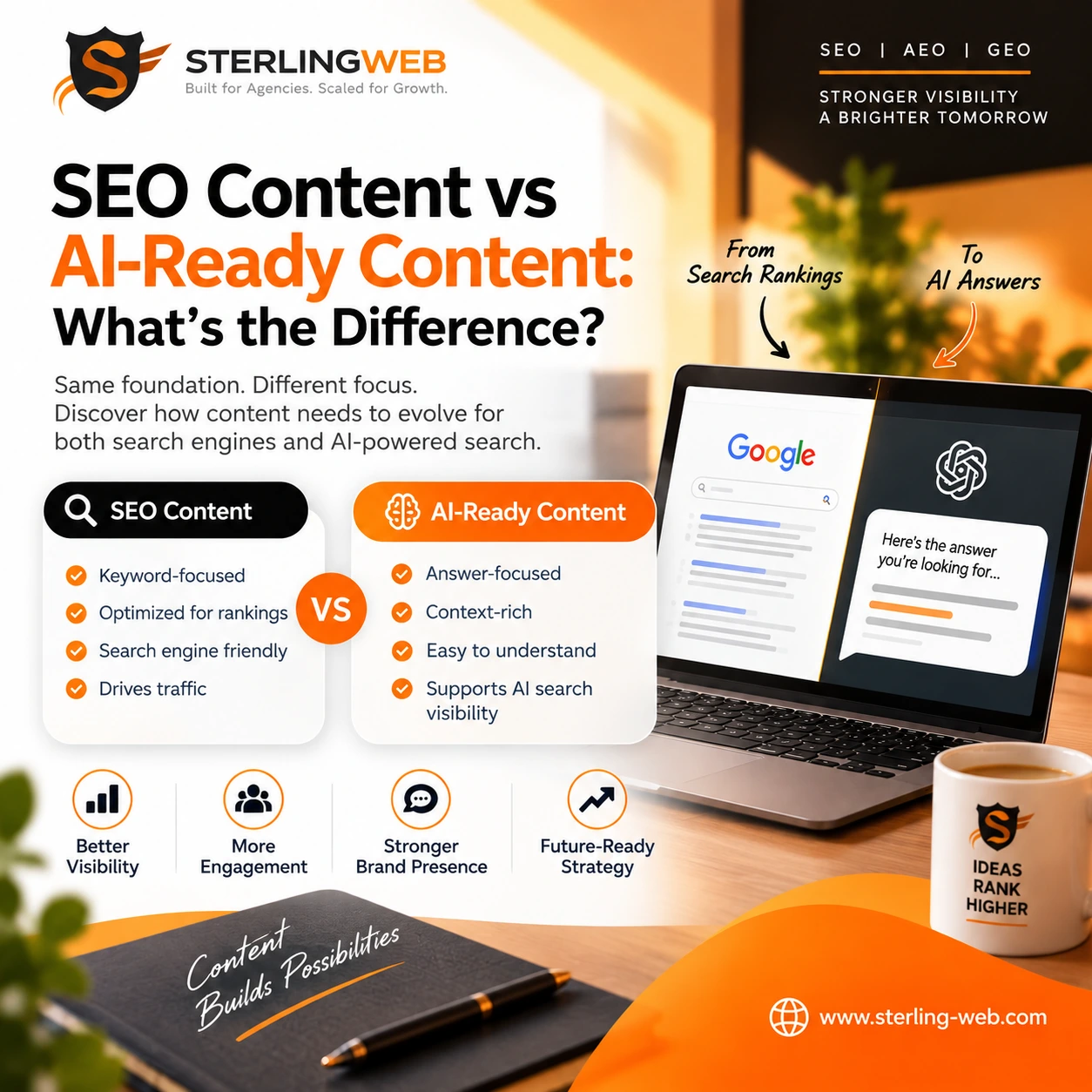
For years, creating content for search meant understanding keywords, matching search intent, optimizing pages, and building authority.
Those fundamentals still matter.
But search is becoming more conversational and AI-driven. People are increasingly looking for direct answers, comparisons, recommendations, and explanations through AI-powered search experiences.
This raises an important question:
Is content that is optimized for traditional search automatically ready for AI search?
Not necessarily.
SEO content and AI-ready content share the same foundation, but they have different priorities.
What Is SEO Content?
SEO content is created primarily to help a webpage become discoverable and relevant in traditional search engines.
It typically focuses on:
- Search intent
- Keyword relevance
- Content quality
- Page structure
- Internal linking
- Technical SEO
- Topical relevance
- Search-friendly titles and headings
For example, a SaaS company targeting the keyword “CRM software for small businesses” might create a detailed page explaining its CRM features, benefits, use cases, and advantages.
The objective is to provide relevant information while making the page understandable to search engines and useful to visitors.
That foundation remains important.
But AI-powered search introduces another layer.
What Makes Content AI-Ready?
AI-ready content is designed to be easy to understand, extract, summarize, and connect with a user’s specific question or context.
Instead of focusing only on the keyword, it considers the broader information need behind the query.
For example, a user might ask:
“What CRM software is best for a small business with a remote sales team?”
This is more than a keyword query.
It contains context, a specific audience, and a decision-making requirement.
AI-ready content should therefore provide clear information that addresses these different aspects rather than simply repeating the phrase “CRM software for small businesses.”
AI-Ready Content Prioritizes Clarity
AI systems need to understand what a page is actually saying.
That makes clear definitions, direct answers, descriptive headings, logical sections, comparisons, examples, and supporting context particularly valuable.
Instead of writing:
“Our platform offers a comprehensive range of powerful features designed to transform your business operations.”
A clearer approach would be:
“Our CRM helps small businesses manage leads, sales activities, customer information, and follow-ups in one platform.”
The second statement communicates the subject much more directly.
SEO Content vs AI-Ready Content
The difference isn’t that one replaces the other.
It’s about expanding the purpose of your content.
| SEO Content | AI-Ready Content |
|---|---|
| Focuses heavily on search intent and keywords | Focuses on questions, context, and meaning |
| Optimized for discoverability | Optimized for discoverability and understanding |
| Uses relevant headings and keywords | Uses clear, question-focused structures |
| Builds topical relevance | Builds topical relevance and contextual clarity |
| Targets search results | Supports traditional and AI-powered discovery |
| Encourages users to click and explore | Makes information easier to extract and understand |
The strongest strategy isn’t SEO vs AI-ready content.
It’s SEO + AI-ready content.
Where AEO Fits In
This is where Answer Engine Optimization (AEO) becomes important.
AEO focuses on creating content that directly addresses the questions people ask.
For example, instead of creating one broad article about accounting software, a business could build content around questions such as:
- What accounting software is best for small businesses?
- What should you look for in accounting software?
- How does cloud accounting work?
- What is the difference between accounting software and ERP software?
Each question represents a different information need.
When your content provides a clear and useful answer, it becomes more valuable for both users and answer-driven search experiences.
Where GEO Comes In
Generative Engine Optimization (GEO) takes the concept further by considering how your brand and expertise are understood within generative search experiences.
GEO isn’t simply about adding AI-related keywords to existing content.
It involves building a stronger overall information ecosystem around your brand.
That can include:
Clear brand information
Your website should clearly explain what your business does, who it serves, and what it offers.
Consistent expertise
Your content should demonstrate knowledge around the topics your business wants to be associated with.
Strong entity signals
Your organization, people, products, and services should be represented consistently across relevant digital properties.
Useful third-party presence
Independent websites, industry publications, review platforms, and other authoritative sources can contribute to how a brand is understood online.
This is why GEO should be viewed as an extension of a broader search visibility strategy rather than simply another content tactic.
How to Make Existing SEO Content More AI-Ready
You don’t necessarily need to replace your entire content library.
Start by looking at your most important pages and ask:
Does this page answer the main question quickly?
Are the sections clearly organized around real user questions?
Can someone understand the key point without reading every paragraph?
Are important facts supported with useful context?
Does the content clearly demonstrate the company’s expertise?
Is the brand’s role and offering clearly explained?
Often, improving structure and clarity can make existing content more useful without completely rewriting it.
The Future Is Not SEO vs GEO
SEO remains an important foundation for online visibility.
But the search environment is expanding.
Users aren’t always looking for a page to visit first. They may want an answer, a comparison, a recommendation, or a solution.
That means businesses need content that works across different discovery experiences.
SEO helps people find your content.
AEO helps your content answer their questions.
GEO helps strengthen how your brand is understood in generative search.
At SterlingWeb, I work across SEO, AEO, and GEO to help businesses build a more complete search visibility strategy—one that considers both traditional search and the growing role of AI-powered discovery.
Final Takeaway
The question isn’t whether you should create SEO content or AI-ready content.
Your best content should be both.
Build it for search engines, structure it for people, make the answers clear, demonstrate genuine expertise, and give AI-powered search enough context to understand your brand and your subject matter.
Search is changing. Your content strategy should evolve with it.
👉 Explore SterlingWeb’s SEO, AEO & GEO services to build a stronger search visibility strategy for your business.
Leave a Reply