Category: Shopify

  • What Happens After Your Shopify Store Launches? The Real Growth Phase Begins

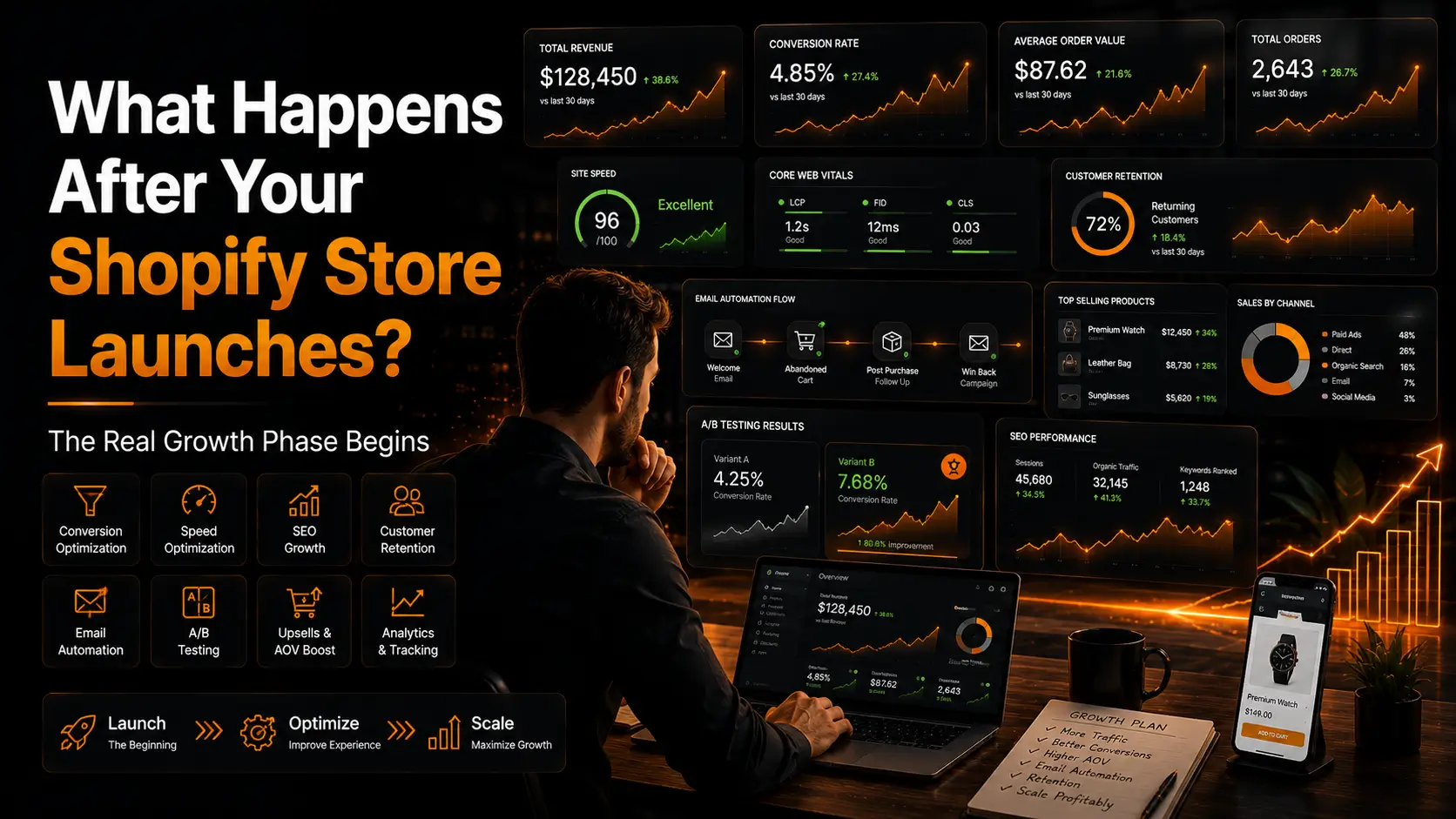
    What Happens After Your Shopify Store Launches? The Real Growth Phase Begins

    Most ecommerce businesses think launching a Shopify store is the finish line.

    It is not.

    It is the starting point.

    This is where many Shopify stores quietly fail.

    Businesses spend:

    • weeks building
    • months planning
    • money on design
    • money on development

    Then launch…

    …and stop optimizing.

    That is a mistake.

    The most profitable Shopify brands continuously improve:

    • conversion rates
    • customer experience
    • speed
    • retention
    • automation
    • analytics
    • SEO
    • average order value

    At SterlingWeb Growth Labs, we treat Shopify launch as phase one — not completion.

    Because ecommerce growth comes from optimization, not just development.

    This guide explains what businesses should actually focus on after launching their Shopify store in 2026.


    The Biggest Post-Launch Mistake Businesses Make

    Most businesses become reactive after launch.

    They only fix problems after:

    • sales drop
    • ads become expensive
    • customers complain
    • conversion rates fall

    Winning ecommerce brands operate differently.

    They continuously improve systems before major problems happen.

    That difference compounds over time.


    Your Shopify Store Should Be Treated Like a Growth System

    Modern ecommerce stores are not static websites anymore.

    Your Shopify store should function like:

    • a sales funnel
    • a conversion engine
    • a customer retention system
    • a marketing automation platform

    That means post-launch optimization becomes critical.


    1. Conversion Rate Optimization (CRO)

    Most stores launch without proper CRO strategy.

    That immediately limits revenue potential.

    What CRO Actually Improves

    Product Pages

    Optimizing:

    • product layout
    • trust signals
    • image hierarchy
    • CTA positioning
    • urgency elements

    can dramatically improve conversions.


    Cart Experience

    Reducing friction through:

    • sticky add-to-cart
    • simplified cart flow
    • trust indicators
    • shipping transparency

    helps reduce abandonment.


    Checkout Optimization

    Checkout issues silently destroy revenue.

    Even small checkout improvements can increase:

    • completed purchases
    • average order value
    • retention

    At SterlingWeb Growth Labs, Shopify stores are designed with conversion-first thinking instead of “just design.”

    That difference matters.


    2. Shopify Speed Optimization

    Many stores become slower after launch because businesses:

    • install too many apps
    • upload unoptimized media
    • add unnecessary scripts

    This hurts:

    • SEO
    • conversions
    • ad performance
    • user experience

    What Professional Shopify Speed Optimization Includes

    • image compression
    • lazy loading
    • app cleanup
    • script optimization
    • Core Web Vitals improvements
    • theme optimization
    • CDN improvements

    A faster Shopify store directly impacts revenue.

    That is not theory anymore.


    3. Analytics & Tracking Setup

    Most businesses make decisions using incomplete data.

    That becomes dangerous.

    Professional tracking should include:

    • Google Analytics
    • Meta Pixel
    • server-side tracking
    • conversion APIs
    • event tracking
    • funnel tracking
    • heatmaps

    Without proper analytics:

    • ad optimization becomes weaker
    • CRO becomes guesswork
    • scaling becomes inefficient

    4. Email & Automation Systems

    Many ecommerce stores still operate manually.

    That limits growth heavily.

    Post-launch automation should include:

    • abandoned cart emails
    • welcome sequences
    • post-purchase flows
    • review requests
    • retention campaigns
    • WhatsApp automation
    • CRM integrations

    Automation increases:

    • repeat purchases
    • retention
    • operational efficiency

    SterlingWeb Growth Labs helps ecommerce brands build scalable automation systems instead of relying on manual workflows.


    5. SEO Optimization After Launch

    Many businesses think SEO is “done” once pages are indexed.

    That is wrong.

    Post-launch SEO should include:

    • technical improvements
    • keyword expansion
    • collection optimization
    • blog content
    • internal linking
    • schema markup
    • speed optimization

    SEO compounds over time.

    The stores that dominate search usually optimize continuously.


    6. A/B Testing & Continuous Improvement

    Most ecommerce stores never properly test anything.

    That means:

    • decisions become emotional
    • assumptions replace data

    Winning brands test:

    • product pages
    • headlines
    • CTAs
    • layouts
    • checkout flow
    • upsell systems

    Small improvements compound into massive revenue differences.


    7. Upsells & Average Order Value Optimization

    Most Shopify stores leave money on the table.

    Good post-launch optimization includes:

    • bundle offers
    • cross-sells
    • post-purchase upsells
    • subscription offers
    • personalized recommendations

    Increasing average order value is often easier than increasing traffic.

    But many stores ignore this completely.


    8. Customer Retention Systems

    Acquiring customers is expensive.

    Retention matters more than most brands realize.

    Post-launch retention systems include:

    • loyalty programs
    • subscriptions
    • email campaigns
    • SMS flows
    • reorder automation
    • customer segmentation

    The brands scaling fastest usually focus heavily on retention.


    9. Mobile Optimization Never Stops

    Mobile UX should be reviewed continuously.

    Because:

    • user behavior changes
    • devices change
    • screen sizes evolve

    Most Shopify traffic today is mobile-first.

    A poor mobile experience destroys:

    • SEO
    • conversions
    • retention
    • ad ROI

    10. Scaling Infrastructure as Your Store Grows

    As revenue grows, stores usually require:

    • advanced integrations
    • better automation
    • ERP systems
    • CRM synchronization
    • advanced reporting
    • warehouse integrations

    Many DIY Shopify setups break under scaling pressure.

    That is why scalable architecture matters early.


    Why Businesses Work With SterlingWeb Growth Labs

    SterlingWeb Growth Labs helps ecommerce brands with:

    • Shopify development
    • CRO optimization
    • Shopify speed optimization
    • automation systems
    • analytics implementation
    • WooCommerce to Shopify migration
    • scalable ecommerce infrastructure
    • conversion-focused UX systems

    We focus on:

    • growth
    • performance
    • scalability
    • retention
    • long-term ecommerce success

    Because a Shopify store should evolve with your business — not hold it back.


    The Truth Most Businesses Learn Too Late

    Launching a Shopify store is easy.

    Building a profitable ecommerce system is hard.

    The businesses that scale successfully usually win because they continuously optimize:

    • conversions
    • retention
    • customer experience
    • automation
    • analytics
    • operational efficiency

    Growth comes from refinement.

    Not just launching.


    Final Thoughts

    Most ecommerce stores are under-optimized.

    Not because the products are bad.

    Because the systems behind the store were never designed properly.

    The real ecommerce advantage in 2026 is no longer:
    “Who launches first?”

    It is:
    “Who optimizes better over time?”

    That is the difference between stores that survive and brands that scale.


    FAQs

    Is Shopify launch the final step?

    No. Launch is only the beginning of optimization and growth.

    What should businesses improve after launch?

    CRO, speed, SEO, analytics, automation, and retention systems.

    Why does Shopify speed matter so much?

    Speed impacts conversions, SEO rankings, bounce rates, and ad performance.

    What is the most overlooked post-launch strategy?

    Customer retention and automation systems.

    How often should Shopify stores be optimized?

    Continuously. High-performing ecommerce stores evolve constantly.
  • Shopify Theme Customization: DIY vs Hiring a Developer in 2026

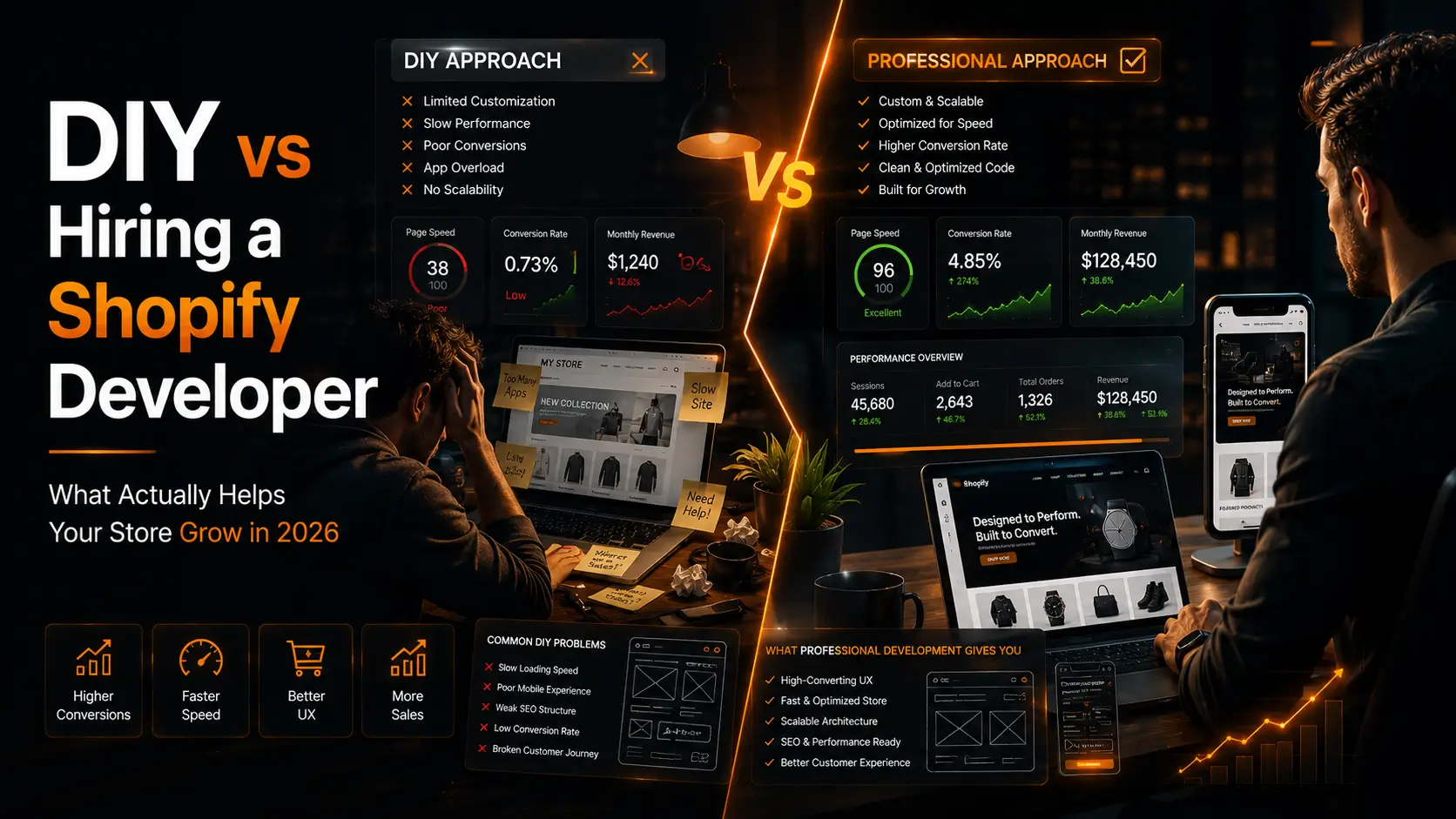
    Shopify Theme Customization: DIY vs Hiring a Developer in 2026

    DIY Shopify vs Hiring a Shopify Developer: Which Choice Will Actually Grow Your eCommerce Business?

    Launching a Shopify store has never been easier.

    Within a few hours, almost anyone can choose a theme, upload products, connect payment gateways, and start selling online. Shopify has made eCommerce accessible to entrepreneurs, startups, and small businesses around the world.

    But that simplicity is both Shopify’s greatest strength and its biggest misconception.

    Many business owners assume that because they can build a Shopify store themselves, they don’t need a Shopify developer. Technically, that’s true—you can launch a functional store without writing a single line of code.

    However, launching a store and building a profitable eCommerce business are two very different things.

    At Sterlingweb Growth Labs, we frequently work with businesses that started with a DIY Shopify setup and later discovered their store wasn’t performing as expected. Their website looked good, but sales were inconsistent, mobile conversions were poor, SEO traffic was limited, and customer drop-offs kept increasing.

    The problem wasn’t Shopify.

    The problem was the lack of strategy, optimization, and technical execution.

    This guide explains when DIY Shopify is enough, when it’s time to hire a Shopify developer, and how professional development can significantly improve your store’s long-term profitability.


    Can You Build a Shopify Store Yourself?

    Absolutely.

    Shopify is designed specifically for non-technical users.

    With its drag-and-drop editor and intuitive dashboard, beginners can:

    • Choose a professional theme
    • Upload products
    • Configure collections
    • Connect payment gateways
    • Set shipping rules
    • Launch within a few days

    For validating a business idea or launching a minimum viable product (MVP), DIY Shopify is often the right decision.

    However, many entrepreneurs confuse store setup with eCommerce optimization.

    Creating a store is relatively easy.

    Building one that consistently converts visitors into customers requires a completely different skill set.


    Where DIY Shopify Stores Usually Fall Short

    Many beginner stores appear professional on the surface but have hidden issues that reduce conversions and limit growth.

    1. Poor Mobile Experience

    Today, most online shoppers browse and purchase using smartphones.

    Despite this, many DIY Shopify stores are designed primarily for desktop users.

    Common issues include:

    • Cluttered layouts
    • Difficult navigation
    • Oversized banners
    • Tiny buttons
    • Confusing product pages
    • Checkout friction

    A website that looks attractive on a laptop can perform poorly on mobile devices.

    Since mobile traffic dominates modern eCommerce, optimizing for smartphones should always be the priority.


    2. Slow Website Speed

    One of the most common mistakes beginners make is installing too many Shopify apps.

    Every additional app introduces:

    • Extra JavaScript
    • Additional server requests
    • Larger page sizes
    • Increased loading times

    This negatively impacts:

    • Core Web Vitals
    • Google rankings
    • Customer experience
    • Conversion rates

    Professional Shopify developers focus on keeping the store lightweight by minimizing unnecessary apps and optimizing every aspect of performance.


    3. Weak Conversion Optimization

    Beautiful design doesn’t guarantee sales.

    Many DIY stores emphasize appearance while overlooking customer psychology.

    Successful Shopify stores are carefully engineered to guide visitors toward purchasing.

    Professional conversion optimization includes:

    • Strong value propositions
    • Clear calls-to-action
    • Trust badges
    • Customer reviews
    • Product comparison tables
    • Urgency messaging
    • Simplified checkout
    • Strategic content hierarchy

    Small improvements in user experience can significantly increase revenue without increasing advertising spend.


    4. Technical SEO Issues

    Search engine optimization begins with technical structure.

    Unfortunately, many DIY stores launch with problems such as:

    • Missing metadata
    • Duplicate content
    • Poor heading hierarchy
    • Unoptimized images
    • Weak internal linking
    • Indexing issues

    These problems limit long-term organic visibility and make it more difficult for potential customers to discover your products.

    Professional Shopify development includes technical SEO from the beginning rather than attempting to fix issues later.


    What Does a Professional Shopify Developer Actually Do?

    Many people believe Shopify developers simply customize themes or write code.

    In reality, modern Shopify development combines multiple disciplines.

    A professional developer improves:

    • Customer experience (UX)
    • Conversion rate optimization (CRO)
    • Technical SEO
    • Store performance
    • Mobile usability
    • Automation
    • Scalability
    • Integrations
    • Long-term maintainability

    At Sterlingweb Growth Labs, every Shopify project is built around measurable business outcomes—not just attractive design.

    Our goal is to create stores that consistently generate revenue while remaining fast, scalable, and easy to manage.


    When DIY Shopify Makes Sense

    DIY Shopify isn’t always the wrong choice.

    It works well when:

    • You’re testing a new product idea
    • You’re launching an MVP
    • Budget is limited
    • Product validation matters more than branding
    • Traffic volume is still low
    • You need to launch quickly

    During the early stages of a business, speed often matters more than perfection.

    However, as your business grows, technical complexity increases rapidly.


    Signs It’s Time to Hire a Shopify Developer

    Your Store Is Generating Revenue

    Once your store begins receiving consistent orders, even small improvements in conversion rate can have a significant financial impact.

    Professional optimization helps improve:

    • Average Order Value (AOV)
    • Checkout completion
    • Customer retention
    • User experience
    • Revenue per visitor

    You’re Investing in Paid Advertising

    If you’re spending money on:

    • Google Ads
    • Meta Ads
    • Instagram campaigns
    • Influencer marketing
    • Shopping campaigns

    then every visitor becomes valuable.

    Sending paid traffic to an underperforming store wastes marketing budget.

    Professional optimization ensures advertising dollars generate the highest possible return.


    You Need Advanced Features

    Growing businesses eventually require functionality beyond Shopify’s default capabilities.

    Examples include:

    • Subscription systems
    • Wholesale pricing
    • Custom product builders
    • Advanced filtering
    • CRM integrations
    • ERP connections
    • Marketing automation
    • Custom checkout experiences

    These features require experienced Shopify development.


    You’re Planning Long-Term Growth

    DIY stores often accumulate technical debt over time.

    Common issues include:

    • App overload
    • Inconsistent branding
    • Slow performance
    • Broken sections
    • Poor organization

    Professional architecture keeps your store organized, scalable, and easier to maintain as your business expands.


    Theme Customization vs Custom Shopify Development

    Many businesses aren’t sure which service they actually need.

    Shopify Theme Customization

    Ideal for businesses that need:

    • Branding improvements
    • Homepage redesigns
    • Better navigation
    • Mobile optimization
    • Conversion improvements
    • Section customization

    This solution is cost-effective for many growing businesses.


    Custom Shopify Development

    Recommended for businesses requiring:

    • Custom applications
    • API integrations
    • Advanced automation
    • Personalized shopping experiences
    • Subscription platforms
    • Enterprise workflows
    • Unique customer journeys

    High-growth brands often benefit from custom development because it creates competitive advantages that standard themes cannot provide.


    Can AI Replace Shopify Developers?

    AI has become an incredible productivity tool.

    It can:

    • Generate code
    • Suggest layouts
    • Write product descriptions
    • Create content
    • Automate repetitive tasks

    However, AI still cannot replace strategic thinking.

    Successful eCommerce depends on understanding:

    • Customer psychology
    • Buying behavior
    • Conversion optimization
    • User experience
    • Brand positioning
    • Business goals

    AI can accelerate development, but experienced developers provide the strategy and expertise needed to build stores that actually perform.

    At Sterlingweb Growth Labs, we use AI to improve efficiency—not to replace human expertise.


    Why Mobile Optimization Matters More Than Ever

    More than half of online purchases now originate on mobile devices.

    A mobile-first Shopify store should include:

    • Fast loading pages
    • Sticky Add-to-Cart buttons
    • Thumb-friendly navigation
    • Optimized product galleries
    • Streamlined checkout
    • Easy payment methods
    • Clear trust signals

    Mobile usability directly impacts:

    • SEO rankings
    • Conversion rates
    • Bounce rates
    • Customer satisfaction
    • Advertising ROI

    If your mobile experience is poor, your store will struggle to scale regardless of how much traffic you generate.


    Professional Shopify Speed Optimization

    Performance optimization is one of the highest ROI improvements available.

    Professional developers optimize:

    • Image compression
    • Theme efficiency
    • JavaScript loading
    • CSS optimization
    • Lazy loading
    • App cleanup
    • CDN configuration
    • Core Web Vitals

    Fast stores improve both customer experience and search engine visibility while reducing bounce rates.


    The Hidden Cost of DIY

    The biggest misconception among store owners is believing that a functional store is a successful store.

    Many DIY Shopify websites technically “work.”

    But behind the scenes they may be:

    • Losing search rankings
    • Reducing conversion rates
    • Increasing advertising costs
    • Creating customer frustration
    • Slowing page speed
    • Limiting scalability

    These hidden inefficiencies compound over time, costing far more than professional development ever would.


    Why Businesses Choose Sterlingweb Growth Labs

    At Sterlingweb Growth Labs, we build Shopify stores that combine strategy, performance, and scalability.

    Our Shopify services include:

    • Custom Shopify Development
    • Shopify Theme Customization
    • Shopify Store Redesigns
    • Shopify App Development
    • Conversion Rate Optimization (CRO)
    • Technical SEO
    • Core Web Vitals Optimization
    • Mobile-First UX Design
    • Shopify Speed Optimization
    • Marketing Automation
    • Shopify Migrations
    • Ongoing Growth Support

    Every decision we make is focused on helping businesses increase revenue, improve customer experience, and build a stronger digital foundation.


    Final Thoughts

    DIY Shopify is an excellent starting point for entrepreneurs testing new ideas or launching their first online store.

    But as your business grows, the challenges become more complex.

    Success in eCommerce is no longer about simply launching a website. It’s about creating a high-performance system that attracts qualified traffic, converts visitors into customers, and scales efficiently over time.

    Instead of asking:

    “Can I build a Shopify store myself?”

    Ask a more valuable question:

    “How much potential revenue is my current store leaving on the table because it isn’t professionally optimized?”

    The answer to that question often determines whether a business remains a side project—or grows into a thriving, scalable eCommerce brand.


    Frequently Asked Questions

    Can beginners build a Shopify store themselves?

    Yes. Shopify is beginner-friendly and allows most users to launch a basic online store without coding. However, advanced optimization for SEO, speed, and conversions typically requires professional expertise.

    Is hiring a Shopify developer worth it?

    If your business relies on organic search, paid advertising, or consistent online sales, hiring a Shopify developer can significantly improve store performance, user experience, and long-term profitability.

    What’s the difference between Shopify customization and custom development?

    Theme customization focuses on improving the appearance and functionality of an existing Shopify theme. Custom development involves building unique features, applications, integrations, and workflows tailored to your business requirements.

    Can AI build Shopify stores?

    AI can assist with coding, content generation, and design suggestions, but it cannot replace strategic planning, conversion optimization, customer psychology, or business decision-making.

    When should I hire a Shopify expert?

    The ideal time is when your store begins generating revenue, advertising costs increase, or you need better performance, advanced functionality, or scalable infrastructure to support future growth.

  • Shopify Development Costs Explained: What Businesses Should Actually Budget For in 2026

    Shopify Development Costs Explained: What Businesses Should Actually Budget For in 2026

    One of the biggest mistakes ecommerce businesses make is underestimating Shopify development costs.

    Most business owners think:
    “I just need a Shopify website.”

    But ecommerce development is not just website creation anymore.

    A modern Shopify store involves:

    • conversion optimization
    • mobile UX
    • automation
    • analytics
    • SEO
    • integrations
    • speed optimization
    • customer retention systems

    That is why Shopify pricing varies massively between developers, freelancers, and agencies.

    At SterlingWeb Growth Labs, we regularly see businesses rebuilding stores because they originally hired based only on low pricing instead of long-term business performance.

    Cheap Shopify development often becomes the most expensive option later.

    This guide breaks down the real Shopify development costs in 2026 and explains where businesses usually waste money.


    How Much Does Shopify Development Actually Cost?

    There is no universal Shopify pricing because project complexity changes everything.

    Typical Shopify Pricing in 2026

    Project TypeEstimated Cost
    Basic Theme Setup$500–$2,000
    Customized Shopify Store$3,000–$10,000
    High-Converting Ecommerce Store$10,000–$25,000
    Shopify Plus / Enterprise$25,000–$100,000+

    Businesses comparing only numbers without understanding deliverables usually make bad decisions.

    A $1,000 store and a $15,000 store are completely different products.

    One is setup work.

    The other is ecommerce infrastructure built for scaling.


    Freelancer vs Agency Pricing

    Shopify Freelancer Pricing

    Freelancers usually charge:

    • $15–$40/hour for beginner to mid-level
    • $50–$150+/hour for experienced Shopify specialists

    Freelancers are useful for:

    • quick edits
    • small tasks
    • bug fixes
    • short-term projects

    But many freelancers struggle with:

    • CRO strategy
    • advanced integrations
    • scaling systems
    • long-term support
    • performance optimization

    Shopify Agency Pricing

    Professional Shopify agencies cost more because they provide:

    • strategy
    • UX design
    • CRO optimization
    • developers
    • SEO specialists
    • QA testing
    • automation setup
    • long-term scaling support

    At SterlingWeb Growth Labs, Shopify projects are approached from a growth perspective instead of just visual design.

    That means stores are built around:

    • conversions
    • performance
    • scalability
    • customer experience
    • retention

    Not just appearance.


    The Biggest Hidden Shopify Costs

    Most ecommerce businesses only calculate “website cost.”

    That is a major mistake.

    Hidden Costs Most Businesses Ignore

    1. Shopify Apps

    Many stores rely on:

    • upsell apps
    • review apps
    • email systems
    • subscriptions
    • loyalty programs
    • automation tools

    Monthly app costs can easily become:

    • $100/month
    • $300/month
    • $1,000+/month for advanced stores

    Bad developers install too many apps instead of building optimized systems.

    That slows stores and increases operational costs.


    2. Premium Themes

    Premium Shopify themes usually cost:

    • $200–$500+

    Custom themes cost more initially but often perform better long term.


    3. CRO Optimization

    Most stores launch without proper conversion optimization.

    Later businesses pay extra for:

    • product page optimization
    • cart optimization
    • mobile UX improvements
    • A/B testing
    • checkout improvements

    Stores that ignore CRO burn money on ads.


    4. SEO Fixes

    Poor Shopify builds often create:

    • duplicate content issues
    • poor URL structures
    • slow loading pages
    • indexing problems

    Fixing technical SEO later is usually more expensive than doing it properly initially.


    5. Maintenance & Support

    Most stores need ongoing help for:

    • app updates
    • bug fixes
    • speed optimization
    • analytics issues
    • integrations
    • CRO updates

    A Shopify store is not a “one-time project.”

    Profitable stores evolve continuously.


    Why Cheap Shopify Development Usually Fails

    Cheap development typically focuses on:

    • fast delivery
    • copied themes
    • app overload
    • visual appearance only

    What gets ignored:

    • conversions
    • performance
    • customer psychology
    • retention
    • scalability

    This creates problems later:

    • slow speed
    • poor mobile UX
    • low conversion rates
    • app conflicts
    • technical debt

    The businesses that scale successfully usually invest properly from the beginning.


    How Long Does Shopify Development Take?

    Realistic Timelines

    Store TypeEstimated Timeline
    Basic Store1–2 weeks
    Customized Store3–6 weeks
    Advanced Ecommerce Store6–12 weeks
    Enterprise Shopify Plus3–6 months

    If someone promises:
    “Complete custom Shopify store in 2 days”

    they are cutting corners somewhere.

    Professional ecommerce development requires:

    • planning
    • UX thinking
    • testing
    • optimization
    • QA

    Fast delivery without strategy usually creates long-term issues.


    What Affects Shopify Development Pricing?

    Major Cost Factors

    1. Custom Design

    Fully custom Shopify UX costs more than template modification.

    But custom UX usually converts better.


    2. Integrations

    Advanced integrations increase development complexity:

    • CRM systems
    • ERP software
    • email automation
    • warehouse systems
    • subscription systems

    3. Shopify Migrations

    Migrating from:

    • WooCommerce
    • Magento
    • Wix
    • BigCommerce

    requires:

    • product migration
    • SEO preservation
    • redirects
    • testing
    • app replacement

    Bad migrations destroy rankings and revenue.

    SterlingWeb Growth Labs handles migration projects with performance and SEO preservation in mind.


    4. Custom Functionality

    Features like:

    • subscriptions
    • wholesale systems
    • advanced filters
    • custom calculators
    • personalized experiences

    increase development requirements significantly.


    Payment Structures: What’s Normal?

    Professional Shopify projects usually follow:

    Common Payment Models

    Fixed Pricing

    Best for:

    • clearly defined projects

    Milestone Payments

    Example:

    • 40% upfront
    • 30% midway
    • 30% before launch

    Monthly Retainers

    Best for:

    • ongoing optimization
    • support
    • CRO
    • maintenance

    Avoid developers demanding 100% upfront without milestone protection.


    How to Avoid Overpaying for Shopify Development

    1. Focus on Outcomes, Not Just Design

    Ask:

    • Will this improve conversions?
    • Will this improve speed?
    • Will this scale?

    Not:
    “Does it look modern?”


    2. Avoid App Overload

    Many stores become slow because developers solve everything using apps.

    Good developers reduce dependency where possible.


    3. Prioritize Mobile Experience

    Most Shopify traffic is mobile.

    Ignoring mobile UX destroys conversion rates.


    4. Ask About Post-Launch Support

    Many problems appear after launch:

    • tracking issues
    • speed drops
    • checkout bugs
    • app conflicts

    Ongoing support matters.


    What Happens After Launch?

    This is where real ecommerce growth starts.

    After launch businesses usually need:

    • CRO optimization
    • speed improvements
    • SEO scaling
    • analytics reviews
    • automation setup
    • retention systems
    • upsell optimization

    At SterlingWeb Growth Labs, launch is considered the starting point — not the finish line.


    Why Businesses Choose SterlingWeb Growth Labs

    SterlingWeb Growth Labs helps ecommerce brands build:

    • high-converting Shopify stores
    • Shopify CRO systems
    • WooCommerce to Shopify migrations
    • performance-optimized stores
    • mobile-first ecommerce experiences
    • automation workflows
    • scalable ecommerce systems

    We focus on:

    • speed
    • conversions
    • scalability
    • growth strategy
    • long-term support

    Because a Shopify store should function like a revenue engine — not just a website.


    Final Thoughts

    The cheapest Shopify quote is rarely the cheapest long term.

    Good Shopify development is not about:

    • installing themes
    • adding apps
    • launching quickly

    It is about building:

    • scalable systems
    • high-converting experiences
    • optimized customer journeys
    • long-term ecommerce infrastructure

    The real question is not:
    “How cheap can I build my store?”

    The real question is:
    “How much revenue will poor development cost me later?”


    FAQs

    Is Shopify worth paying a developer for?

    Yes. Professional developers improve conversions, speed, UX, SEO, and scalability.

    Why are Shopify agencies expensive?

    Because they usually provide strategy, design, CRO, development, QA, and ongoing support.

    What is the biggest hidden Shopify cost?

    Apps, maintenance, CRO work, and ongoing optimization.

    How much should a serious Shopify store cost?

    Most serious ecommerce brands spend between $5,000–$25,000 depending on complexity.

    Can cheap Shopify stores still succeed?

    Rarely at scale. Most cheap stores struggle with performance and conversion issues later.

  • How to Hire the Right Shopify Developer in 2026 (Without Wasting Money)

    How to Hire the Right Shopify Developer in 2026 (Without Wasting Money)

    Most Shopify stores fail before marketing even starts.

    Not because Shopify is bad.

    Not because the products are weak.

    Because businesses hire the wrong developer.

    A poor Shopify setup creates problems that destroy growth later:

    • Slow website speed
    • Low mobile conversions
    • Broken customer journeys
    • SEO issues
    • App conflicts
    • Poor user experience
    • High bounce rates
    • Low conversion rates

    And the worst part?

    Most business owners don’t realize these problems exist until they already start losing money on ads and traffic.

    Hiring a Shopify developer is not just a technical decision anymore.

    It is a revenue decision.

    At SterlingWeb Growth Labs, we have seen businesses spend thousands fixing stores that were originally built cheaply without strategy. The reality is simple:

    Cheap Shopify development usually becomes expensive later.

    This guide explains how to hire the right Shopify developer in 2026 without wasting time, money, or growth potential.


    What Does a Shopify Developer Actually Do?

    Most people think Shopify developers only:

    • install themes
    • upload products
    • customize pages

    That is beginner-level work.

    A professional Shopify developer should help improve:

    • conversion rates
    • site speed
    • customer experience
    • SEO performance
    • mobile responsiveness
    • checkout flow
    • retention systems
    • scalability

    A real Shopify developer combines:

    • development
    • ecommerce strategy
    • UX thinking
    • CRO optimization
    • performance optimization

    That is the difference between a store that “looks good” and a store that actually generates revenue.

    At SterlingWeb Growth Labs, Shopify development is approached as a growth system — not just a website project.


    How Much Does It Cost to Hire a Shopify Developer?

    This depends on the type of developer you hire.

    Shopify Freelancer Pricing

    Typical freelancer rates:

    • Beginner: $10–$25/hour
    • Mid-level: $25–$60/hour
    • Advanced Shopify specialist: $75–$150+/hour

    Shopify Agency Pricing

    Typical agency pricing:

    • Basic Shopify store: $1,500–$5,000
    • Custom conversion-focused store: $5,000–$15,000
    • Enterprise ecommerce system: $15,000–$50,000+

    If someone offers to build a “professional Shopify store” for $200–$300, understand what usually happens:

    • copied themes
    • bloated apps
    • poor speed optimization
    • weak mobile UX
    • no CRO strategy
    • no scalability planning

    That is not ecommerce development.

    That is template installation.


    Shopify Freelancer vs Shopify Agency

    This is one of the biggest decisions businesses struggle with.

    When a Freelancer Makes Sense

    Freelancers are useful when:

    • your budget is limited
    • you need small changes
    • you need short-term support
    • the project scope is simple

    When an Agency Makes More Sense

    Agencies become valuable when your business needs:

    • long-term scaling
    • CRO optimization
    • technical SEO
    • custom functionality
    • automation systems
    • advanced integrations
    • dedicated support
    • white-label development

    The truth most people avoid saying:

    Many freelancers are developers.

    Very few are ecommerce growth partners.

    That distinction matters.

    SterlingWeb Growth Labs works with businesses that want:

    • scalable Shopify systems
    • high-converting UX
    • performance optimization
    • automation workflows
    • ongoing growth support

    Not just “website delivery.”


    Red Flags When Hiring a Shopify Developer

    Most bad Shopify projects show warning signs early.

    Businesses ignore them because they focus only on price.

    Major Red Flags

    1. No Real Portfolio

    If their portfolio only shows screenshots without:

    • live stores
    • performance proof
    • conversion improvements
    • case studies

    be careful.

    A beautiful homepage proves nothing.

    The important question is:
    Did the store perform?


    2. They Only Talk About Design

    Good ecommerce developers discuss:

    • speed
    • conversions
    • mobile UX
    • customer journey
    • SEO structure
    • retention

    If the conversation is only about “making it look modern,” that is a problem.

    Design without strategy does not scale revenue.


    3. They Promise Unrealistic Timelines

    Professional Shopify development takes planning.

    If someone promises:
    “Full custom Shopify store in 3 days”

    they are either:

    • using shortcuts
    • copying work
    • outsourcing badly
    • skipping optimization

    4. No Post-Launch Support

    Most ecommerce growth happens after launch.

    If your developer disappears after delivery, you will struggle later with:

    • app conflicts
    • bugs
    • speed drops
    • checkout issues
    • analytics problems

    5. Poor Communication

    Communication problems during sales usually become worse during development.

    If replies are:

    • inconsistent
    • vague
    • confusing
    • delayed

    expect project issues later.


    What Questions Should You Ask Before Hiring?

    Most businesses ask weak questions like:
    “How much?”
    “How fast?”

    Those are not enough.

    Better Questions to Ask

    Technical Questions

    • How do you optimize Shopify speed?
    • How do you improve mobile conversions?
    • Which apps do you avoid and why?
    • How do you handle SEO during migration?
    • What is your testing process before launch?

    Business Questions

    • How will this store improve conversions?
    • What KPIs should improve after launch?
    • How do you approach CRO?
    • What happens after launch?
    • What ongoing support do you provide?

    Professional developers should think beyond coding.


    How to Vet a Shopify Developer’s Portfolio

    This is where most businesses fail badly.

    They judge portfolios emotionally instead of strategically.

    What Actually Matters

    1. Mobile Experience

    Open stores on your phone.

    Most Shopify traffic is mobile.

    If the mobile experience feels weak, conversions will suffer.


    2. Site Speed

    Check:

    • load speed
    • responsiveness
    • smoothness
    • checkout flow

    Slow stores kill ad ROI.


    3. Industry Understanding

    A luxury brand should not look like a discount store.

    A good developer adapts UX based on:

    • target audience
    • buying psychology
    • customer behavior

    4. Real Business Logic

    Look for:

    • upsells
    • trust signals
    • sticky add-to-cart
    • CRO elements
    • retention systems

    Good ecommerce development is strategic.


    Should You Hire Local or Remote Shopify Developers?

    Many businesses still think local developers are safer.

    That is outdated thinking.

    Local Developer Advantages

    • easier meetings
    • local market familiarity

    Remote Developer Advantages

    • better talent pool
    • global ecommerce expertise
    • often stronger technical skills
    • scalability

    The ecommerce industry is already remote-first.

    The smarter question is not:
    “Are they local?”

    The smarter question is:
    “Can they grow the business?”


    Best Places to Find Shopify Developers

    Recommended Platforms

    • Shopify Partners Directory
    • LinkedIn
    • Clutch
    • Upwork
    • Ecommerce communities
    • Agency referrals

    But platforms alone do not solve hiring problems.

    Bad developers exist everywhere.

    The evaluation process matters more than the platform.


    How to Find Shopify Developers on LinkedIn

    Most people search:
    “Shopify Developer”

    That is too broad.

    Instead search for:

    • Shopify CRO specialist
    • Shopify performance expert
    • Shopify Plus developer
    • ecommerce UX developer
    • Shopify conversion optimization

    Then review:

    • case studies
    • content quality
    • technical knowledge
    • ecommerce understanding

    Developers who teach publicly are often more credible than developers hiding behind generic portfolios.


    What Makes a Great Shopify Developer?

    A good Shopify developer builds stores.

    A great Shopify developer understands:

    • ecommerce psychology
    • customer intent
    • conversion optimization
    • retention systems
    • speed performance
    • analytics
    • SEO structure
    • scalability

    The biggest difference is business thinking.

    At SterlingWeb Growth Labs, stores are built around:

    • conversion-first UX
    • scalable architecture
    • performance optimization
    • growth systems
    • long-term support

    Because a Shopify store should function like a sales machine — not just an online brochure.


    Getting Multiple Shopify Quotes: What’s Normal?

    You should always compare multiple proposals.

    But here is the mistake businesses make:

    They compare only price.

    You should compare:

    • deliverables
    • strategy
    • support
    • scalability
    • optimization
    • communication quality
    • growth understanding

    A $2,000 store and a $10,000 store are often completely different products.

    One is setup work.

    The other is ecommerce infrastructure.


    Final Thoughts

    The wrong Shopify developer can:

    • waste your budget
    • slow your growth
    • hurt conversions
    • damage SEO
    • create long-term technical problems

    The right Shopify development partner helps:

    • improve conversions
    • optimize customer experience
    • scale operations
    • increase retention
    • support long-term growth

    That difference becomes very expensive over time.

    Most ecommerce brands do not fail because of Shopify.

    They fail because their store was never strategically built for growth.


    Why Businesses Work With SterlingWeb Growth Labs

    SterlingWeb Growth Labs helps ecommerce brands build:

    • high-converting Shopify stores
    • custom Shopify experiences
    • WooCommerce to Shopify migrations
    • CRO-focused UX systems
    • Shopify speed optimization
    • automation workflows
    • scalable ecommerce infrastructure

    Our focus is not just development.

    Our focus is building Shopify systems designed to grow revenue.


    FAQs

    Is hiring a Shopify developer worth it?

    Yes, especially if your store depends on conversions, speed, SEO, and scalability.

    Can beginners build Shopify stores themselves?

    Yes, but DIY stores usually struggle with performance, CRO, and scalability.

    How long does Shopify development take?

    Typically between 2–8 weeks depending on complexity.

    Should I hire a freelancer or agency?

    Freelancers work for small projects. Agencies are better for long-term ecommerce growth.

    What is the biggest mistake when hiring Shopify developers?

    Choosing based only on price instead of business outcomes.

  • From 0 to ₹10L/Month: The Exact Shopify Store Structure That Converts

    From 0 to ₹10L/Month: The Exact Shopify Store Structure That Converts

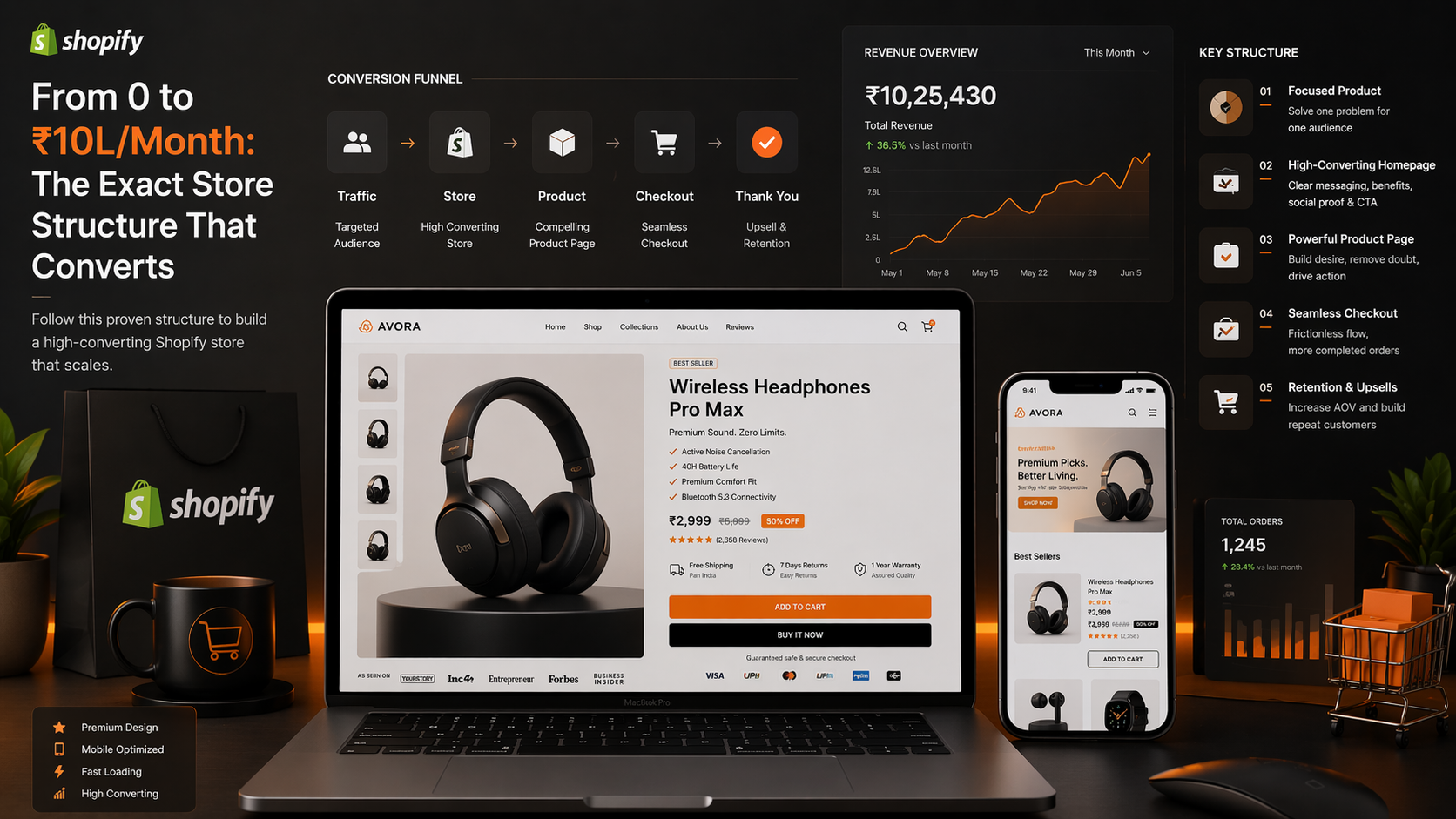
    Most Shopify storThe Shopify Store Blueprint: How to Build a Store That Scales to ₹10L+ Per Month

    Launching a Shopify store has never been easier. Building one that consistently generates revenue is a completely different challenge.

    Thousands of new Shopify stores go live every day, yet the majority fail to achieve sustainable growth. Contrary to popular belief, the biggest problem isn’t the product itself. Most stores fail because they’re built without a clear strategy, weak product positioning, poor user experience, and no conversion-focused structure.

    Many businesses spend heavily on Facebook Ads, Google Ads, and influencer marketing, only to discover that visitors aren’t buying. They blame traffic, competition, or advertising costs. In reality, the issue often lies within the store itself.

    At Sterlingweb Growth Labs, we approach Shopify differently. We don’t build online catalogs—we build conversion-focused eCommerce systems engineered to attract qualified visitors, maximize conversions, and scale profitably.

    Here’s the framework we use to build Shopify stores capable of generating ₹10L+ in monthly revenue.


    Start With One Product, One Audience, One Goal

    One of the biggest mistakes new store owners make is trying to sell everything to everyone.

    A successful Shopify store begins with focus.

    Instead of offering hundreds of unrelated products, identify one hero product or build around a tightly defined niche. Your product should solve one specific problem for one clearly defined audience.

    Ask yourself:

    • Who is my ideal customer?
    • What pain point am I solving?
    • Why should customers choose my product over competitors?
    • What transformation does my product provide?

    The more specific your positioning becomes, the easier your marketing, messaging, and advertising will be.

    Focused brands consistently outperform general stores because customers immediately understand what they offer.


    Turn Your Homepage Into a Sales Page

    Many Shopify homepages look attractive but fail to generate sales.

    Visitors don’t arrive on your website to admire the design—they arrive looking for confidence that your product can solve their problem.

    Your homepage should function like a high-converting landing page.

    A proven homepage structure includes:

    • A compelling headline that communicates the primary benefit
    • A strong value proposition above the fold
    • High-quality product images or videos
    • Key product benefits presented in an easy-to-scan format
    • Customer testimonials and user-generated content
    • Problem-to-solution storytelling
    • Frequently asked questions
    • Multiple strategically placed call-to-action buttons

    Every section should move visitors one step closer to purchasing.

    If your homepage isn’t guiding users toward checkout, it’s leaking potential revenue.


    Create Product Pages That Remove Every Objection

    Your product page is where buying decisions are made.

    Unfortunately, most Shopify stores provide only basic descriptions copied from suppliers.

    That approach rarely converts.

    A high-performing product page answers every question before customers think to ask it.

    Include:

    • Professional lifestyle photography
    • Demonstration videos
    • Benefit-driven headlines
    • Persuasive product descriptions
    • Feature-to-benefit explanations
    • Customer reviews
    • Trust badges
    • Shipping information
    • Return policy
    • Warranty details
    • Frequently asked questions
    • Comparison tables
    • Limited-time offers
    • Stock indicators

    Every unanswered question creates hesitation.

    Every hesitation reduces conversions.

    The objective is to eliminate uncertainty and make purchasing feel like the obvious decision.


    Simplify the Checkout Experience

    Cart abandonment remains one of the biggest challenges in eCommerce.

    One complicated checkout process can erase thousands of rupees in potential revenue.

    An optimized Shopify checkout should include:

    • Guest checkout options
    • Minimal form fields
    • Multiple payment gateways
    • Fast page loading
    • Transparent shipping costs
    • Clear return policies
    • Secure payment indicators
    • Mobile-friendly payment flow

    Remove unnecessary distractions.

    Reduce decision fatigue.

    Make purchasing effortless.

    Small improvements in checkout can dramatically increase revenue without spending additional money on advertising.


    Design for Mobile First

    Today, the majority of Shopify traffic comes from smartphones.

    Yet many stores are still designed primarily for desktop users.

    A mobile-first Shopify experience includes:

    • Lightning-fast loading speeds
    • Sticky Add-to-Cart buttons
    • Thumb-friendly navigation
    • Large touch targets
    • Mobile-optimized product galleries
    • Easy-to-complete forms
    • Simplified navigation menus
    • Streamlined checkout process

    Google also prioritizes mobile usability when evaluating websites.

    A mobile-optimized store improves both SEO rankings and conversion rates.


    Build Systems That Generate Revenue Automatically

    A successful Shopify store doesn’t rely solely on first-time purchases.

    The real profitability comes from automated systems running behind the scenes.

    Every store should include:

    Email Marketing Automation

    Recover abandoned carts automatically.

    Welcome new customers.

    Recommend complementary products.

    Request product reviews.

    Encourage repeat purchases.

    SMS Marketing

    Recover abandoned checkouts.

    Send promotional offers.

    Announce product launches.

    Notify customers about shipping updates.

    Upsell and Cross-Sell Strategies

    Increase average order value through:

    • Product bundles
    • Frequently bought together recommendations
    • Post-purchase upsells
    • Subscription offers

    Increasing Average Order Value (AOV) often has a greater impact than acquiring additional traffic.


    Focus on High-Intent Traffic

    Traffic alone doesn’t generate revenue.

    Qualified traffic does.

    Many businesses chase low-cost clicks instead of buyers.

    Successful Shopify marketing focuses on visitors with genuine purchase intent.

    Traffic sources may include:

    • Google Search
    • Shopping Ads
    • Meta Ads
    • Pinterest
    • Email campaigns
    • Organic SEO
    • Influencer partnerships
    • AI-powered search platforms

    Your advertising, landing pages, and product messaging should remain consistent from the first click to final checkout.

    Message consistency improves Quality Score, lowers advertising costs, and increases conversions.


    Use Data to Continuously Improve

    The highest-performing Shopify brands never stop optimizing.

    Every visitor leaves valuable information.

    Track:

    • Conversion rates
    • Heatmaps
    • User journeys
    • Cart abandonment
    • Product page engagement
    • Checkout completion
    • Average Order Value
    • Customer Lifetime Value
    • Revenue by traffic source
    • Returning customer rate

    Instead of making assumptions, use data to identify exactly where customers are dropping off and improve those areas continuously.

    Incremental improvements compound into significant revenue growth over time.


    Optimize Store Speed for Better Rankings and Sales

    Website performance has a direct impact on customer experience, SEO, and conversions.

    Slow-loading Shopify stores increase bounce rates and reduce trust.

    Performance optimization should include:

    • Lightweight themes
    • Compressed images using WebP or AVIF
    • Lazy loading
    • Minified CSS and JavaScript
    • Reduced third-party apps
    • Optimized fonts
    • Efficient code
    • CDN optimization

    A faster website creates a smoother shopping experience and helps improve both search visibility and sales.


    Build for Long-Term Scalability

    Many Shopify stores become difficult to manage as they grow.

    A scalable store includes:

    • Clean navigation structure
    • Organized collections
    • Flexible product templates
    • Custom Shopify sections
    • Metafields for structured content
    • Automated inventory management
    • App integrations that support growth
    • Clean, maintainable code

    Scalability ensures your store can handle increased traffic, larger product catalogs, international expansion, and new marketing campaigns without sacrificing performance.


    Future-Proof Your Shopify Store

    Search is evolving rapidly.

    Customers increasingly discover products through AI-powered platforms like ChatGPT, Gemini, Claude, and Perplexity—not just traditional search engines.

    Modern Shopify stores should be optimized for:

    • Technical SEO
    • Structured data
    • Answer Engine Optimization (AEO)
    • Generative Engine Optimization (GEO)
    • Core Web Vitals
    • AI-friendly content
    • Rich product schema
    • Product review markup
    • Merchant Center optimization

    Preparing for AI-driven search today gives your business a competitive advantage tomorrow.


    Why Businesses Choose Sterlingweb Growth Labs

    At Sterlingweb Growth Labs, we build Shopify stores that combine strategy, performance, and conversion optimization.

    Our Shopify services include:

    • Custom Shopify Store Development
    • Shopify Theme Customization
    • Shopify App Development
    • Conversion Rate Optimization (CRO)
    • Shopify SEO
    • Core Web Vitals Optimization
    • Technical SEO
    • AEO & GEO Optimization
    • Speed Optimization
    • Shopify Migrations
    • Marketing Automation
    • Ongoing Growth Support

    We don’t measure success by how a store looks—we measure it by how it performs.


    Final Thoughts

    The difference between an average Shopify store and a high-performing eCommerce business isn’t the product alone—it’s the system behind it.

    When strategy, positioning, user experience, performance, automation, SEO, and conversion optimization work together, your Shopify store becomes far more than an online catalog. It becomes a scalable revenue engine that attracts qualified traffic, converts visitors into customers, and supports long-term business growth.

    If your store isn’t delivering consistent sales, don’t assume you need more traffic. First, evaluate how your store is built.

    A well-structured Shopify store doesn’t just generate orders—it builds a sustainable, profitable business that continues to grow month after month.

  • Shopify Stores Don’t Fail Because of Traffic — They Fail Because of This

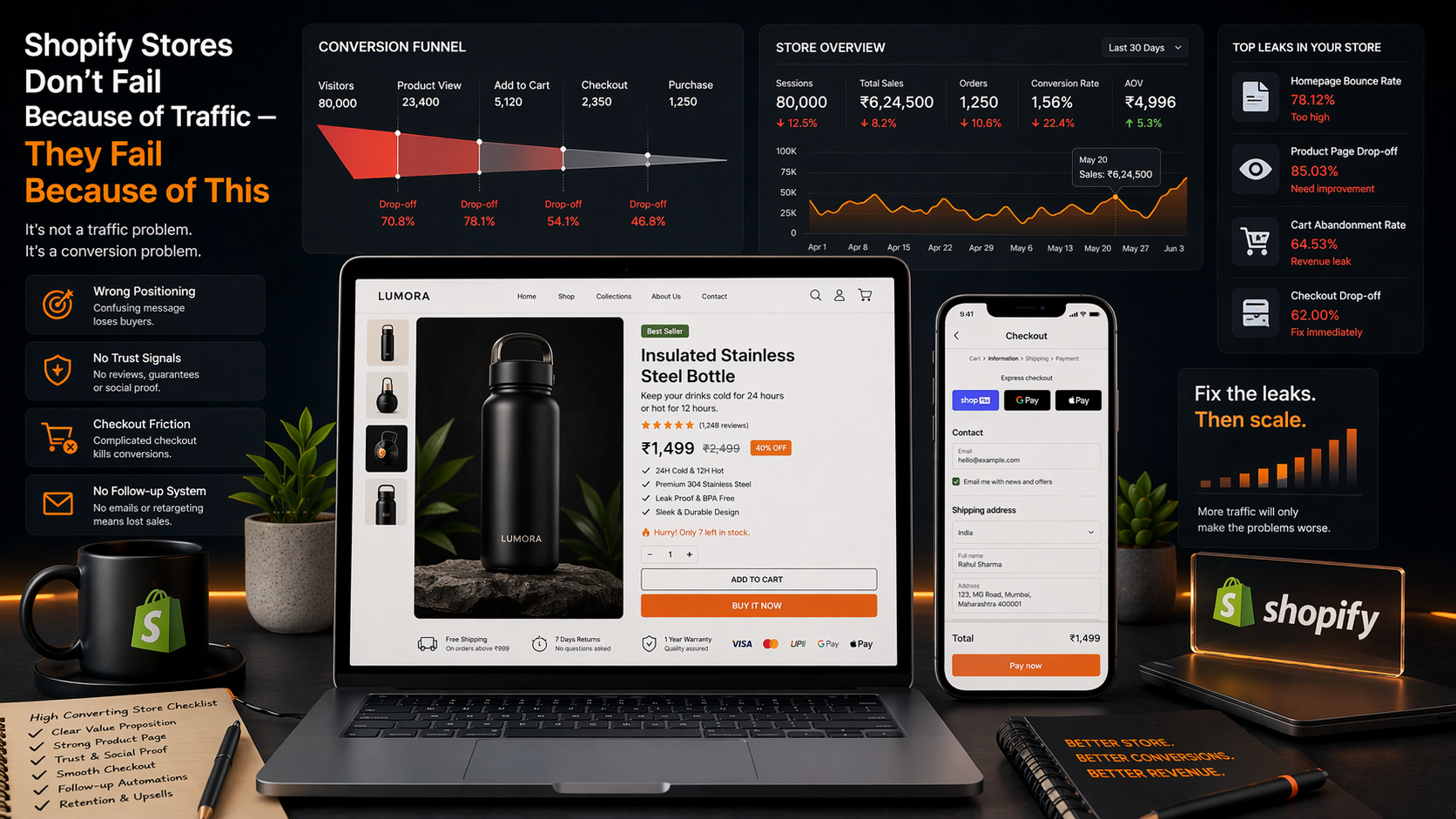
    Shopify Stores Don’t Fail Because of Traffic — They Fail Because of This

    Most Shopify store owners blame traffic when sales don’t happen.

    “Not enough visitors.”
    “Ads are not working.”
    “Need to scale campaigns.”

    That’s the wrong diagnosis.

    Traffic is rarely the real problem. The real issue is what happens after the visitor lands on your store.


    The Real Problem: Poor Conversion Structure

    If 1,000 people visit your store and only a handful buy, the issue is not traffic—it’s conversion.

    Here’s where most stores fail:

    • Confusing homepage with no clear direction
    • Weak product positioning
    • No trust signals
    • Slow loading speed
    • Complicated checkout
    • No urgency or reason to act

    You don’t have a traffic problem. You have a system problem.


    Your Store Is Leaking Money

    Think of your store like a funnel.

    If users are dropping off at every stage:

    • Landing → Bounce
    • Product → Exit
    • Cart → Abandon
    • Checkout → Drop

    Then increasing traffic just means losing more money faster.

    Fix the leaks before pouring more traffic in.


    Homepage That Doesn’t Sell

    Most homepages look like catalogs.

    That doesn’t work.

    Your homepage should:

    • Clearly explain what you sell in seconds
    • Show the product in action
    • Highlight key benefits
    • Build trust instantly
    • Push users toward the product page

    If users are confused, they leave.


    Product Pages That Don’t Build Desire

    A weak product page kills conversions instantly.

    Common mistakes:

    • Generic descriptions
    • No emotional hook
    • Poor visuals
    • No reviews or proof
    • No objection handling

    A strong product page should make the user feel like they’re missing out if they don’t buy.


    Checkout That Creates Friction

    Every extra step reduces conversions.

    Problems:

    • Too many fields
    • Forced account creation
    • Limited payment options
    • Hidden charges

    Fix this, and conversions improve immediately.


    No Trust = No Sales

    People don’t buy from stores they don’t trust.

    If your store lacks:

    • Reviews
    • Testimonials
    • Clear policies
    • Professional design

    You’re losing sales, no matter how good your product is.


    Mobile Experience Is Broken

    Most users are on mobile.

    If your store:

    • Loads slowly
    • Feels cluttered
    • Is hard to navigate

    They leave instantly.

    Mobile optimization is not optional. It’s critical.


    No Backend Systems

    Even if users don’t buy immediately, you should bring them back.

    Most stores miss:

    • Abandoned cart emails
    • Retargeting ads
    • SMS follow-ups
    • Upsell sequences

    Without this, you’re leaving easy money on the table.


    The Truth

    More traffic will not fix a broken store.

    It will just expose how broken it is.

    A high-performing Shopify store focuses on:

    • Clear positioning
    • Strong product pages
    • Smooth checkout
    • Trust and credibility
    • Backend revenue systems

    Fix these, and your existing traffic will start converting.


    Final Reality Check

    If your store isn’t making money, stop blaming traffic.

    Fix the structure first.

    Because once your store converts, scaling becomes predictable—not risky.

  • Shopify vs Custom eCommerce: Which One Actually Makes You More Profit?

    Shopify vs Custom eCommerce: Which One Actually Makes You More Profit?

    Most people compare Shopify and custom eCommerce based on features.

    That’s the wrong approach.

    The only thing that matters is profit.

    Not setup speed. Not ease of use. Not even design.

    Profit.


    The Real Difference: Control vs Convenience

    Shopify is built for convenience.

    Custom eCommerce is built for control.

    Shopify gives you:

    • Fast setup
    • Ready-made features
    • App ecosystem
    • Managed hosting

    Custom eCommerce gives you:

    • Full control over everything
    • No platform limitations
    • Tailored performance
    • Custom workflows

    Convenience helps you start. Control helps you scale.


    Where Shopify Wins

    Let’s be clear—Shopify is not weak.

    It’s powerful for:

    • Quick launch stores
    • Founders with limited technical knowledge
    • Businesses testing products
    • Standard eCommerce models

    You can go live in days and start selling immediately.

    That speed matters in the early stage.


    Where Shopify Starts Costing You

    The problem shows up when you grow.

    As your store scales:

    • App costs increase
    • Transaction fees eat margins
    • Customization becomes limited
    • Performance depends on apps

    You don’t notice it at ₹1L/month.

    You feel it at ₹10L+/month.


    The Power of Custom eCommerce

    Custom eCommerce is not about building from scratch for fun.

    It’s about building exactly what your business needs.

    You get:

    • Optimized performance for your use case
    • Faster load times
    • Higher conversion control
    • No dependency on third-party apps
    • Better long-term cost efficiency

    You’re not renting a system. You’re owning it.


    Profit Comes From Margins + Conversion

    Let’s break it down simply.

    Profit depends on:

    • Conversion rate
    • Average order value
    • Cost per transaction
    • Operational efficiency

    Shopify impacts:

    • Transaction fees
    • App costs
    • Limited checkout control

    Custom eCommerce improves:

    • Conversion optimization
    • Checkout flow control
    • Cost efficiency at scale

    This is where the profit gap starts widening.


    Performance = Revenue

    Speed and performance directly impact revenue.

    A slower Shopify store (due to apps and scripts):

    • Reduces conversions
    • Increases bounce rate

    A custom-built store:

    • Loads faster
    • Handles traffic better
    • Delivers smoother UX

    Even a small increase in conversion rate can mean lakhs in extra revenue.


    Scalability: The Hidden Profit Factor

    Most people ignore this until it’s too late.

    As you grow:

    • Shopify becomes restrictive
    • Complex features require workarounds
    • Costs keep stacking

    Custom eCommerce:

    • Scales without performance drops
    • Supports advanced features easily
    • Adapts to your business model

    Scaling without friction = higher profit.


    Cost Comparison (The Truth Most Don’t Say)

    Shopify looks cheaper upfront.

    But over time:

    • Monthly plans
    • App subscriptions
    • Transaction fees

    All add up.

    Custom eCommerce:

    • Higher initial investment
    • Lower long-term operational cost

    Short-term saving vs long-term profit.


    When Shopify Makes More Sense

    Use Shopify if:

    • You’re starting out
    • You want to validate a product quickly
    • You don’t have technical resources
    • Speed matters more than control

    When Custom eCommerce Wins

    Go custom if:

    • You’re scaling aggressively
    • You need advanced features
    • You want better margins
    • You care about long-term profit

    The Reality

    Shopify helps you start fast.

    Custom eCommerce helps you grow profitably.

    The mistake most businesses make is staying on Shopify when they’ve already outgrown it.


    Final Take

    If your goal is to test, Shopify is enough.

    If your goal is to maximize profit, control your system.

    Because at scale, profit doesn’t come from convenience.

    It comes from optimization, control, and performance.