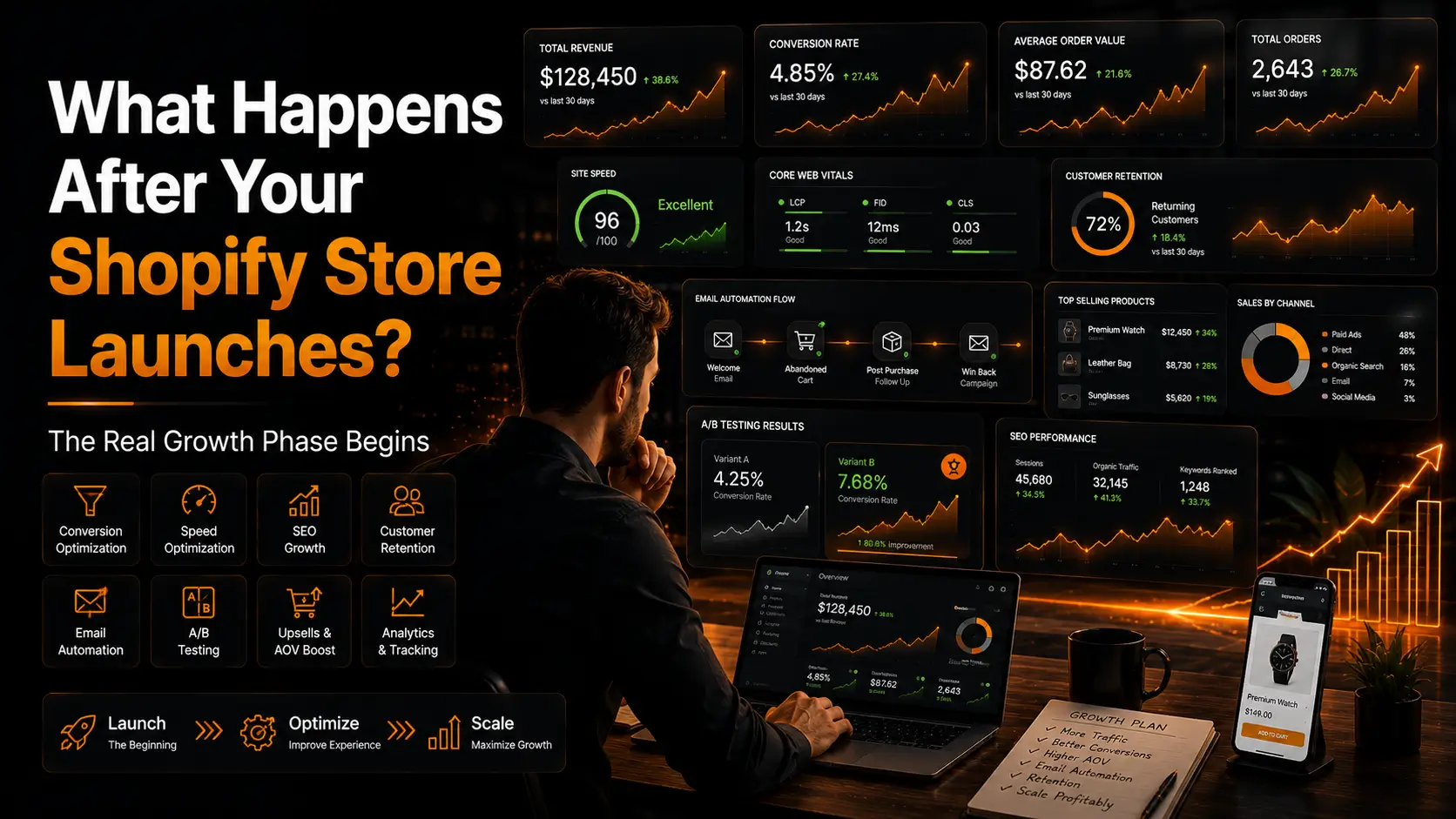
Most ecommerce businesses think launching a Shopify store is the finish line.
It is not.
It is the starting point.
This is where many Shopify stores quietly fail.
Businesses spend:
- weeks building
- months planning
- money on design
- money on development
Then launch…
…and stop optimizing.
That is a mistake.
The most profitable Shopify brands continuously improve:
- conversion rates
- customer experience
- speed
- retention
- automation
- analytics
- SEO
- average order value
At SterlingWeb Growth Labs, we treat Shopify launch as phase one — not completion.
Because ecommerce growth comes from optimization, not just development.
This guide explains what businesses should actually focus on after launching their Shopify store in 2026.
The Biggest Post-Launch Mistake Businesses Make
Most businesses become reactive after launch.
They only fix problems after:
- sales drop
- ads become expensive
- customers complain
- conversion rates fall
Winning ecommerce brands operate differently.
They continuously improve systems before major problems happen.
That difference compounds over time.
Your Shopify Store Should Be Treated Like a Growth System
Modern ecommerce stores are not static websites anymore.
Your Shopify store should function like:
- a sales funnel
- a conversion engine
- a customer retention system
- a marketing automation platform
That means post-launch optimization becomes critical.
1. Conversion Rate Optimization (CRO)
Most stores launch without proper CRO strategy.
That immediately limits revenue potential.
What CRO Actually Improves
Product Pages
Optimizing:
- product layout
- trust signals
- image hierarchy
- CTA positioning
- urgency elements
can dramatically improve conversions.
Cart Experience
Reducing friction through:
- sticky add-to-cart
- simplified cart flow
- trust indicators
- shipping transparency
helps reduce abandonment.
Checkout Optimization
Checkout issues silently destroy revenue.
Even small checkout improvements can increase:
- completed purchases
- average order value
- retention
At SterlingWeb Growth Labs, Shopify stores are designed with conversion-first thinking instead of “just design.”
That difference matters.
2. Shopify Speed Optimization
Many stores become slower after launch because businesses:
- install too many apps
- upload unoptimized media
- add unnecessary scripts
This hurts:
- SEO
- conversions
- ad performance
- user experience
What Professional Shopify Speed Optimization Includes
- image compression
- lazy loading
- app cleanup
- script optimization
- Core Web Vitals improvements
- theme optimization
- CDN improvements
A faster Shopify store directly impacts revenue.
That is not theory anymore.
3. Analytics & Tracking Setup
Most businesses make decisions using incomplete data.
That becomes dangerous.
Professional tracking should include:
- Google Analytics
- Meta Pixel
- server-side tracking
- conversion APIs
- event tracking
- funnel tracking
- heatmaps
Without proper analytics:
- ad optimization becomes weaker
- CRO becomes guesswork
- scaling becomes inefficient
4. Email & Automation Systems
Many ecommerce stores still operate manually.
That limits growth heavily.
Post-launch automation should include:
- abandoned cart emails
- welcome sequences
- post-purchase flows
- review requests
- retention campaigns
- WhatsApp automation
- CRM integrations
Automation increases:
- repeat purchases
- retention
- operational efficiency
SterlingWeb Growth Labs helps ecommerce brands build scalable automation systems instead of relying on manual workflows.
5. SEO Optimization After Launch
Many businesses think SEO is “done” once pages are indexed.
That is wrong.
Post-launch SEO should include:
- technical improvements
- keyword expansion
- collection optimization
- blog content
- internal linking
- schema markup
- speed optimization
SEO compounds over time.
The stores that dominate search usually optimize continuously.
6. A/B Testing & Continuous Improvement
Most ecommerce stores never properly test anything.
That means:
- decisions become emotional
- assumptions replace data
Winning brands test:
- product pages
- headlines
- CTAs
- layouts
- checkout flow
- upsell systems
Small improvements compound into massive revenue differences.
7. Upsells & Average Order Value Optimization
Most Shopify stores leave money on the table.
Good post-launch optimization includes:
- bundle offers
- cross-sells
- post-purchase upsells
- subscription offers
- personalized recommendations
Increasing average order value is often easier than increasing traffic.
But many stores ignore this completely.
8. Customer Retention Systems
Acquiring customers is expensive.
Retention matters more than most brands realize.
Post-launch retention systems include:
- loyalty programs
- subscriptions
- email campaigns
- SMS flows
- reorder automation
- customer segmentation
The brands scaling fastest usually focus heavily on retention.
9. Mobile Optimization Never Stops
Mobile UX should be reviewed continuously.
Because:
- user behavior changes
- devices change
- screen sizes evolve
Most Shopify traffic today is mobile-first.
A poor mobile experience destroys:
- SEO
- conversions
- retention
- ad ROI
10. Scaling Infrastructure as Your Store Grows
As revenue grows, stores usually require:
- advanced integrations
- better automation
- ERP systems
- CRM synchronization
- advanced reporting
- warehouse integrations
Many DIY Shopify setups break under scaling pressure.
That is why scalable architecture matters early.
Why Businesses Work With SterlingWeb Growth Labs
SterlingWeb Growth Labs helps ecommerce brands with:
- Shopify development
- CRO optimization
- Shopify speed optimization
- automation systems
- analytics implementation
- WooCommerce to Shopify migration
- scalable ecommerce infrastructure
- conversion-focused UX systems
We focus on:
- growth
- performance
- scalability
- retention
- long-term ecommerce success
Because a Shopify store should evolve with your business — not hold it back.
The Truth Most Businesses Learn Too Late
Launching a Shopify store is easy.
Building a profitable ecommerce system is hard.
The businesses that scale successfully usually win because they continuously optimize:
- conversions
- retention
- customer experience
- automation
- analytics
- operational efficiency
Growth comes from refinement.
Not just launching.
Final Thoughts
Most ecommerce stores are under-optimized.
Not because the products are bad.
Because the systems behind the store were never designed properly.
The real ecommerce advantage in 2026 is no longer:
“Who launches first?”
It is:
“Who optimizes better over time?”
That is the difference between stores that survive and brands that scale.
FAQs
Is Shopify launch the final step?
No. Launch is only the beginning of optimization and growth.
What should businesses improve after launch?
CRO, speed, SEO, analytics, automation, and retention systems.
Why does Shopify speed matter so much?
Speed impacts conversions, SEO rankings, bounce rates, and ad performance.
What is the most overlooked post-launch strategy?
Customer retention and automation systems.
How often should Shopify stores be optimized?
Continuously. High-performing ecommerce stores evolve constantly.
Leave a Reply