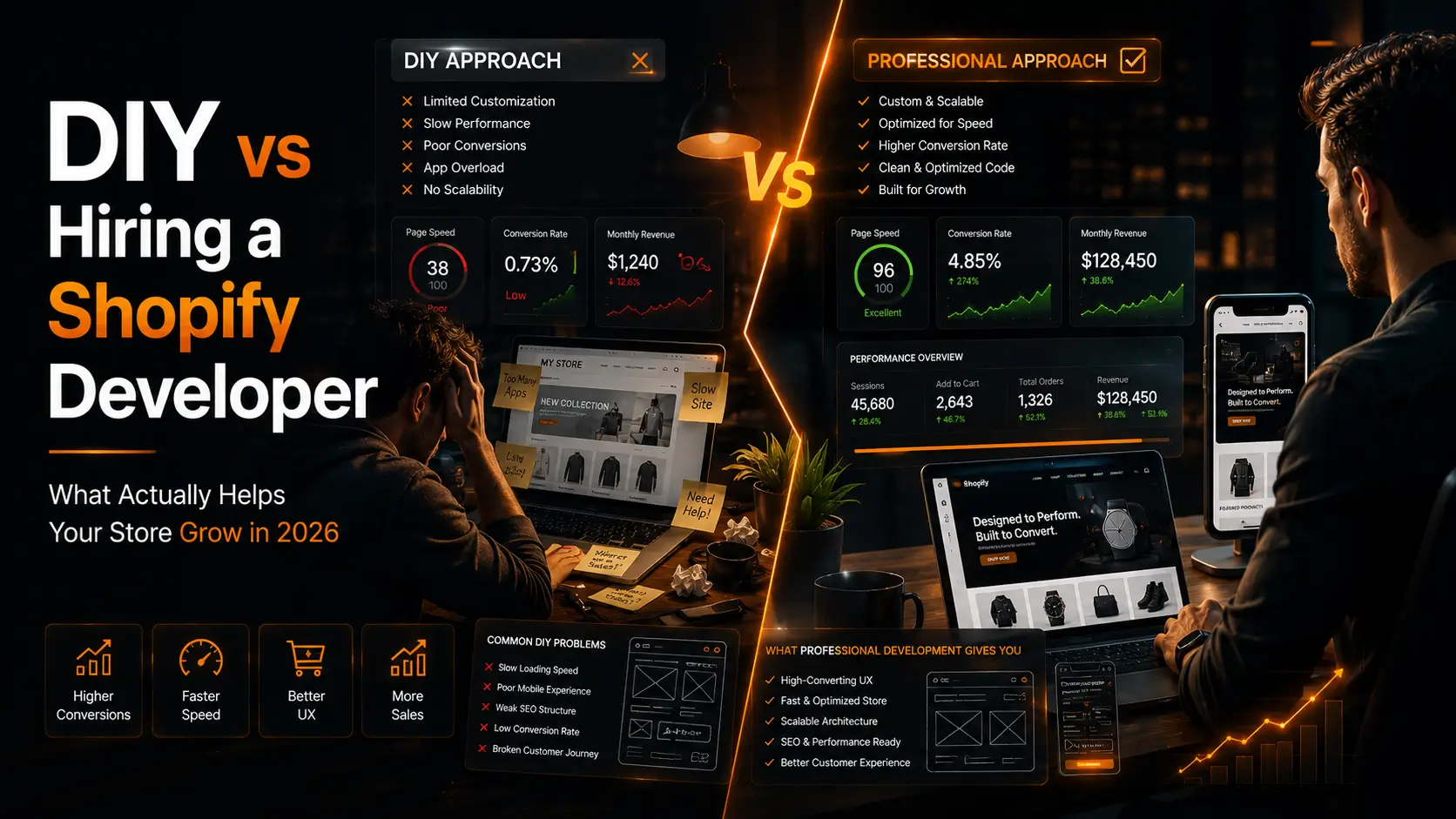
DIY Shopify vs Hiring a Shopify Developer: Which Choice Will Actually Grow Your eCommerce Business?
Launching a Shopify store has never been easier.
Within a few hours, almost anyone can choose a theme, upload products, connect payment gateways, and start selling online. Shopify has made eCommerce accessible to entrepreneurs, startups, and small businesses around the world.
But that simplicity is both Shopify’s greatest strength and its biggest misconception.
Many business owners assume that because they can build a Shopify store themselves, they don’t need a Shopify developer. Technically, that’s true—you can launch a functional store without writing a single line of code.
However, launching a store and building a profitable eCommerce business are two very different things.
At Sterlingweb Growth Labs, we frequently work with businesses that started with a DIY Shopify setup and later discovered their store wasn’t performing as expected. Their website looked good, but sales were inconsistent, mobile conversions were poor, SEO traffic was limited, and customer drop-offs kept increasing.
The problem wasn’t Shopify.
The problem was the lack of strategy, optimization, and technical execution.
This guide explains when DIY Shopify is enough, when it’s time to hire a Shopify developer, and how professional development can significantly improve your store’s long-term profitability.
Can You Build a Shopify Store Yourself?
Absolutely.
Shopify is designed specifically for non-technical users.
With its drag-and-drop editor and intuitive dashboard, beginners can:
- Choose a professional theme
- Upload products
- Configure collections
- Connect payment gateways
- Set shipping rules
- Launch within a few days
For validating a business idea or launching a minimum viable product (MVP), DIY Shopify is often the right decision.
However, many entrepreneurs confuse store setup with eCommerce optimization.
Creating a store is relatively easy.
Building one that consistently converts visitors into customers requires a completely different skill set.
Where DIY Shopify Stores Usually Fall Short
Many beginner stores appear professional on the surface but have hidden issues that reduce conversions and limit growth.
1. Poor Mobile Experience
Today, most online shoppers browse and purchase using smartphones.
Despite this, many DIY Shopify stores are designed primarily for desktop users.
Common issues include:
- Cluttered layouts
- Difficult navigation
- Oversized banners
- Tiny buttons
- Confusing product pages
- Checkout friction
A website that looks attractive on a laptop can perform poorly on mobile devices.
Since mobile traffic dominates modern eCommerce, optimizing for smartphones should always be the priority.
2. Slow Website Speed
One of the most common mistakes beginners make is installing too many Shopify apps.
Every additional app introduces:
- Extra JavaScript
- Additional server requests
- Larger page sizes
- Increased loading times
This negatively impacts:
- Core Web Vitals
- Google rankings
- Customer experience
- Conversion rates
Professional Shopify developers focus on keeping the store lightweight by minimizing unnecessary apps and optimizing every aspect of performance.
3. Weak Conversion Optimization
Beautiful design doesn’t guarantee sales.
Many DIY stores emphasize appearance while overlooking customer psychology.
Successful Shopify stores are carefully engineered to guide visitors toward purchasing.
Professional conversion optimization includes:
- Strong value propositions
- Clear calls-to-action
- Trust badges
- Customer reviews
- Product comparison tables
- Urgency messaging
- Simplified checkout
- Strategic content hierarchy
Small improvements in user experience can significantly increase revenue without increasing advertising spend.
4. Technical SEO Issues
Search engine optimization begins with technical structure.
Unfortunately, many DIY stores launch with problems such as:
- Missing metadata
- Duplicate content
- Poor heading hierarchy
- Unoptimized images
- Weak internal linking
- Indexing issues
These problems limit long-term organic visibility and make it more difficult for potential customers to discover your products.
Professional Shopify development includes technical SEO from the beginning rather than attempting to fix issues later.
What Does a Professional Shopify Developer Actually Do?
Many people believe Shopify developers simply customize themes or write code.
In reality, modern Shopify development combines multiple disciplines.
A professional developer improves:
- Customer experience (UX)
- Conversion rate optimization (CRO)
- Technical SEO
- Store performance
- Mobile usability
- Automation
- Scalability
- Integrations
- Long-term maintainability
At Sterlingweb Growth Labs, every Shopify project is built around measurable business outcomes—not just attractive design.
Our goal is to create stores that consistently generate revenue while remaining fast, scalable, and easy to manage.
When DIY Shopify Makes Sense
DIY Shopify isn’t always the wrong choice.
It works well when:
- You’re testing a new product idea
- You’re launching an MVP
- Budget is limited
- Product validation matters more than branding
- Traffic volume is still low
- You need to launch quickly
During the early stages of a business, speed often matters more than perfection.
However, as your business grows, technical complexity increases rapidly.
Signs It’s Time to Hire a Shopify Developer
Your Store Is Generating Revenue
Once your store begins receiving consistent orders, even small improvements in conversion rate can have a significant financial impact.
Professional optimization helps improve:
- Average Order Value (AOV)
- Checkout completion
- Customer retention
- User experience
- Revenue per visitor
You’re Investing in Paid Advertising
If you’re spending money on:
- Google Ads
- Meta Ads
- Instagram campaigns
- Influencer marketing
- Shopping campaigns
then every visitor becomes valuable.
Sending paid traffic to an underperforming store wastes marketing budget.
Professional optimization ensures advertising dollars generate the highest possible return.
You Need Advanced Features
Growing businesses eventually require functionality beyond Shopify’s default capabilities.
Examples include:
- Subscription systems
- Wholesale pricing
- Custom product builders
- Advanced filtering
- CRM integrations
- ERP connections
- Marketing automation
- Custom checkout experiences
These features require experienced Shopify development.
You’re Planning Long-Term Growth
DIY stores often accumulate technical debt over time.
Common issues include:
- App overload
- Inconsistent branding
- Slow performance
- Broken sections
- Poor organization
Professional architecture keeps your store organized, scalable, and easier to maintain as your business expands.
Theme Customization vs Custom Shopify Development
Many businesses aren’t sure which service they actually need.
Shopify Theme Customization
Ideal for businesses that need:
- Branding improvements
- Homepage redesigns
- Better navigation
- Mobile optimization
- Conversion improvements
- Section customization
This solution is cost-effective for many growing businesses.
Custom Shopify Development
Recommended for businesses requiring:
- Custom applications
- API integrations
- Advanced automation
- Personalized shopping experiences
- Subscription platforms
- Enterprise workflows
- Unique customer journeys
High-growth brands often benefit from custom development because it creates competitive advantages that standard themes cannot provide.
Can AI Replace Shopify Developers?
AI has become an incredible productivity tool.
It can:
- Generate code
- Suggest layouts
- Write product descriptions
- Create content
- Automate repetitive tasks
However, AI still cannot replace strategic thinking.
Successful eCommerce depends on understanding:
- Customer psychology
- Buying behavior
- Conversion optimization
- User experience
- Brand positioning
- Business goals
AI can accelerate development, but experienced developers provide the strategy and expertise needed to build stores that actually perform.
At Sterlingweb Growth Labs, we use AI to improve efficiency—not to replace human expertise.
Why Mobile Optimization Matters More Than Ever
More than half of online purchases now originate on mobile devices.
A mobile-first Shopify store should include:
- Fast loading pages
- Sticky Add-to-Cart buttons
- Thumb-friendly navigation
- Optimized product galleries
- Streamlined checkout
- Easy payment methods
- Clear trust signals
Mobile usability directly impacts:
- SEO rankings
- Conversion rates
- Bounce rates
- Customer satisfaction
- Advertising ROI
If your mobile experience is poor, your store will struggle to scale regardless of how much traffic you generate.
Professional Shopify Speed Optimization
Performance optimization is one of the highest ROI improvements available.
Professional developers optimize:
- Image compression
- Theme efficiency
- JavaScript loading
- CSS optimization
- Lazy loading
- App cleanup
- CDN configuration
- Core Web Vitals
Fast stores improve both customer experience and search engine visibility while reducing bounce rates.
The Hidden Cost of DIY
The biggest misconception among store owners is believing that a functional store is a successful store.
Many DIY Shopify websites technically “work.”
But behind the scenes they may be:
- Losing search rankings
- Reducing conversion rates
- Increasing advertising costs
- Creating customer frustration
- Slowing page speed
- Limiting scalability
These hidden inefficiencies compound over time, costing far more than professional development ever would.
Why Businesses Choose Sterlingweb Growth Labs
At Sterlingweb Growth Labs, we build Shopify stores that combine strategy, performance, and scalability.
Our Shopify services include:
- Custom Shopify Development
- Shopify Theme Customization
- Shopify Store Redesigns
- Shopify App Development
- Conversion Rate Optimization (CRO)
- Technical SEO
- Core Web Vitals Optimization
- Mobile-First UX Design
- Shopify Speed Optimization
- Marketing Automation
- Shopify Migrations
- Ongoing Growth Support
Every decision we make is focused on helping businesses increase revenue, improve customer experience, and build a stronger digital foundation.
Final Thoughts
DIY Shopify is an excellent starting point for entrepreneurs testing new ideas or launching their first online store.
But as your business grows, the challenges become more complex.
Success in eCommerce is no longer about simply launching a website. It’s about creating a high-performance system that attracts qualified traffic, converts visitors into customers, and scales efficiently over time.
Instead of asking:
“Can I build a Shopify store myself?”
Ask a more valuable question:
“How much potential revenue is my current store leaving on the table because it isn’t professionally optimized?”
The answer to that question often determines whether a business remains a side project—or grows into a thriving, scalable eCommerce brand.
Frequently Asked Questions
Can beginners build a Shopify store themselves?
Yes. Shopify is beginner-friendly and allows most users to launch a basic online store without coding. However, advanced optimization for SEO, speed, and conversions typically requires professional expertise.
Is hiring a Shopify developer worth it?
If your business relies on organic search, paid advertising, or consistent online sales, hiring a Shopify developer can significantly improve store performance, user experience, and long-term profitability.
What’s the difference between Shopify customization and custom development?
Theme customization focuses on improving the appearance and functionality of an existing Shopify theme. Custom development involves building unique features, applications, integrations, and workflows tailored to your business requirements.
Can AI build Shopify stores?
AI can assist with coding, content generation, and design suggestions, but it cannot replace strategic planning, conversion optimization, customer psychology, or business decision-making.
When should I hire a Shopify expert?
The ideal time is when your store begins generating revenue, advertising costs increase, or you need better performance, advanced functionality, or scalable infrastructure to support future growth.
Leave a Reply