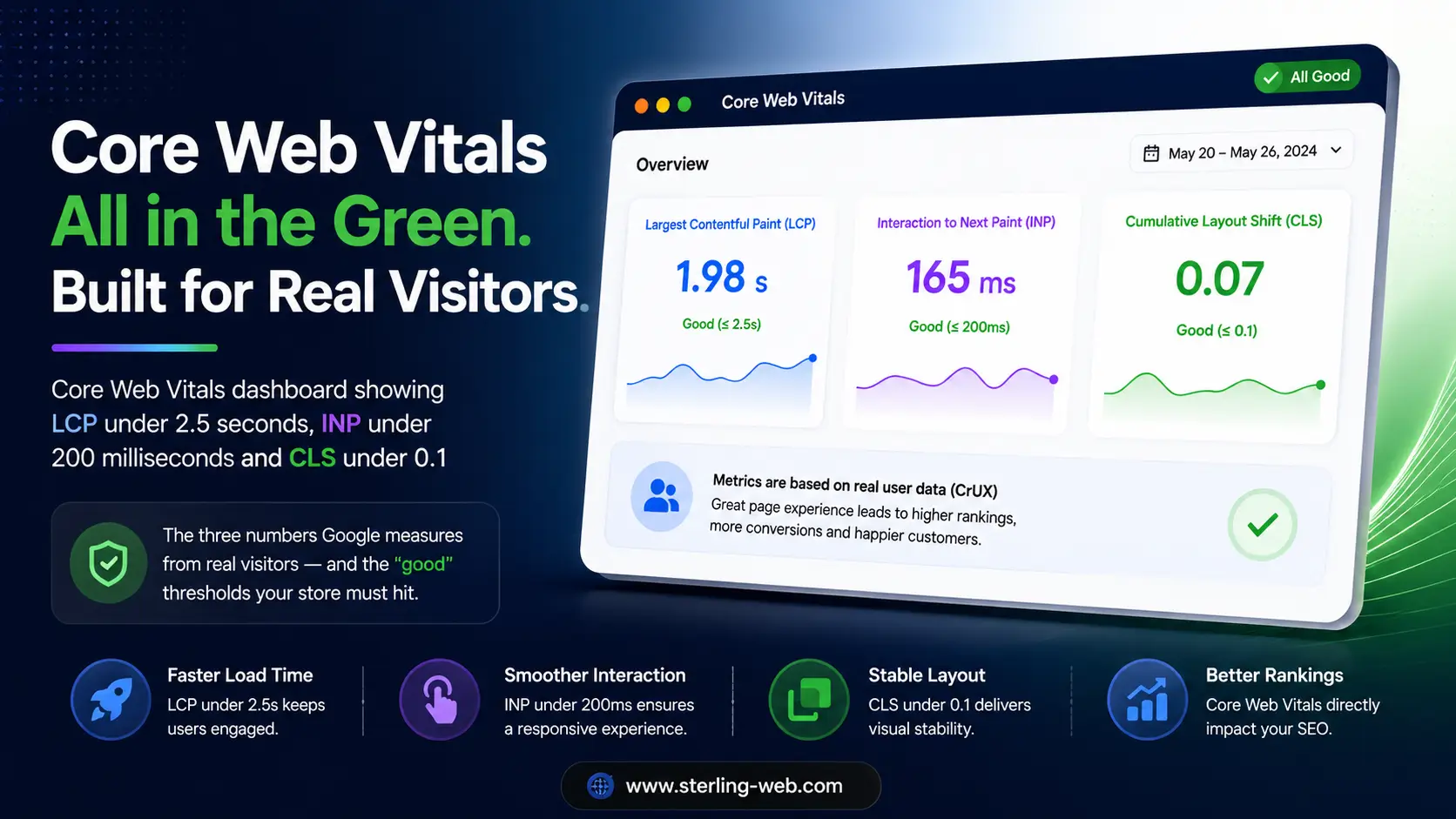
Your Shopify store can rank #1 on Google and still lose the sale. In 2026 that sentence isn’t a paradox — it’s the new default. A shopper types “best magnesium gummies for sleep,” and before a single blue link loads, Google’s AI writes a paragraph naming three brands, summarising the reviews, and comparing the price per serving. If your product isn’t inside that answer, the ranking underneath it barely matters.
This guide breaks down the three disciplines now deciding which Shopify stores get discovered — SEO, AEO, and GEO — how they differ, why answer and generative optimisation are no longer optional, and where Core Web Vitals fit into all of it. It’s written for store owners and merchants, not just developers, so you’ll leave knowing exactly what to fix first.
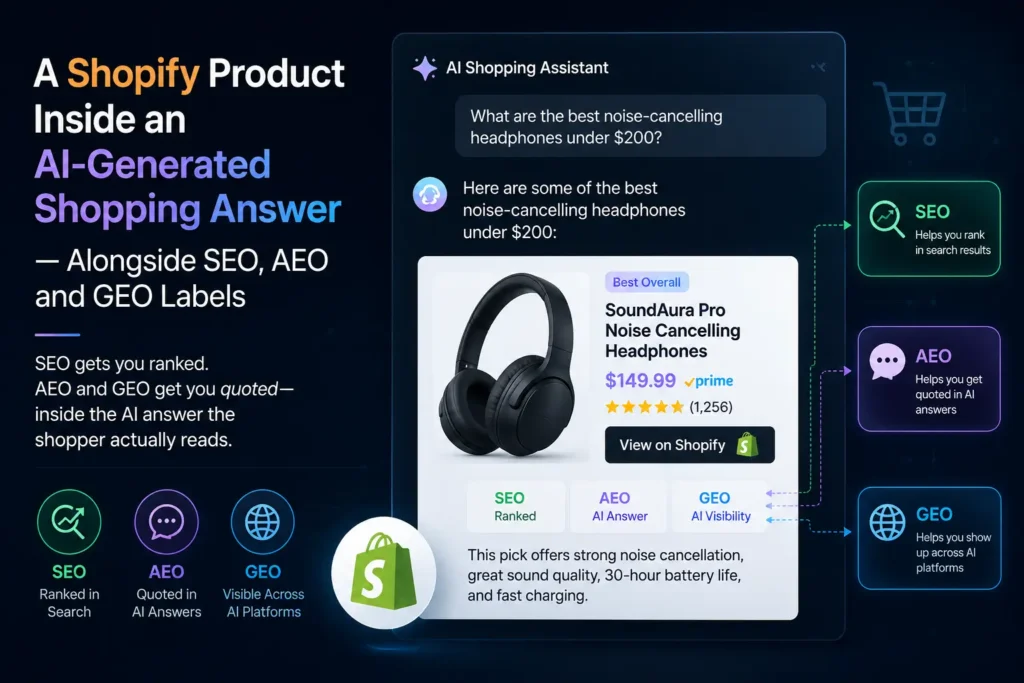
Search didn’t evolve. It got replaced.
For twenty years, the deal was simple: optimise your pages, climb the rankings, earn the click. That deal is being rewritten in real time. At Google I/O in May 2026, Google confirmed that its conversational AI Mode had crossed one billion monthly users roughly a year after launch — one of the fastest-scaling products in the company’s history — and announced the biggest redesign of the search box in over 25 years.
Here’s what that means for a store owner in plain numbers:
- AI answers first, links second. When an AI summary appears, independent studies have measured click-through rate drops of roughly 34–46%. On AI Mode specifically, some 2026 estimates put the share of searches ending without any outbound click as high as 90%+.
- The AI reads sixteen pages, not one. Google uses a “query fan-out” technique — a single shopper question is silently broken into around 16 parallel searches across subtopics, then synthesised into one answer. Your store competes to be one of the sources it pulls from.
- Being cited is the new ranking. Around 97% of AI Mode responses include at least one citation, and AI Mode and AI Overviews cite the same URLs only about 14% of the time (per Ahrefs). Translation: there are now multiple “first pages” to win, not one.
- AI-referred traffic is exploding. Previsible reported AI-referred sessions up 527% year-over-year. The traffic that does click through is smaller — but higher-intent.
The question for 2026 isn’t “where do I rank?” It’s “when an AI describes my category, does it mention my store — and does it get the facts right?”
SEO, AEO, GEO: what each one actually means
SEO — Search Engine Optimisation
The foundation. SEO is everything that helps Google crawl, understand, and rank your store: clean site architecture, fast pages, keyword-aligned product and collection content, internal links, and structured data. For Shopify this means optimised product titles and descriptions, sensible collection pages, working canonical tags, and a crawlable navigation. SEO is not dead — it’s the soil everything else grows in.
AEO — Answer Engine Optimisation
Optimising to be the direct answer to a specific question — in featured snippets, voice search, and AI answer boxes. AEO is about structure and clarity: answering “Is creatine safe to take daily?” in a clean, self-contained block that a machine can lift cleanly. For a Shopify store, AEO turns your product education, FAQs, and buying guides into the source an answer engine quotes.
GEO — Generative Engine Optimisation
Optimising to be cited and recommended by generative AI platforms — Google AI Overviews and AI Mode, ChatGPT Search, Perplexity, Gemini, and Claude. GEO is about being seen as a trustworthy, distinctive source: original data, real expertise, consistent brand information across the web, and machine-readable facts about your products. When a shopper asks ChatGPT “what’s the best protein powder for a lactose-intolerant runner?”, GEO decides whether your brand makes the shortlist.
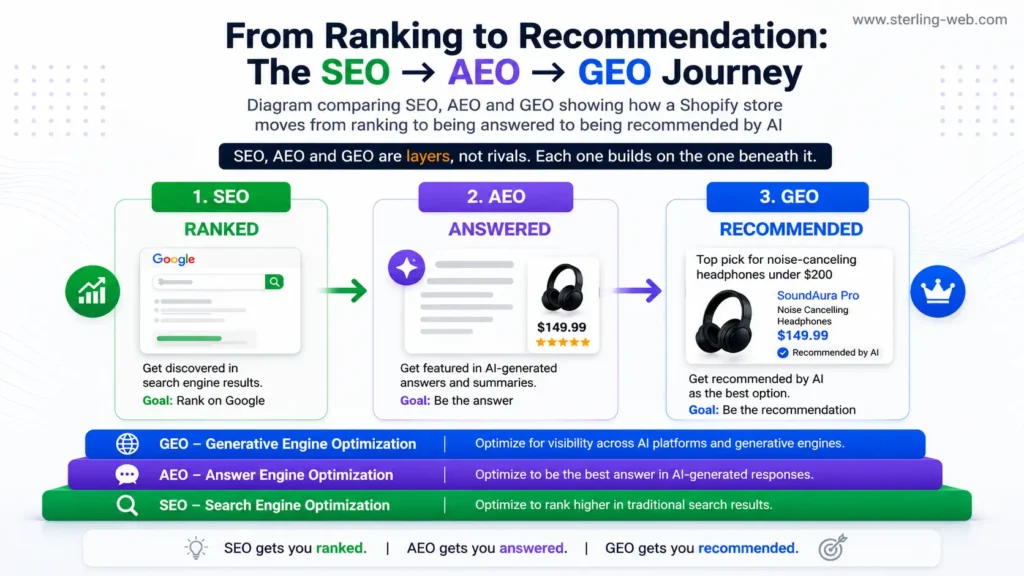
SEO vs AEO vs GEO — side by side
| Factor | SEO | AEO | GEO |
|---|---|---|---|
| Goal | Rank in the list of results | Be the direct answer to a question | Be cited / recommended inside AI answers |
| Surface | Classic blue links | Featured snippets, voice, answer boxes | AI Overviews, AI Mode, ChatGPT, Perplexity, Gemini |
| Wins on | Keywords, authority, technical health | Clear, structured, self-contained answers | Trust, originality, entity consistency, structured facts |
| Query style | “magnesium gummies” | “are magnesium gummies good for sleep?” | “recommend a magnesium supplement for a 40-year-old with anxiety” |
| Success metric | Ranking position & clicks | Snippet ownership & voice answers | Citations, brand mentions, AI recommendations |
| For your Shopify store | Product/collection pages found & indexed | Buying guides & FAQs answer real questions | Your brand named when AI suggests products |
These layers stack. You don’t choose one — you build all three on a healthy technical base.
Why AEO and GEO matter right now for Shopify merchants
E-commerce sits directly in the blast radius of AI search, because shopping queries are exactly the kind AI loves to answer: comparisons, recommendations, “best X for Y” questions. Google is already testing direct-purchase ads and shopping inside AI Mode — the model is shifting from “I’ll send you to the store” to “buy this here.” Three reasons this is urgent:
- Product discovery is moving inside the AI. Shoppers increasingly ask an assistant to do the comparison shopping. If your products aren’t structured for machines to read — price, availability, materials, reviews — you’re invisible to that flow.
- The agentic web is coming. AI shopping agents (OpenAI’s Operator and others) browse, compare and complete tasks for users. They favour stores with clear pricing tables, feature comparisons and clean structured data. Messy PDPs get skipped.
- Your competitors haven’t done it yet. Most Shopify stores still run default theme metadata and zero product schema. The window to be the brand AI knows in your niche is open — and closing.
A balanced note worth making: in May 2026, Google published official guidance stating that, from its perspective, “AEO” and “GEO” are still SEO — its AI features run on the same core ranking and quality systems, and you don’t need special files or markup just to appear. That’s true for Google. But it doesn’t change the practical reality: structured data still earns rich results and helps machines understand your products unambiguously, and the disciplines of AEO and GEO are simply how you make a store winnable across every AI surface — including the ones Google doesn’t control, like ChatGPT and Perplexity. At SterlingWeb, we treat them as one connected system rather than three competing buzzwords.
Core Web Vitals: the gatekeeper nobody skips
Here’s the part merchants underestimate: none of the above happens if your store is slow. Before an AI engine will cite you, the page has to be indexed, fast, and stable. Google’s Core Web Vitals are the three metrics that measure this real-world experience, and after the March 2026 core update they carry more ranking weight than ever.
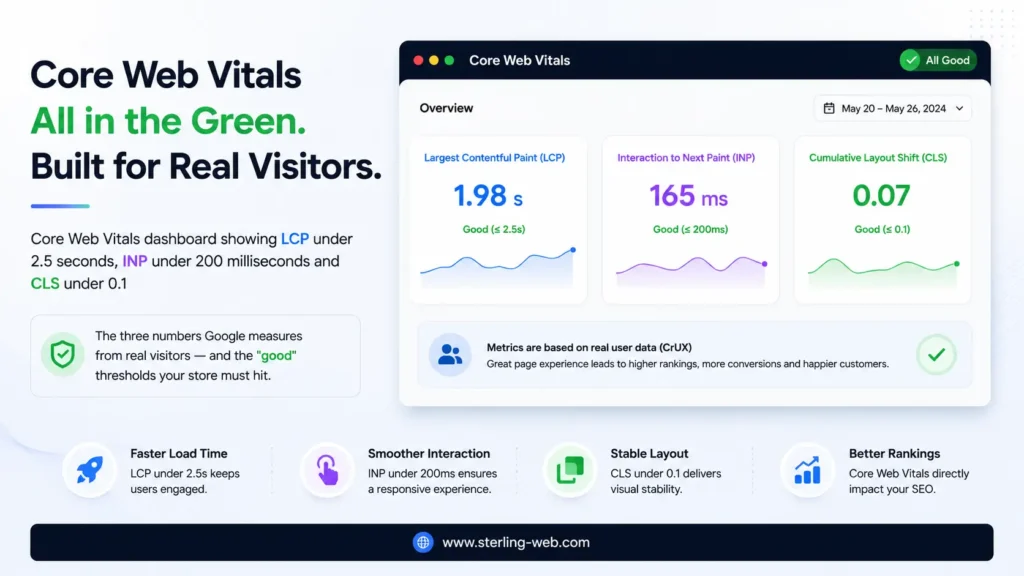
- LCP (Largest Contentful Paint) — how fast your main content loads. Good: under 2.5 seconds. On Shopify, the usual culprit is an oversized hero or product image.
- INP (Interaction to Next Paint) — how quickly the page responds when a shopper taps “Add to Cart” or filters a collection. Good: under 200 milliseconds. This replaced FID in March 2024 and is the most commonly failed metric — around 43% of sites fail it — because it’s caused by heavy JavaScript, and Shopify stores stack a lot of apps.
- CLS (Cumulative Layout Shift) — how much the layout jumps as it loads. Good: under 0.1. The classic offender is a product grid that shifts as images and review widgets pop in.
Two things make this business-critical for stores. First, Google judges these at the 75th percentile of real users — meaning your slowest realistic shopper on a mid-range phone has to have a good experience, not just you on office wi-fi. Second, the revenue link is direct: a one-second delay is associated with roughly 7% fewer conversions, and stores that pass all three metrics see meaningfully lower bounce rates. On Shopify, the highest-impact fixes are usually auditing and removing unused apps, serving properly sized next-gen images, lazy-loading below-the-fold content, and reserving space for review and dynamic widgets so nothing jumps.
How AI search changes the Shopify game — with real examples
Picture three shoppers in 2026:
- The researcher asks Perplexity: “compare the top 3 reusable water bottles for keeping drinks cold 24 hours.” It returns a comparison with citations. GEO decides if your bottle is one of the three — driven by clear specs on your PDP, third-party reviews, and consistent brand facts across the web.
- The voice shopper asks their phone: “what’s a good gift for a coffee lover under $50?” AEO decides if your gift guide is the answer — driven by a clean, structured, genuinely useful guide rather than a thin product dump.
- The classic searcher still types “organic dog treats” into Google. SEO plus Core Web Vitals decides if you rank and load fast enough to earn the click that AI didn’t intercept.
The winning store serves all three — and the connective tissue is structured product data (Product, Offer, AggregateRating, Brand) so every engine reads your price, stock, and ratings without guessing, plus original, non-commodity content that an AI can’t just write itself. Generic “5 benefits of X” posts earn zero citations; your real test results, sizing data, and customer outcomes earn them.
Your Shopify AI-search readiness checklist
- Add complete Product schema (price, availability, brand, GTIN) and AggregateRating to every product page.
- Rewrite product descriptions to answer real buyer questions — materials, sizing, use-cases — not just feature lists.
- Build buying guides and FAQ blocks that answer one clear question per section (AEO gold).
- Audit your apps and theme JavaScript to fix INP; resize and serve next-gen images to fix LCP.
- Keep your brand facts identical everywhere — Google Merchant Center, your About page, social, directories — so AI can resolve your store as one trusted entity.
- Publish original data: tests, comparisons, real customer results that AI can’t fabricate.
Frequently asked questions
Is SEO still worth it for Shopify in 2026?
Yes. SEO is the foundation AEO and GEO are built on. AI features run on the same core ranking systems, so a technically healthy, well-optimised store is the prerequisite for being cited by any AI engine. SEO hasn’t been replaced — it’s been expanded.
What’s the difference between AEO and GEO?
AEO (Answer Engine Optimisation) focuses on being the direct answer to a specific question in snippets and voice search. GEO (Generative Engine Optimisation) focuses on being cited and recommended inside generative AI answers like AI Overviews, ChatGPT and Perplexity. They overlap heavily and are best run as one strategy.
Do I need special schema to appear in AI search?
Google says no special markup is required just to appear in its AI features. However, standard structured data (Product, Offer, AggregateRating) still earns rich results and helps every engine — including ChatGPT and Perplexity — read your products accurately, so it remains strongly recommended for Shopify stores.
How do Core Web Vitals affect my Shopify sales?
Core Web Vitals measure load speed (LCP), responsiveness (INP) and visual stability (CLS) from real visitors. They’re a ranking signal and a conversion driver — a one-second delay is linked to roughly 7% fewer conversions. Slow stores also struggle to be indexed and cited by AI engines.
Make your Shopify store the one AI recommends
Ranking is no longer the finish line. The stores that win in the AI era are fast, structured, and trusted enough that AI engines quote them by name. That’s exactly the work SterlingWeb specialises in — technical SEO, AEO, GEO, schema, and Core Web Vitals, built for Shopify.
Leave a Reply